




























No rain, no hops – no hops, no beer. Climate change, heat and dry farmland are hitting Bavaria’s key crop. Could solar panels save it?
A wave of farm closures is washing over Germany’s lush hop-growing regions as climate change, falling prices and declining demand for beer leave desolation in their wake.
 ADVERTISEMENT
ADVERTISEMENT
ADVERTISEMENT
As of 2026, there are just over 900 agricultural businesses in Germany specialising in hops – a dramatic drop of 40 per cent since two decades ago, with many farmers either switching to other crops or giving up altogether.
The phenomenon is so acute, it has even earned its own name: ‘höfesterben’ describes the creeping structural decline and closing of small and family-owned farms.
Increasingly, even traditional Bavarian farmers now speak openly of climate change as rising temperatures, water shortages and dry soils squeeze their yields.
Beer is integral to their region’s cultural identity, with school summer holidays timed to coincide with hop harvests replete with ‘hop queens’. Bavaria produces 86 per cent of German hops and roughly one third of global output.
The Hallertau, in the heart of the southeast German region, is the largest continuous hop-growing area in the world. Dating back to at least 860 AD, it is home to 722 of the country’s remaining hop farms.
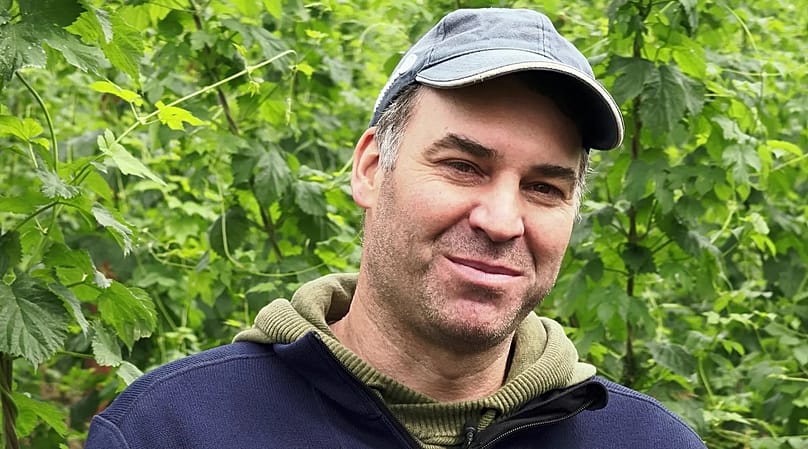
One of them is run by fourth-generation hop grower Josef Wimmer. “The years are getting hotter and drier,” he tells Euronews Earth.
To secure the future of his farmstead in the small hamlet of Neuhub near Osseltshausen, drastic action was a necessity.
Could solar 'hats' save German hop farms?
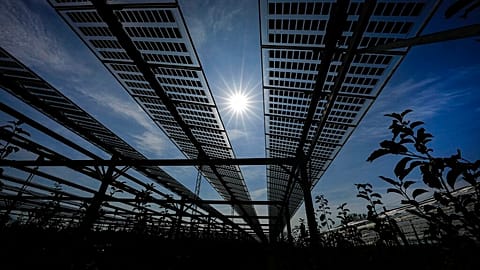
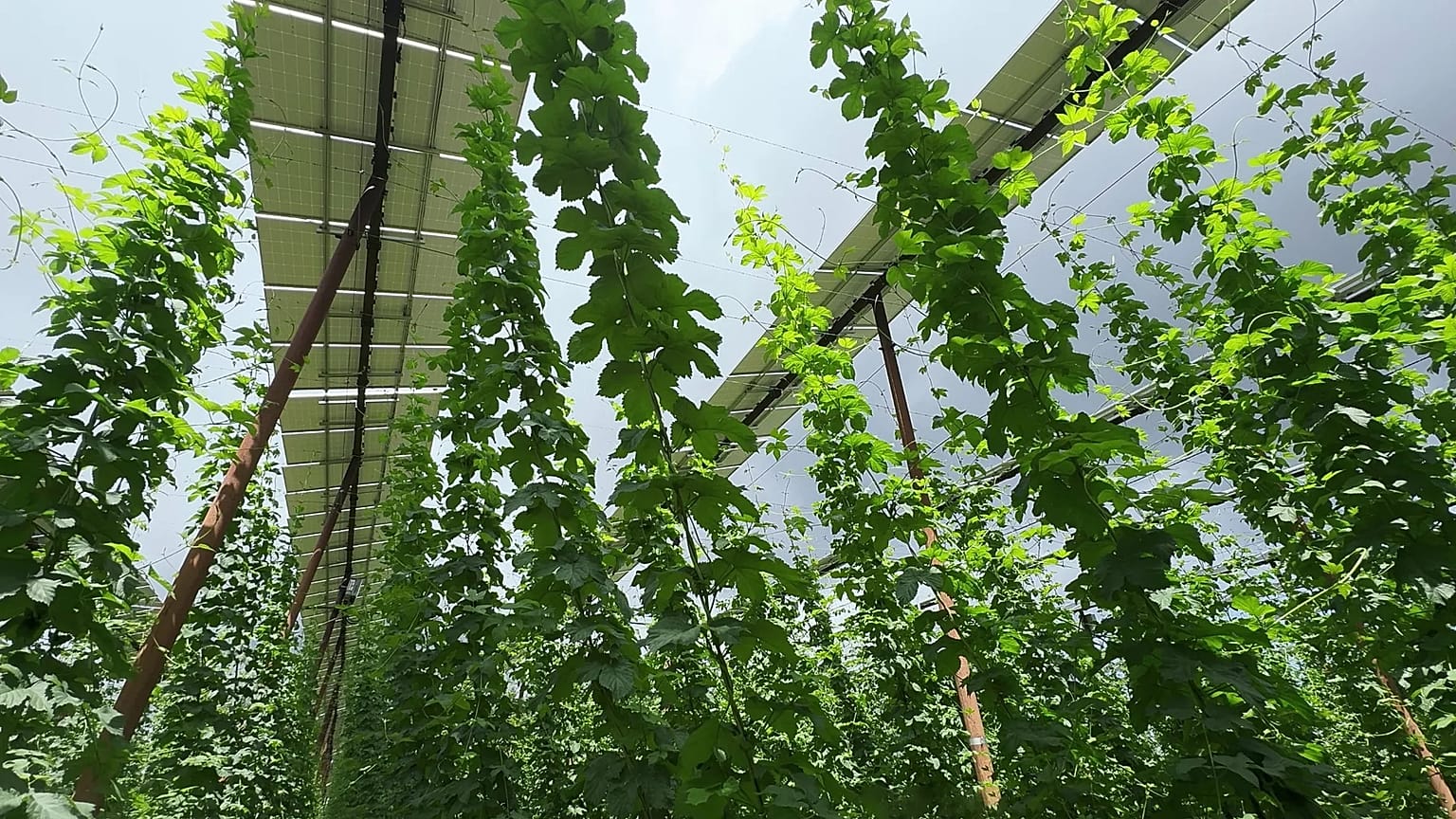
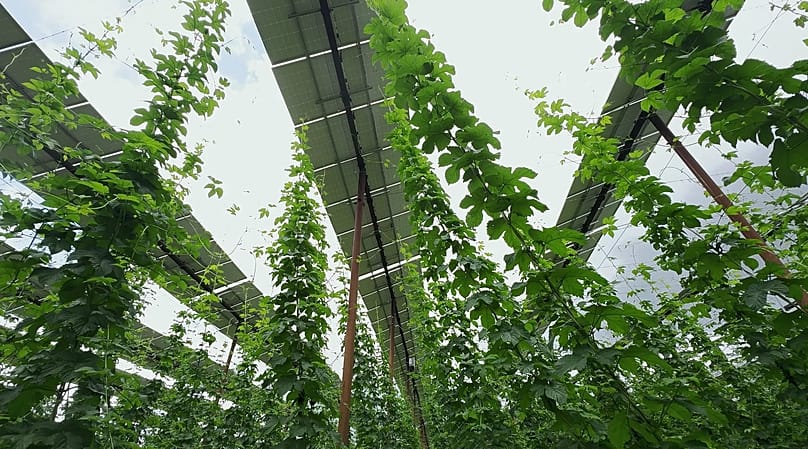
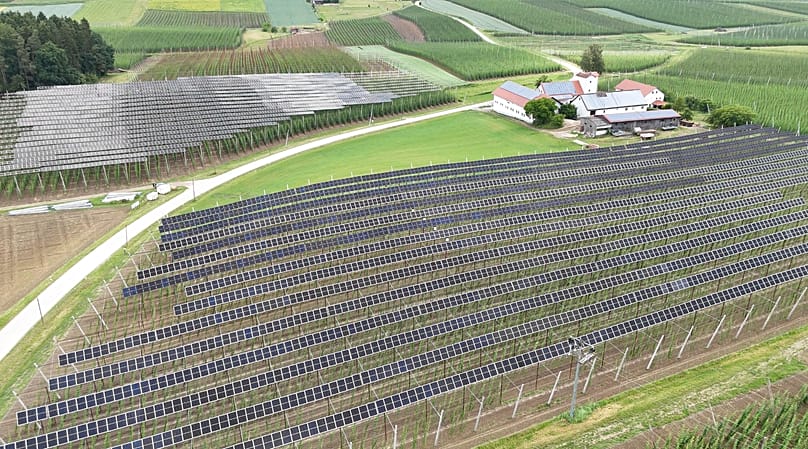
Seven metres above the ground on Wimmer’s farm, solar panels glint, forming a sea of pale blue.
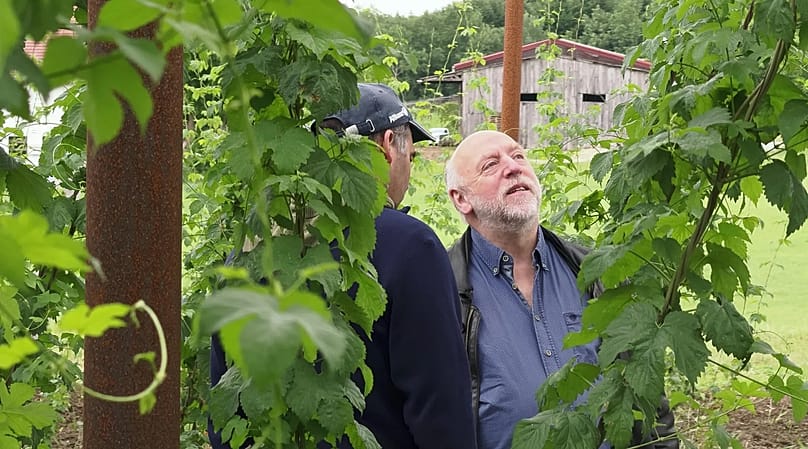
“We wanted to shade the hops because hops are a shade-loving plant,” the farmer explains. Heat slows the production of alpha acids, the compound that gives beer its pleasantly aromatic bitterness. Heat-related drought and the ensuing decline in soil health can also spark dramatic drops in yield.
Of course, the photovoltaic modules come with another key benefit: providing renewable energy for the farm. “In the first step we covered five hectares of hops with PV,” says Wimmer. “That gives us an output of two megawatts at its peak.”
He first came up with the idea 10 years ago, after seeing the benefits of rooftop solar he installed in 2009. His neighbours were awash with skepticism: “There were voices saying ‘Wimmer’s lost it now, that’ll never work!’,” he recalls.
“When we started building, we became the hot spot of the Hallertau. Everyone came by to have a look. And after every big storm… everyone wanted to know whether the installation was still standing or had been blown away,” Wimmer laughs. “But everything is still standing, even after the storms.”
After the curious neighbours came the hop farmers from more distant villages to inspect the system. They were followed by local councillors and district officials, right up to ministers from the Bavarian state capital Munich.
Now Wimmer plans to expand his successful project over 20 hectares and add a one-megawatt battery storage system.
How red tape is slowing farm solar installations
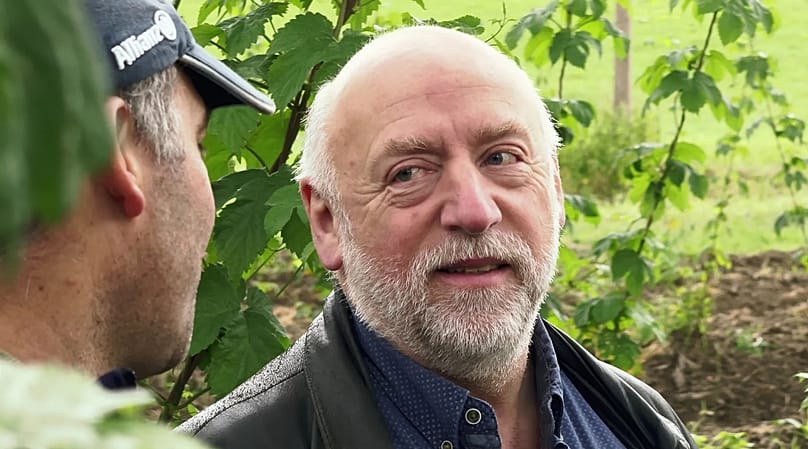
He got there with the help of Bernhard Gruber, a former Airbus engineer turned solar innovator who ran with Willmer’s unconventional idea.
After two years of planning and permitting negotiations, a five kilometre power cable is being installed to connect the panels to a substation capable of sending excess energy to the grid.
“Long approval procedures are a problem. They put some farmers off going for agri-PV on a larger scale, because the bureaucratic effort is simply too great for many of them,” Gruber tells Euronews Earth.
“Especially for hop growing, but also for other agricultural specialty crops, the decisions and approvals could be made much more easily. Why things aren’t moving faster is honestly a mystery to me,” he adds.
Agri-PV keeps soil moist – and hops like that
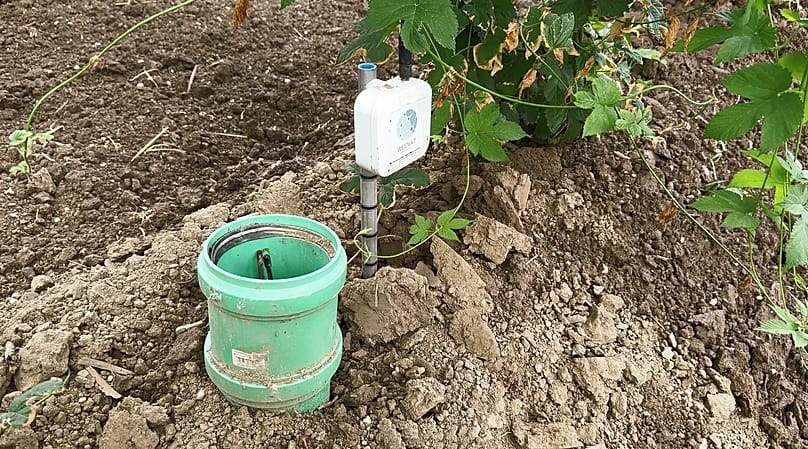
“We’ve found that the soil has become wetter since the agri-PV modules were installed,” Wimmer says, pointing to a moisture sensor tucked among the trellises, which takes measurements both at the surface and deeper down.
“Evaporation is lower, we can keep the water from rainfall in the soil for longer – and that is good for the hops, especially in June, July and August. That’s when the hops need water.”
Balancing the right amount of shade with a solar panel angle conducive to energy production from the sun is no easy feat.
Gruber puzzled over daily and seasonal movements of the sun, hourly fluctuations in power prices, and the outcomes for the crops.
Too much shade resulted in the hop plants producing bushy shoots in the shaded upper zone – but fewer cones. Overall yields fell and less hop extract was produced.
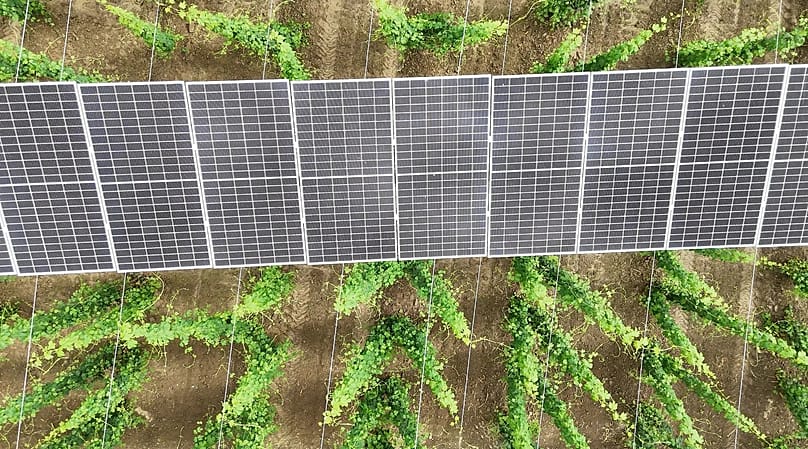
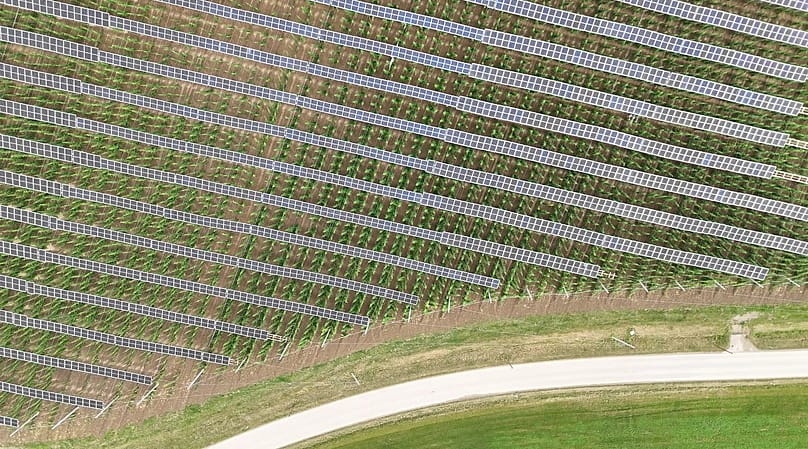
After two years of tweaks, he achieved a happy medium, settling on a 45-degree angle for the panels instead of the original 20 degrees. This means the panels receive slightly less direct sunlight, but the hops produce more cones.
Less energy but higher income
Despite producing less energy, the steeper panels actually earn Willmer more money.
If the modules are almost flat (as in the first prototype), the PV system generates most power around midday, precisely at the time when there is already surplus power in the grid and producer prices are accordingly low.
Positioned at a steeper angle, the solar system starts working efficiently from the early morning, as soon as the sun rises, or, depending on orientation, in the late afternoon and early evening – the times when electricity prices are high.
The 45-degree solution also boosts energy production in the winter, when the sun sits low on the horizon for longer periods.
“And in winter in particular you need every kilowatt hour,” says Gruber.
“At the moment we’re looking at a payback period of around 14 years, and the PV system will last at least 30 years,” the engineer calculates. “So you can imagine how much you can earn.”
Cutting-edge research in the hop garden
Wimmer and Gruber are not alone out in the fields. Their pilot project is the subject of several research programmes. Their cooperation and funding partners include the University of Applied Sciences Weihenstephan–Triesdorf, the internationally renowned Fraunhofer Institute for Solar Energy Systems in Freiburg, and the Federal Office for Agriculture and Food.
The Technical University of Munich, with its agricultural research station at Dürnast, and the Hop Research Centre in Hüll are also providing scientific support for the agri-PV project. Last but not least, the Agriculture Ministry is funding the three-year trial phase with €1.4 million in research money.
Analysis by Weihenstephan–Triesdorf university reveals that Wimmer’s agri-PV installation has resulted in a 10 to 20 per cent reduction in hop yields. But the farmer says these losses are more than made up for: “The profit from electricity generation is excellent, really very good. The strong power yield offsets the lower hop yield… It’s worth it.”
And with only two grams of hop extract needed to brew one litre of beer, one kilo of hops can be turned into 500 litres.
“In the end this is a win-win situation,” agrees Gruber. “You’re not only earning money from electricity, you’re also earning secure money from the hop harvest.”
“Even in the part of the year when no hops are growing, the soil is still partially shaded by the PV modules,” he adds. “This keeps the soil’s moisture profile more uniform overall – and that means the land is better prepared for the next planting season.”
Researchers are now testing whether the significant improvements in soil health beneath 20-degree panels are retained under a 45-degree shade.
Could agri-PV slow the decline of farming in Europe’s south?
As human-caused global warming continues to shift Europe’s climate, traditional growing areas, developed over centuries, may have to be abandoned for cooler climes.
It’s a pattern already troubling winemakers, and bringing new opportunities for vineyards in places like Scandinavia and the UK.
Bavaria’s hop farmers jokingly quip among themselves that in 30 years’ time the hops for good Bavarian beer may have to be imported from Norway. Sooner or later, some hop farmers in the Hallertau fear it could turn into bitter reality.
Farmers are desperately searching for solutions but not everyone can afford to install costly irrigation systems, which are also politically controversial due to their high water use.
Some hop growers are experimenting with cover crops between the hop rows to reduce evaporation, while researchers are breeding varieties that can cope better with drought.
Others have been forced to bid a reluctant farewell to the hop business – in some cases carpeting their former farmland with solar panels instead.
Wimmer has thought about this too: “I could have said, fine, I’ll rip out my hops and install ground-mounted solar instead of hop gardens everywhere. But then I’d no longer be a farmer, just a PV entrepreneur,” he says.
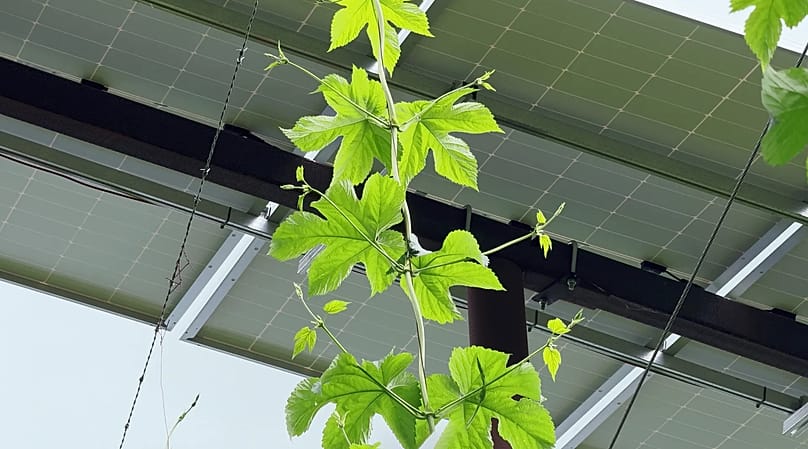
‘Energy must never compete with food production’
“For me it’s about preserving hop-growing on my land,” says Wimmer. “I want to hand the farm on to the next generation in a way that gives it security and a future – but with additional income from photovoltaics.”
On a broader scale, adds Gruber, “Energy must never compete with food production” – and agri-PV could be an important way to ensure both thrive in harmony.
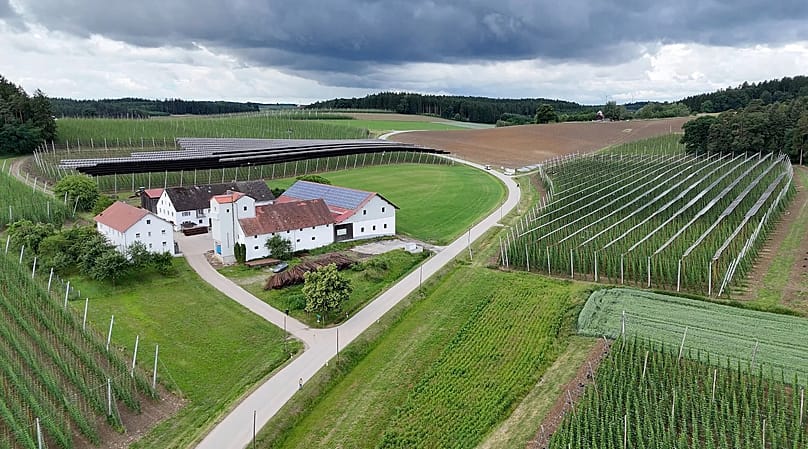
Already, agri-PV trials have cropped up over vineyards, berry patches, apple orchards and asparagus fields in Germany.
“What we’re doing could become a model for the whole of Europe,” says Gruber, as French hop farmers battle sandy, drifting soils and drought, while Czech, Slovenian, Slovakian, Polish and Austrian hop growers face similar challenges.
With extreme dry spells worsening in Europe – Germany’s ‘drought monitor’ at the Helmholtz Centre for Environmental Research shows extreme droughts in 1976, 2003 and then almost continuously since 2018 – solutions like Wimmer’s could be a lifeline.