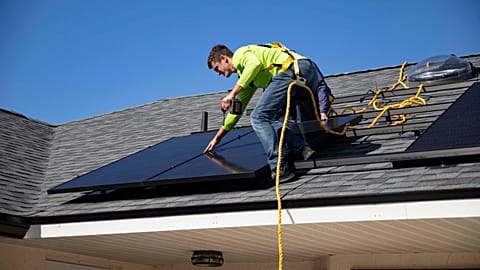
















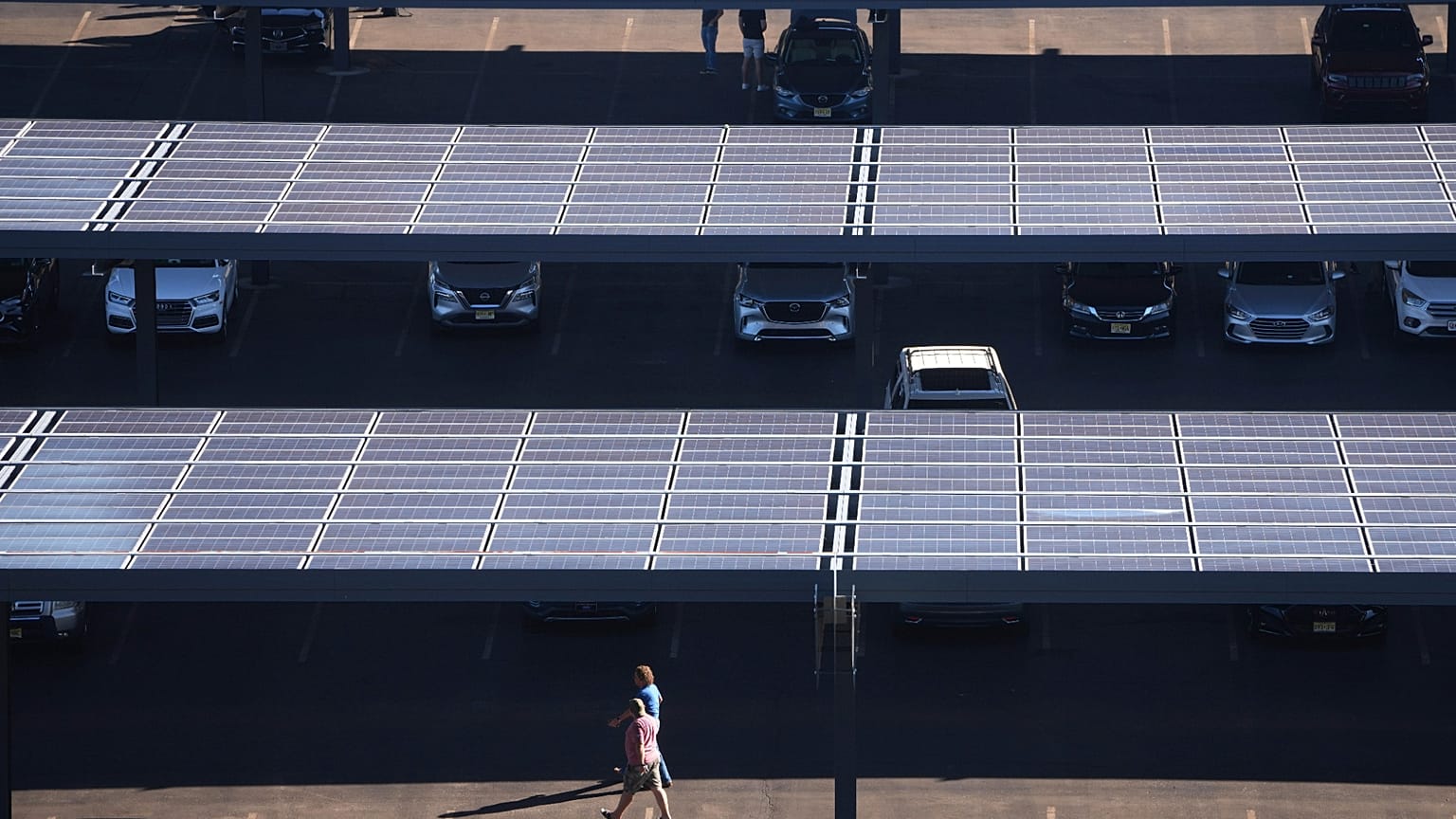













Investing in renewables has also ensured greater energy security at a moment when the war on Iran is destabilising supplies and forcing up costs.
Europe made huge energy cost savings in 2025 thanks to reducing its dependence on polluting fossil fuels by driving investment in renewables.
 ADVERTISEMENT
ADVERTISEMENT
ADVERTISEMENT
Using wind and solar to generate power meant significantly less reliance on imported oil and gas, according to energy think tank Ember. Europe looks set for further savings in 2026 as renewable energy generation hits record highs thanks to ideal Spring conditions.
This is also ensuring greater energy security at a moment when the US-Israel and Iran war is destabilising supplies and forcing up costs.
Europe saves billions by investing in renewables
The EU saved $60 billion (€51.4 billion) in 2025 by lowering fossil fuel imports, according to a report by the International Energy Agency (IEA). Investing in renewables has also set Europe up well to handle the energy price shocks from the US-Israel and Iran war.
"Europe's energy transition is paying dividends - the $60 billion in fossil savings last year will be eclipsed by the savings this year as prices of all oil, gas and coal surge,” a spokesperson from Ember tells Euronews Earth.
“Because of renewables, the electricity sector is the least impacted of all of Europe's energy sectors - most of the fossil imports are now for outside of the power sector. Therefore, it is great to see Europe's investment focus now shifting towards electrification, to cut oil use in transport and cut gas use in heating and industry."
In 2025, the EU imported €336.7 billion worth of energy products, amounting to 723.3 million tonnes. Compared with 2024, imports decreased both in value (-11.1 per cent) and in net mass (-0.6 per cent ), according to the think tank Strategic Perspectives.
Instead, the EU invested $105 billion (€90 billion) in renewables. Solar power was the clear standout performer. With a total generation of more than 340 TWh, it reached 12.5 per cent of the EU generation mix, says Strategic Perspectives.
Solar output rose by more than 60 TWh year-on-year, equivalent to Portugal's entire annual electricity demand.
The investments in renewables, electrification and energy efficiency are good news for both the planet and for consumers, Marin Gillot, Energy Analyst at Strategic Perspectives, tells Euronews Earth.
"Clean energy is no longer just about climate, it is also an economic and geopolitical strategy," he says. "The faster Europe moves away from fossil fuels, the less exposed European citizens and businesses will be to price shocks and geopolitical instability."
Wind and solar generated more electricity than gas worldwide in April
2026 is also proving a bumper year for renewables.
Wind and solar generated more electricity than gas globally for the first month ever in April 2026, according to data analysed by Ember. Together, wind and solar generated 22 per cent of global electricity in April 2026, compared with 20 per cent from gas.
The milestone occurred during the first full month of the latest global energy crisis triggered by the conflict in the Middle East, highlighting how rapidly growing wind and solar generation is reshaping the global power mix even amid fossil fuel market volatility, the think tank wrote in a report.
Globally, output is estimated to have grown 13 per cent year-on-year, with gains across major markets including China (+14 per cent), the EU (+13 per cent), the UK (+35 per cent), the US (+8 per cent), Australia (+17 per cent), Chile (+24 per cent) and Brazil (+4 per cent).
Ember notes, however, that so far, wind and solar have overtaken gas only for a single month and not on an annual basis.
April was the most likely month for this milestone, as spring conditions in the northern hemisphere – where most global solar capacity is concentrated – typically combine strong wind output with rising solar generation.
At the same time, electricity demand is typically lower between the heating and cooling seasons, meaning gas generation tends to be lower than in most other months of the year.