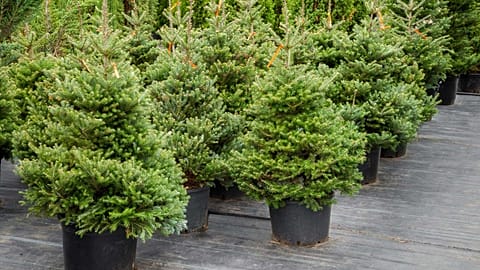














Some people are turning to rented options as a green alternative to fresh-cut or artificial Christmas trees.
With December on the horizon, an annual debate is brewing: should I get a real or fake Christmas tree?
 ADVERTISEMENT
Artificial Christmas tree lovers may have already resurrected their old family favourite, bringing the dusty box out of the attic as the festive season begins. Those who opt for fresh cut might be yet to make their pilgrimage to a local Christmas tree farm, convinced the nostalgic smell of pine and sense of tradition is well worth the yearly fuss.
Whether you are wrestling with a tangled wire mess or trying to tie a too-big fir to the roof of your car, you might be wondering, is a fake or real Christmas tree more sustainable?
As with most environmentally responsible choices, it's not a straightforward answer. Which one you should go for depends on a number of factors, from where you buy your tree to how you get rid of it come January.
What's the most sustainable Christmas tree option?
There is a lot of conflicting information out there about what type of Christmas tree is the most sustainable.
It is often claimed that an artificial tree is actually greener as the CO2 emitted by its production is spread across the years you use it. This can be true but it requires a long term commitment. The Carbon Trust says that a plastic pine has to be used for seven to 20 years for it to have a lower footprint than a real one.
That’s a long time when you consider that 14 per cent of artificial tree buyers in the UK plan to throw theirs away after just one use, according to research carried out in 2017.
“If you’ve got a fake tree already, keep using it – make it last as long as possible,” says Friends of the Earth tree campaigner, Emi Murphy, “but look into more environmentally-sound options when it eventually comes to replacing it.”
When looking for an artificial tree, Friends of the Earth recommends you try to find one secondhand from charity shops or online selling sites instead of buying new.
How to choose a sustainable fresh-cut Christmas tree
If you aren’t ready to make that kind of devotion to a plastic pine, then a real, fresh-cut tree might be a better option for you.
Make sure that you look for FSC-certified trees as an assurance that it has been grown sustainably in an environmentally responsible way. It’s also important to seek out places selling locally grown trees as a vast number are sent all over Europe from commercial tree producers in Denmark and Germany.
Woodland charity Grown in Britain found that €3.3 million worth of imported trees were being sold to unaware Britons in 2017 – this is often the case across the continent too. It is worth having a look at what is available close to you, as some companies will even deliver from small sustainable farms straight to your door.

How to rent a Christmas tree
Both of these traditional options, however, might soon be a thing of the past. A shift in attitude in recent years has triggered real innovation as businesses attempt to appeal to the responsible consumer. Christmas shopping doesn’t seem to have escaped that conscious shift and novel solutions, like renting a potted tree, have started to receive a lot of attention.
One company, London Christmas Tree Rental, regularly sells out of stock well in advance of the festive season.
"It just felt so wasteful for these beautiful trees to grow just for the sake of three weeks of our pleasure," Catherine Loveless, co-founder of the company, tells Euronews Earth.
It was this thought that led her and co-founder Jonathan Mearns to discover the damage done by real trees when they end up in landfill.
To reduce waste and environmental impact, the company offers a living tree, delivered straight to your front door at the beginning of December. Provided in a pot, it can be decorated, put it in pride of place and even named. Once January rolls around, they will contact you to arrange a collection so that the tree can be taken back to the farm and looked after to live another year. If you do name your tree, there is even a chance that next year you can get the same one back.
"It will have grown, changed shape slightly over the year and we love the idea of being excited to welcome it into your home like a long lost friend," says Loveless.

How to get rid of your Christmas tree
Once the big day has passed, getting rid of your tree in an eco-friendly way can cause more environmental concern. As many of us who have walked through the January Christmas tree graveyard can attest, a lot of real trees end up dumped unceremoniously on roadsides or pavements. Assuming that you’ve already ditched the plastic decorations, it will just degrade naturally, right?
Despite being wholly plant material, cut real trees still need to be properly recycled. An average two-metre-tall tree left to decompose in landfill releases around 16kg of CO2 whilst also producing methane, a gas that has up to 30 times more global warming potential than CO2 over a 100-year timespan.
The Carbon Trust says that burning or chipping your tree can reduce this carbon footprint by up to 80 per cent down to just 3.5kg of CO2.
Instead of abandoning your pine on the pavement, check if your local authority offers a tree collection scheme, which will see your wilted Christmas decoration chipped and used to cover pathways or composted to feed plants in public spaces.
Artificial trees cannot be recycled but that doesn’t mean that their life has to end when you don’t want them anymore. Voluntary organisations, churches and charities may well accept them if they are in good condition.
This generally counts as a negative against the artificial tree though, as if it makes its way to landfill it could contribute to the planet’s ongoing plastic pollution problem. Ocean Conservancy even found an artificial tree washed up on a beach during their 2018 International Coastal Cleanup.
A version of this article was first published in 2019.