










Newsletter Newsletters Events Events Podcasts Videos Africanews
Loader
Advertisement

Can agri-PV save Bavaria's hop gardens? 'Solar hats' help fight climate crisis

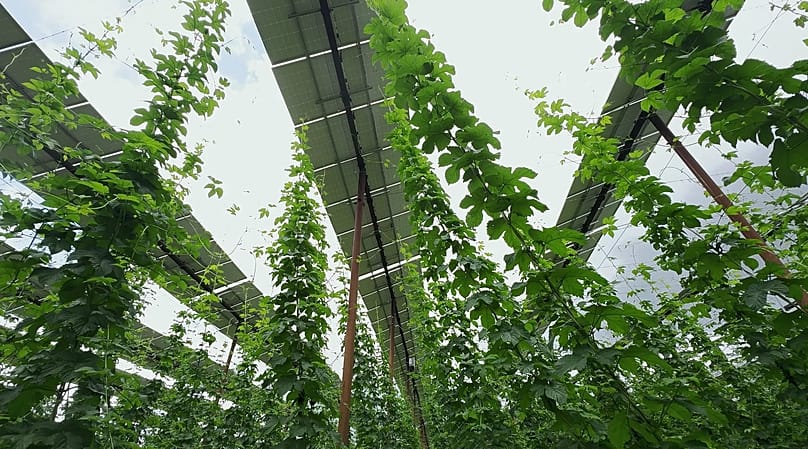
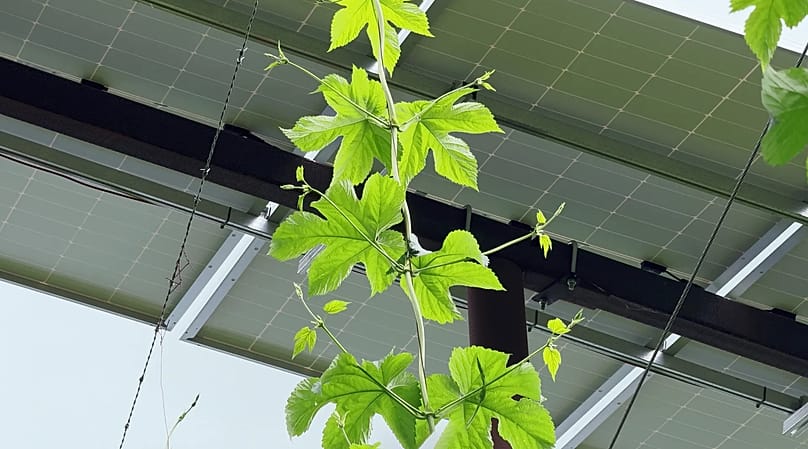
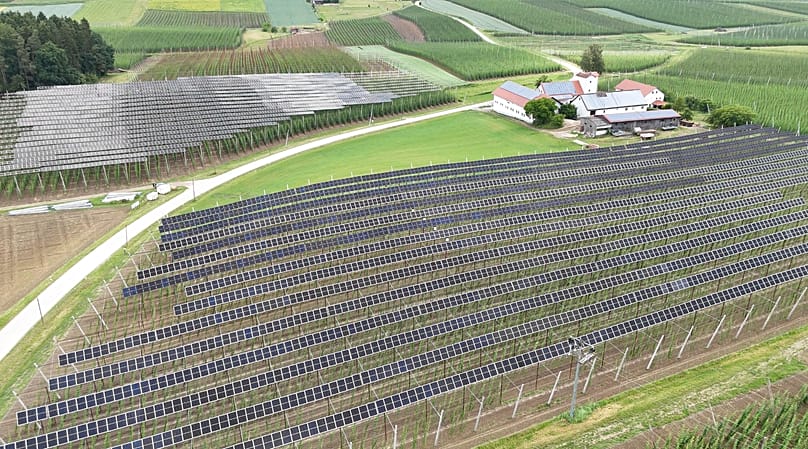
Solar panels mounted seven metres high provide shade for the hop plants
Solar panels installed seven metres up provide shade for the hop plants Copyright  Hans von der Brelie
Copyright Hans von der Brelie
By Hans von der Brelie
Published on
Share Comments Add Euronews on Google
Share Close Button

No hops, no beer. And without rain there are no hops. Climate change, rising heat and dry farmland are hitting Bavaria’s key crop. Could solar panels seven metres up help hop farmers?

It is a slow, creeping death that has set off across the seemingly lush, apparently thriving paradise of Germany’s hop-growing regions. The name of the disease that threatens their very existence? A wave of farm closures. As of 2026, there are still 904 agricultural businesses in Germany specialising in hops as a speciality crop. That is a dramatic figure compared with 2006. In just two decades, 40 percent of all hop farmers have either switched to other crops or given up altogether.

ADVERTISEMENT
ADVERTISEMENT

The reasons are many. Anyone who talks to hop farmers on the ground, out in the fields at daybreak or later at the regulars’ table in the pub, has been hearing complaints for years about falling prices worldwide and declining beer consumption. But increasingly, even down-to-earth Bavarian farmers now speak openly of climate change, rising temperatures, water shortages and loss of yields as their soils dry out.

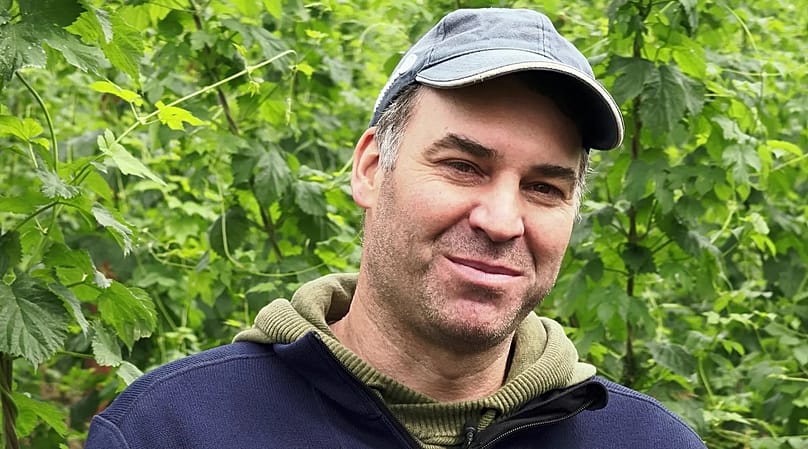
The Hallertau is the largest continuous hop-growing region in the world. This gently rolling farming landscape lies in the heart of Bavaria, the federal state in Germany’s far south. Of Germany’s 904 hop farms, 722 are located here. One of them is run by Josef Wimmer. “The years are getting hotter and drier,” warns the farmer in an interview with Euronews Earth.

“The years are getting hotter and drier,” says hop grower Josef Wimmer from Neuhub near Osseltshausen.
“The years are getting hotter and drier,” says hop grower Josef Wimmer from Neuhub near Osseltshausen. Hans von der Brelie

Hop farmer Wimmer wants his farm to survive

Wimmer also confirms that the number of hop farms is falling: “When I did my training 30 years ago, there were more than 2,000 hop growers in the Hallertau, today it is well below 1,000.” To secure the future of his farm, he felt he had to act, says Wimmer, an energetic man who clearly does not shy away from problems.

When I did my training 30 years ago, there were more than 2,000 hop growers in the Hallertau, today it is well below 1,000.
Josef Wimmer
Fourth-generation hop farmer

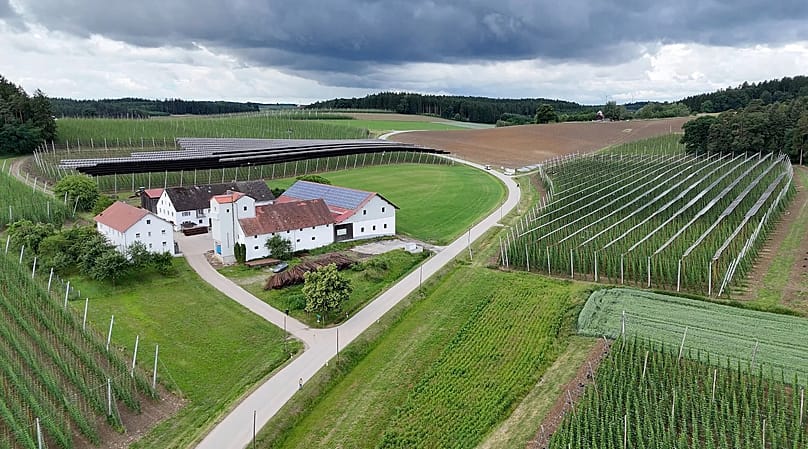
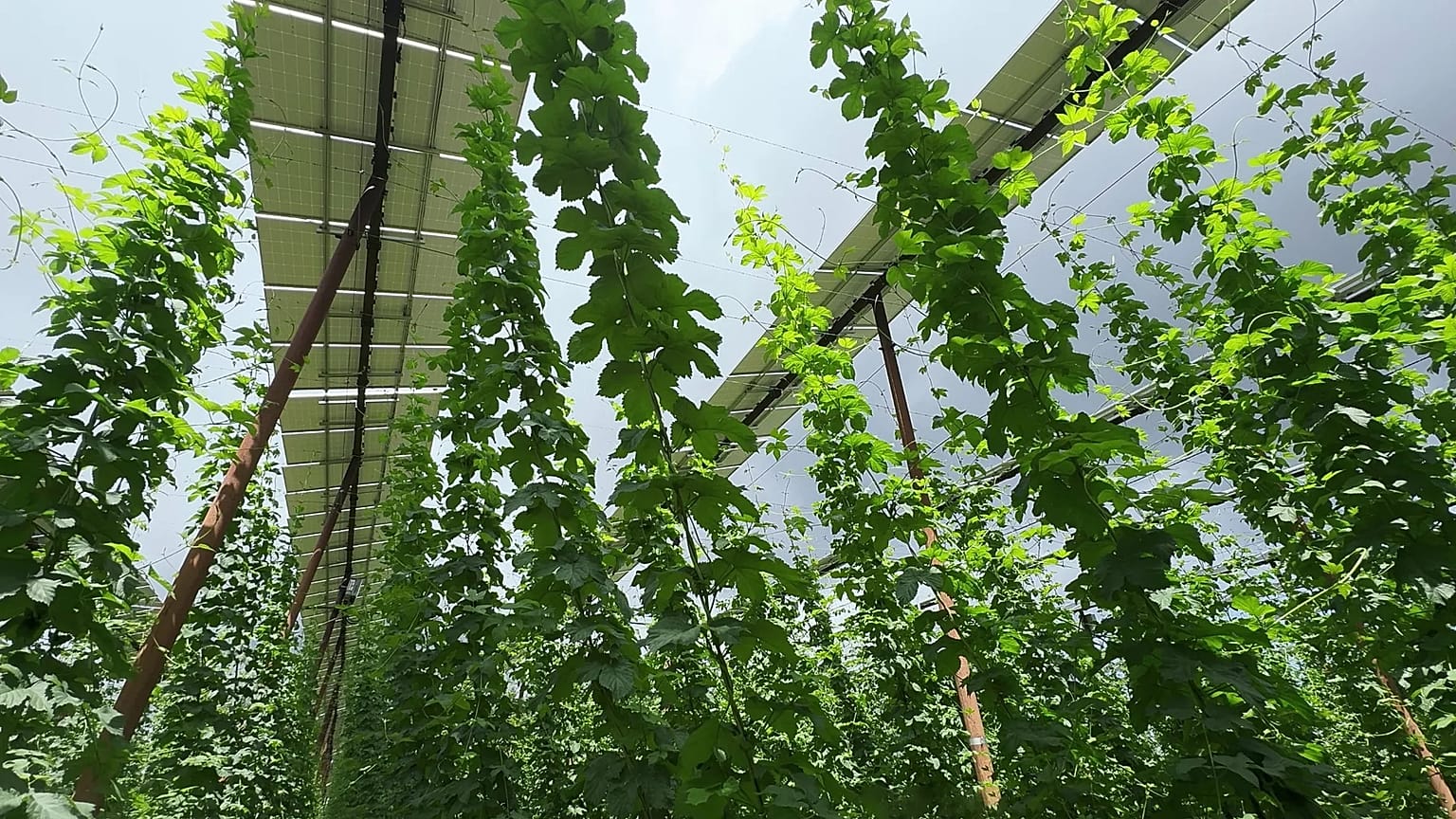
From his imposing four-sided farmstead in Neuhub near Osseltshausen, a small village in the centre of the Hallertau, it is only a few metres to the edge of the hop fields. As far as the eye can see, hop gardens cling to the softly undulating terrain. At regular intervals stand seven-metre-high poles, up which the hop plants climb, shining gold-green against the light. The cones are harvested in late summer; the hop extract obtained from them gives beer its typical, slightly bitter flavour.

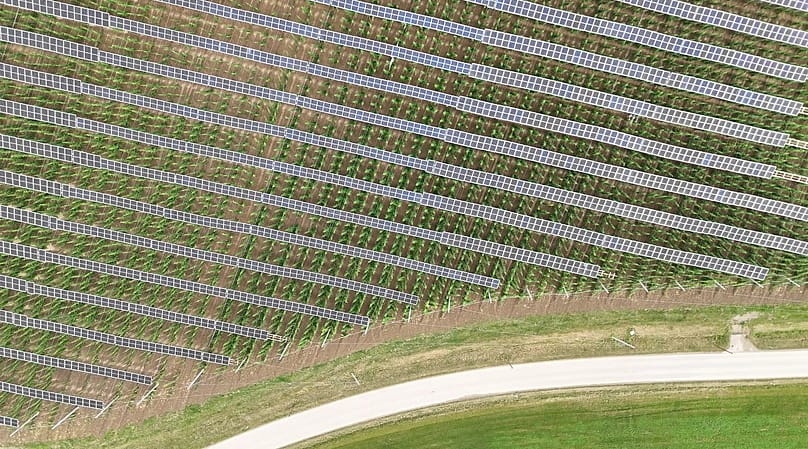
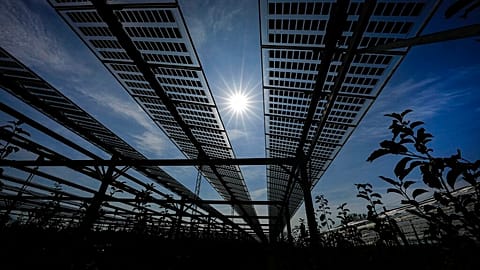
Wimmer points upwards. High above the ground, just above the hop poles, he has installed photovoltaic modules. The lush green of the hop plants blends into the landscape with the gentle blue of the solar panels. The aim is to mitigate the effects of climate change, Wimmer explains: “We wanted to shade the hops because hops are a shade-loving plant.”

Hops are a shade-loving crop. The plants climb up seven-metre-high poles.
Hops are a shade-loving crop. The plants climb up seven-metre-high poles. Hans von der Brelie

From aircraft construction to agri-PV

Today farmer Wimmer is hosting a visit from Bernhard Gruber, a former Airbus engineer who has changed careers. Instead of building aircraft, Gruber now designs and installs agri-PV systems: he researches and refines, plans and experiments, calculates and tests. Wimmer’s hop PV system is, in a way, also Gruber’s baby. The lead engineer, with decades of professional experience, designed the entire agri-PV installation on paper, puzzling over structural stability and the sun’s path, over potential wind loads and the ideal tilt angle for PV panels at a height of seven to eight metres above the ground.

“In a first step we covered five hectares of hops with PV,” reports Wimmer. “That gives us an output of two megawatt peak.” The pilot system’s results were so encouraging that Wimmer now wants to roof his other hop gardens with agri-PV modules as well: “Over the next two or three years we’ll expand it to 20 hectares, which will give us eight megawatt peak of PV capacity; and we’ll add a battery storage system with a capacity of one megawatt.” Megawatt peak (MWp) is the unit used to measure the peak output of a solar installation.

Engineer Gruber lets his eyes wander with satisfaction through the dense, healthy green of the hop foliage. “Have the power line and the connection to the substation now been secured?” he asks. Hop farmer Wimmer nods: “Yes. We now have to lay a five-kilometre cable, but we have to pay for it ourselves.”

“And the planning permission,” Gruber asks, “how long did it take you to get the building permit?” Farmer Wimmer lets out a brief sigh: “Almost two years!” Gruber is not impressed: “Two years is a long time if you want to expand renewables quickly.”

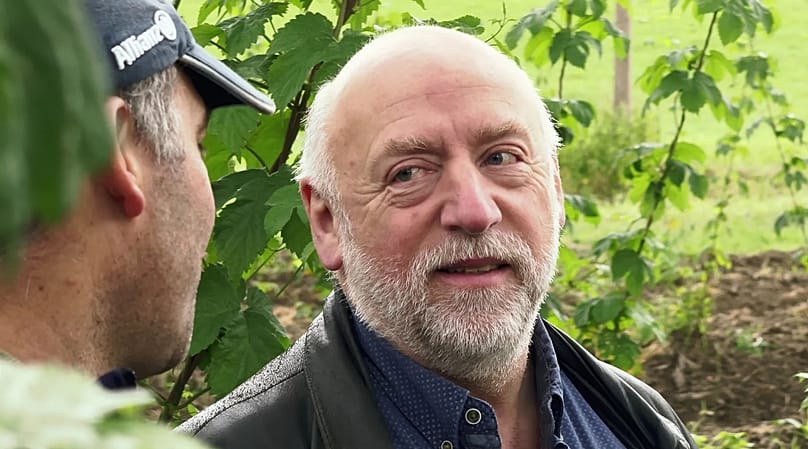
Engineer Bernhard Gruber talking to hop farmer Josef Wimmer.
Engineer Bernhard Gruber talking to hop farmer Josef Wimmer. Hans von der Brelie

In Bavaria, in Germany, in the European Union, everyone talks about cutting red tape. Wimmer’s agri-PV system above his hop gardens shows very concretely what that could look like. Engineer Gruber sums it up: “Long approval procedures are a problem. They put some farmers off from going for agri-PV on a larger scale, because the bureaucratic effort is simply too great for many of them,” says Gruber.

Long approval procedures put farmers off.
Bernhard Gruber
Lead engineer, AgrarEnergie & feld.energy

Ultimately, he says, it is up to politicians. “Especially for hop growing, but also for other agricultural speciality crops, the decisions and approvals could be made much more easily. Why things aren’t moving faster is honestly a mystery to me,” says engineer Gruber. In the cool green shade of the towering hop plants, farmer Wimmer nods in agreement.

Agri-PV keeps soils moist – and hops like that

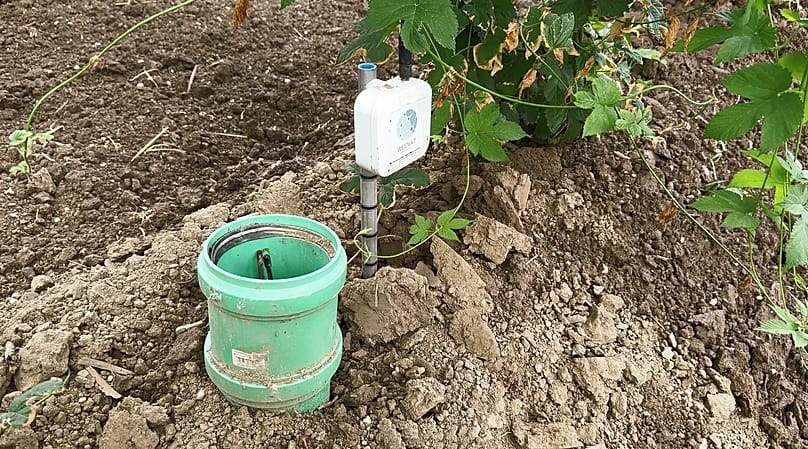
Wimmer and Gruber walk in the shade of the hop trellises rising high into the blue-and-white Bavarian sky to a moisture sensor. “We’ve found that the soil has become wetter since the agri-PV modules were installed,” Wimmer says, pointing to the earth between the plants. “Evaporation is lower, we can keep the water from rainfall in the soil for longer – and that is good for the hops, especially in June, July and August. That’s when the hops need water.”

The idea of putting a kind of solar “hat” made of PV modules above his hop plants came to farmer Wimmer more than ten years ago. But as is often the case with true pioneers, he first had to overcome a number of obstacles. It was not easy to persuade a PV company to join him in venturing into entirely new territory. After all, Wimmer’s agri-PV installation above hop gardens is a world first.

Innovation among the hops: agrivoltaics is being further developed in the Hallertau.
Innovation among the hops: agrivoltaics is being further developed in the Hallertau. Hans von der Brelie

Josef Wimmer still remembers the early days well: “My father, from whom I took over the farm, was very positive about it. But among the local population there were voices saying: ‘Wimmer’s lost it now, that’ll never work!’ When we started building, we became the hot spot of the Hallertau. Everyone came by to have a look. And after every big storm… everyone wanted to know whether the installation was still standing or had been blown away,” Wimmer laughs. Then he adds proudly: “But everything is still standing, even after the storms.”

Everything is still standing, even after the storm.
Josef Wimmer
Fourth-generation hop farmer

After the curious neighbours came the hop farmers from more distant villages to inspect the system. They were followed by local councillors and district officials, right up to ministers from the Bavarian state capital Munich. Thanks to his innovative hop PV system, farmer Wimmer is known in the Hallertau like the proverbial colourful dog – in other words, by everyone.

Josef Wimmer’s hop farm is known throughout the region: the state-of-the-art agri-PV installation attracts visitors from all over Bavaria.
Josef Wimmer’s hop farm is known throughout the region: the state-of-the-art agri-PV installation attracts visitors from all over Bavaria. Hans von der Brelie

Now prototype 2 is coming

Engineer Gruber is proud of “his” installations too. The Wimmer–Gruber tandem has now reached prototype 2. In the first experimental agri-PV system, built in 2023, Gruber installed the solar modules above the hop plants at an angle of 20 degrees, “which means more sunlight can be converted into energy – but conversely it also means more shade for the hops,” Gruber explains.

A little extra shade is good for growing (because it keeps the soil moister), but it is a fine balancing act in farming terms. Too much shade creates problems, as farmer Wimmer discovered in the first trial phase. As soon as the hops had climbed up to seven metres and reached the PV roof, the plants produced bushy shoots in the shaded upper zone – but fewer cones. Overall yields fell and less hop extract was produced.

This is where engineer Gruber came in. “I spent two years thinking and improving the model,” he recalls. He had to take account of agricultural, economic and seasonal factors alike: How does the sun move across the sky in summer? And in winter? What does the typical price curve at the power exchange look like in the morning, at midday and in the evening? How much shade is good for the hops and the soil? Where is the tipping point between too little and too much? How exactly does the tilt angle of the PV modules change the way shadows move over the course of the day? It was a mathematical equation with many variables. Engineer Gruber solved it. Then he turned up again at Wimmer’s farm with the plans for prototype 2.

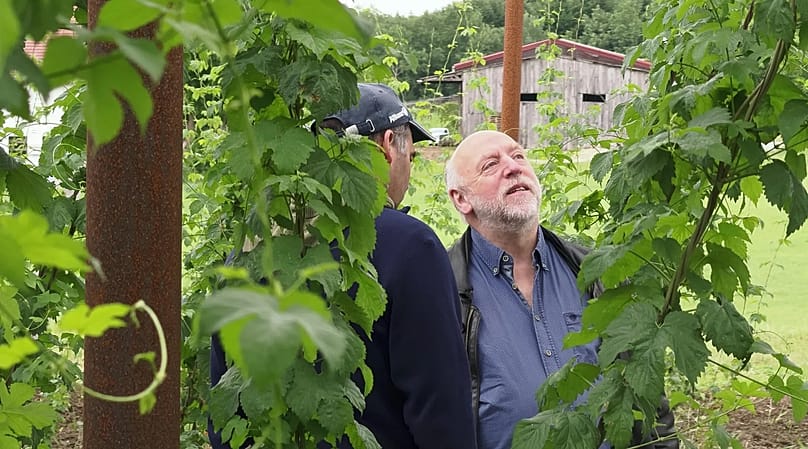
Agri-PV pioneers Bernhard Gruber and Josef Wimmer on a site visit in the hop garden.
Agri-PV pioneers Bernhard Gruber and Josef Wimmer on a site visit in the hop garden. Hans von der Brelie

Masterstroke: PV panels at a 45-degree angle

In this second prototype, installed on Wimmer’s land in 2025, the PV modules are steeper, set at a 45-degree angle. The photovoltaic panels receive slightly less direct sunlight, but the hops produce more cones. In business terms, that ultimately pays off twice over. If the modules are flat (as in the first prototype), the PV system generates most power around midday, precisely at the time when there is already surplus power in the grid and producer prices are accordingly low.
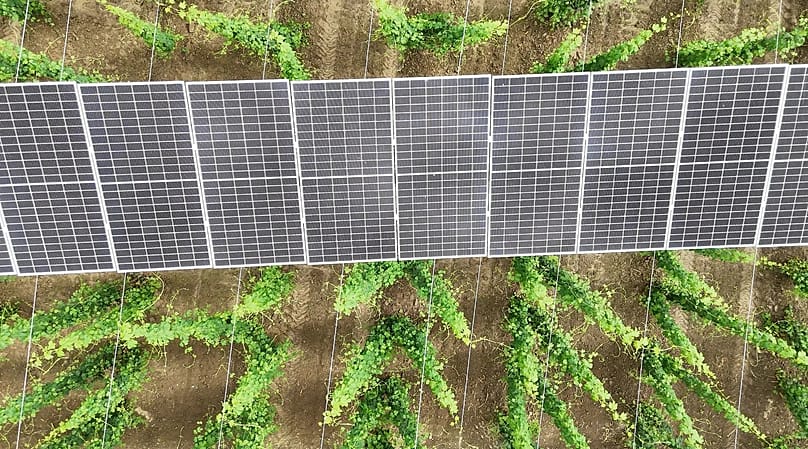
The 45-degree solution in prototype 2 is something of a masterstroke. Now the solar system starts working efficiently from the early morning, as soon as the sun rises, or, depending on orientation, in the late afternoon and early evening – the times when electricity prices are high. With prototype 2, Wimmer generates a smaller quantity of electricity, but earns more money from it. And on top of that, he can look forward to plentiful cones on his hop plants.

Spread over the seasons, the 45-degree solution works far better, too. In winter the sun stays low on the horizon for many hours, so at a tilt of 45 degrees the rays can be captured and converted into electricity much more effectively. “And in winter in particular you need every kilowatt hour,” as engineer Gruber puts it.

Agri-PV makes it possible to do both at once: grow hops and generate solar power.
Agri-PV makes it possible to do both at once: grow hops and generate solar power. Hans von der Brelie

Cutting-edge research in the hop garden

Wimmer and Gruber are not alone out in the fields. Their pilot project is firmly embedded in several research programmes. Their cooperation and funding partners include the University of Applied Sciences Weihenstephan–Triesdorf, the internationally renowned Fraunhofer Institute for Solar Energy Systems in Freiburg and the Federal Office for Agriculture and Food, all backing what may prove to be a groundbreaking innovation. The Technical University of Munich, with its agricultural research station at Dürnast, and the Hop Research Centre in Hüll are also providing scientific support for the agri-PV project. And not to forget: the Agriculture Ministry is funding the three-year trial phase with 1.4 million euros in research money.

Internationally, agri-PV research is also slowly getting under way. “The Japanese already have data and good results too,” says Gruber appreciatively. Trials are also being carried out elsewhere in Asia and the Americas, but for now agri-PV research “made in Germany” – and more broadly “made in Europe” – is still seen as the global benchmark.

Engineer Gruber goes into detail: “In Mr Wimmer’s hop garden we have installed moisture sensors in the soil.” Soil moisture is measured at the surface and at greater depth. Wimmer and his scientific team also continuously monitor temperature and humidity between the hop rows at different heights. To ensure the data are scientifically robust, all measurements are duplicated: once in the hop garden with the shady agri-PV installation and once in a comparison field without PV modules above the plants.

Soil moisture is also measured precisely.
Soil moisture is also measured precisely. Hans von der Brelie

The first evaluations are now available and are clear, at least for prototype 1: the slight additional shading created by the agri-PV system above the hops has significantly improved soil health. Results from the University of Applied Sciences Weihenstephan and the Fraunhofer Institute in Freiburg are consistent on this point. Whether and to what extent prototype 2 proves even better remains to be seen; field trials are still ongoing.

Vegetation zones shifting north

Wimmer’s fascinating field trial in the hop garden is now a talking point not only in the Hallertau, but across Germany and Europe. Because a spectre is haunting Europe: are climate change and global warming pushing entire vegetation zones northwards?

Will traditional growing areas, developed over centuries, have to be abandoned and shifted to cooler latitudes? Will rural customs, traditions and cultivated landscapes disappear with them? Will we soon see “French” wine from England and “German” hops from Scandinavia?

There is great unease among Bavaria’s hop farmers. They jokingly quip among themselves that in 30 years’ time the hops for good Bavarian beer may have to be imported from Norway. For now it is meant as a joke – but for how much longer? Sooner or later, some hop farmers in the Hallertau fear, it could turn into bitter reality.

The first documented reference to hop growing anywhere in the world is found in Bavaria.
The first documented reference to hop growing anywhere in the world is found in Bavaria. Hans von der Brelie

Agri-PV for vines, orchards and asparagus too

The issue goes well beyond hops as a speciality crop. “Some winegrowers are already trying similar systems above their vines,” notes engineer Gruber. Winegrowers and their plants are also struggling with climate change and parched soils. While hop PV is being tested in Bavaria’s Hallertau, similar trials are under way in other regions of Germany: agri-PV systems above berry crops, in orchards and above asparagus fields.

Something has begun to move here that could soon grow into something big. On the basis of the promising research results, it is reasonable to expect that agri-PV will in a few years become an everyday feature of European agriculture.

A third of global production

Back to hops. Although 86 percent of German hops come from the Hallertau and the Bavarian region produces roughly one third of world output, there are other growing areas in Europe that face similar challenges. French hop farmers are battling sandy, drifting soils and drought. The Czech Republic, Slovenia, Slovakia, Poland and Austria also grow hops. “What we’re doing could become a model for the whole of Europe,” engineer Gruber is convinced.

Gruber and Wimmer agree that the time for action has come. After a handful of drought years in the Middle Ages (1302–1307 and 1540), extreme dry spells in Germany have today multiplied. The “drought monitor” at the Helmholtz Centre for Environmental Research records extreme drought in 1976, 2003 and then almost continuously from 2018 onwards: 2019, 2020, 2022, 2023, 2025…

Germany’s hop farmers are feeling the effects too. Heat slows the production of alpha acids, the compound that gives beer its pleasantly aromatic bitterness. But more serious than the lower alpha acid content of the hop extract are the sometimes dramatic drops in yield reported by farmers. Drought damages the quality of the hops, but above all the quantity. Fewer hop cones are harvested.

Farmers are desperately searching for solutions. Costly irrigation systems are being installed, including in the Hallertau. Not every farmer can afford them, and they are politically controversial. Other hop growers are experimenting with cover crops between the hop rows to reduce evaporation. Hop researchers are breeding varieties that can cope better with drought, but not all brewers readily accept the new varieties.

As the crisis has worsened over the years, some farmers have taken the plough to their fields, cutting through the perennial roots of their hop plants, clearing the “forests” of seven-metre hop poles – and bidding a reluctant farewell to the hop business. Yet hop growing is as much part of Bavaria and Germany as wine is of France or olive groves are of Greece and Italy.

The fifth generation is ready to go

The earliest documented evidence of hop growing anywhere in the world comes from the Freising area, on the edge of today’s Hallertau, and dates back to the year 860 AD. The Bavarian region is therefore among the oldest hop-growing areas in the world. That still matters today. Many hop farmers have been running their holdings for generations, including Josef Wimmer. He is a fourth-generation hop grower.

“And the fifth generation is already waiting in the wings,” Wimmer smiles. “My son is 17 and currently doing his training as a farmer. He is in his second year and will take over the business later. In fact, I’m making the investment in the agri-PV system above the hops for my son, because by the time it is all paid off I’ll probably already be retired,” Wimmer laughs. “My son will carry it on.”

Is all this effort worth it? Put another way: does investing in agri-PV make economic sense? Engineer Gruber is convinced that agri-PV could become a new business model for many farmers: “At the moment we’re looking at a payback period of around 14 years, and the PV system will last at least 30 years,” Gruber calculates. “So you can imagine how much you can earn.”
A win–win situation

At this point many farmers ask very detailed questions. Everyone involved is aware that this is a finely tuned balancing act: (slight) reductions in agricultural yields on the one hand, and (fluctuating) additional income from solar power generation on the other.

So how do the numbers add up for farmer Wimmer? “The Weihenstephan university has analysed the drop in hop yields very precisely; we have reductions of between 10 and 20 percent. If our losses come out between 10 and 15 percent, then it makes economic sense for me, because the profit from electricity generation is excellent, really very good. The strong power yield offsets the lower hop yield.”

So is it a zero-sum game – no gain, no loss? Wimmer clarifies: “On the hops I lose a bit of money, but with the PV system above them I make good money.” He laughs, clearly pleased, and adds: “It’s worth it. It’s worth it.” Engineer Gruber agrees: “In the end this is a win–win situation. You’re not only earning money from electricity, you’re also earning secure money from the hop harvest.”

It’s worth it. It’s worth it.
Josef Wimmer
Fourth-generation hop farmer

It is also about continuity and survival over the years, because, as Gruber points out: “Even in the part of the year when no hops are growing, the soil is still partially shaded by the PV modules. This keeps the soil’s moisture profile more uniform overall – and that means the land is better prepared for the next planting season.”

Last year, just under 19,000 hectares of hops were grown in Germany. In terms of volume, Germany is therefore the world’s second most important hop producer after the USA. The German harvest in 2025 totalled just over 43,000 tonnes (38 percent of global hop production), of which more than 37,000 tonnes came from the Hallertau.

Hop growing is part of Bavaria’s cultural identity

People in Bavaria are proud of these achievements. In the Hallertau, hops and beer are not folklore but everyday life. Every year a “hop queen” is chosen. Picking hops – harvesting the ripe cones in late summer – is a major event. The timing of school holidays in Bavaria has for centuries been aligned with the hop harvest, because every helping hand is needed. The many beer festivals in Bavarian towns and villages, whether called Oktoberfest or something else, are at their core harvest thanksgiving celebrations.

The cultural identity of an entire region and the financial interests of numerous farmers often overlap in the Hallertau. That is also evident from the way Wimmer puts it: “One of the main reasons I installed the agri-PV system above the hops was financial. It was about future-proofing the business and securing an income with fewer fluctuations. We’ve had PV on our roofs since 2009, and we saw that it works well. So we said to ourselves that from now on we wanted to do this on a large scale above the hops too.”

Elsewhere some farmers are giving up agriculture and covering their former fields entirely with ground-mounted solar installations. They earn money from this, but resistance among neighbours, in villages and local communities is growing. People do not want to see their traditional landscapes “carpeted over” with ground-mounted PV systems. Agri-PV is different, because it allows both at once: farmers can continue to cultivate their land – and at the same time harvest the sun.

Wimmer has thought about this too: “I could have said, fine, I’ll rip out my hops and install ground-mounted solar instead of hop gardens everywhere. But then I’d no longer be a farmer, just a PV entrepreneur. And that’s not what I wanted and still don’t want.”

Because Wimmer wants both: “For me it’s about preserving hop growing on my land. I want to hand the farm on to the next generation in a way that gives it security and a future – but with additional income from photovoltaics.”

It’s about preserving hop growing.
Josef Wimmer
Fourth-generation hop farmer

Pioneer in the hop garden

During their conversation, engineer Gruber and farmer Wimmer have walked across one of the hop fields and are now making their way back to the imposing farmstead on the rise. A thunderstorm front is building on the horizon, banks of inky-blue cloud piling up above Wimmer’s farm and hop gardens. The storm has not yet reached Neuhub near Osseltshausen; shafts of sunlight illuminate the onion-shaped church tower in the neighbouring village and then move on to Wimmer’s agri-PV modules.

Gruber and Wimmer know that climate change cannot be halted overnight, any more than the approaching thunderstorm can. But they also know they can take precautions, to some extent. Engineer Gruber nods appreciatively to his business partner and friend: “I think it’s great that you’re such a pioneer. I also think it’s great that after our first trials proved their worth, you’re carrying on and will now roof your remaining hop fields with PV too. I see it exactly as you do: agri-PV is a huge opportunity for hop growing, so that it stays in Bavaria and doesn’t have to move north somewhere.”

Agri-PV makes hop growing in the Hallertau more resilient to climate change and global warming.
Agri-PV makes hop growing in the Hallertau more resilient to climate change and global warming. Hans von der Brelie

One-fifth of a nuclear power plant

As they part, Gruber offers a little number game: “Of the roughly 17,000 hectares of total hop-growing area, about 20 percent is well suited to shading, in other words to agri-PV above hop gardens. If you actually implemented that on a large scale across those 20 percent, you would install the equivalent output of one-fifth of a nuclear power plant.”

Of course, the “power line situation” would first need to be improved, as Gruber cautiously puts it – by which he means missing connections and an underdimensioned grid. The electricity generated above the hops has to be able to flow away and be fed into the grid, “including into the medium-voltage and high-voltage grid.”

Benefit for all

Once this infrastructure hurdle has been overcome, Gruber believes, the goal will have been achieved: “For hop farmers it would be a gain. For the hop plant it would be a gain. For the soil it would be a gain.”

After a brief pause for thought, engineer Gruber adds: “Agri-PV is a huge step forward on the road towards renewable energy.” A model that would also ensure that agriculture and power generation can coexist. “Because energy,” Gruber concludes, “must never compete with food production. If that is the goal, then we have to clear the way to get there.”

Energy production must never compete with food production.
Bernhard Gruber
Lead engineer, AgrarEnergie & feld.energy

And finally a little hop-related postscript for the curious: did you know that you only need two grams of hop extract to brew one litre of beer? One kilo of hops can therefore be turned into 500 litres of beer.

Go to accessibility shortcuts
Share Comments Add Euronews on Google

Read more