




























Media headlines warn that Spain has over-delivered on solar. But is that really the full story?
Spain’s ambitious expansion of renewables is facing growing scrutiny over fears that too much solar power could trigger a mass investor exodus.
 ADVERTISEMENT
ADVERTISEMENT
ADVERTISEMENT
Over the last fortnight, two major news publications have criticised the country’s efforts to wean itself off of polluting fossil fuels by investing more than €70 billion in clean energy in the last 15 years.
Headlines declaring that “Spain’s solar is so cheap investors are looking for an exit,” and “How Spain’s solar power boom turned to bust” suggest that the country’s excess electricity is devaluing solar farms and turning business away.
But, is this the full picture, what solutions does Spain have and what does all of this actually mean for citizens?
Renewables are sheltering Spain from volatile fossil fuel prices
Last year, 75 per cent of Spain’s electricity came from clean sources – with wind and solar making up 42 per cent of the country’s overall mix.
According to energy think tank Ember, Spain relied on fossil fuels for just 25 per cent of its electricity in 2025. Its per capita emissions of 0.9 tonnes of CO2 equivalent were below the EU average of 1.3 tonnes of CO2e.
“Thanks to the rise of renewable energy, Spanish households and businesses have access to some of the cheapest electricity in Europe," Rosslowe tells Euronews Earth.
The merit order principle ensures that electricity prices are based on the most expensive power plants still needed to meet demand. So, if a country’s electricity needs can’t be covered exclusively by clean energy – more expensive (and polluting) sources such as coal or gas step in.
This is the main reason why electricity prices remain high across Europe despite investment in renewables.
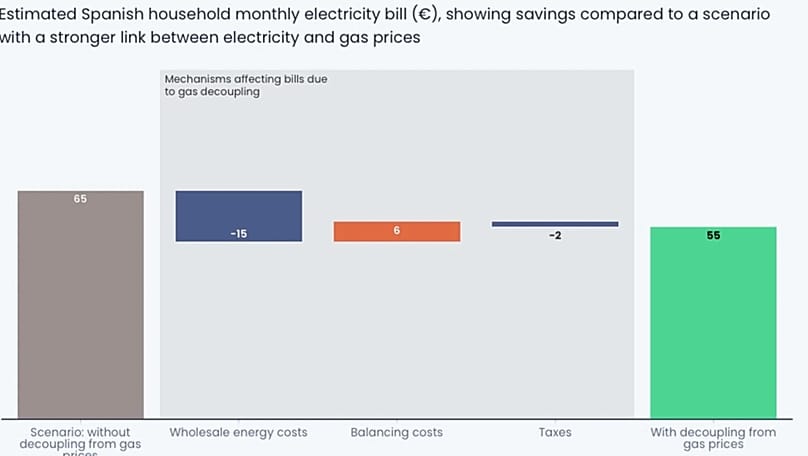
However, a report published by Ember last month found that Spain’s strong growth of wind and solar had “significantly weakened the link between gas and electricity prices” since the gas crisis of 2021-2024.
As a result, Spanish bill payers are avoiding costs of around €10 per month thanks to the shielding of electricity prices.
Solar investors turn their back on Spain
However, low consumer prices do not dictate the movements of private investments.
Bloomberg recently reported that at least four Spanish projects or companies have been offered for sale, claiming that the surge in solar investment has created a “glut of electricity” so large that solar farms are plummeting in value.
Sources who wished not to be named say one solar producer has received “lowball offers” from potential buyers and has since stalled its asset sales.
José Donoso, director general of UNEF, the main association of the solar photovoltaic sector in Spain, tells Euronews Earth that in a sector where investment funds are key players, “corporate transactions involving the purchase and sale of companies and projects are a normal cyclical occurrence”.
“At present, there is no unusual level of this type of activity,” he adds. “On the one hand, some companies have decided to sell, while on the other, there are companies that believe current market valuations are too low and are therefore choosing not to sell.”
While some firms may be thinking of selling up, Spain’s expansion of renewables hasn’t yet slowed. Between May 2025 and April 2026, following nationwide blackouts, the country has added an average of 1.2 GW of combined wind and solar capacity per month, slightly more than the average in the year preceding the power outage.
However, that doesn’t mean that Spain’s solar glut isn’t an issue that needs to be tackled.
Why does Spain waste so much solar?
This year, between January and March, Spain recorded 397 hours of negative electricity prices – a significant spike compared to the 48 hours registered in the same period last year.
Electricity prices can fall below zero when supply outstrips demand. In these periods, some generators bid increasingly low – or even negative – prices to remain on the grid, as shutting down or being ‘curtailed’ can be more costly and in some cases would result in loss of subsidies or other sources of revenue.
Unlike markets such as Germany or the UK, Spanish law doesn’t legally oblige the grid operator to compensate generators when they are forced to reduce output to prevent flooding the grid. This means investors will be seeing less return on their solar farms.
Solar, in particular, is a rather inflexible form of renewable energy. It is generated in the day, when energy consumption tends to be low, and stops producing energy in the evening – when many households will be returning from work and school and needing more energy.
Donoso argues that the electricity market currently operates under rules that are not suited to solar, adding: “We have a technology with virtually zero marginal costs, so it cannot be efficiently priced through a market mechanism based on marginal costs.”
To tackle this, he suggests introducing a price floor and a price ceiling similar to the mechanism used under the “Iberian exception”. This allowed Spain and Portugal to decouple the price of gas from that of electricity for 12 months back in 2022, following Russia’s full-scale invasion of Ukraine.
“We also need a price floor to prevent the widespread occurrence of zero or negative prices and to ensure that renewable generators, which have no variable operating costs, can earn an adequate return on their investments,” Donoso says.
“In addition, we have proposed several measures to the government, including the abolition of the electricity generation tax, which has already been announced.”
UNEF is also calling for technical curtailments to be compensated at market prices and for the social tariff contribution – a mandatory levy that helps fund discounted electricity for vulnerable and low-income households – to be calculated as a proportion of the revenues actually earned by each plant rather than as a fixed amount.
Can batteries solve Spain’s solar dilemma?
While the business case for solar is weaker than what it was, multiple experts have argued that batteries present the best solution – allowing both households and solar farms to store energy produced during the day for citizens to use later in the evening.
It would help even out Spain’s energy consumption and reduce the amount of negative electricity prices.
Bloomberg even states that one solar firm it interviewed in Spain pulled its sale after choosing to invest in batteries.
In the last 10 years, battery costs have plummeted by 85 per cent, making them a much more affordable solution. Last year, the EU installed 10GW of battery storage capacity – enough to power on average 7.5 to 10 million households.
The European Commission approved €200 million in Spanish State aid last year to accelerate the green transition. This includes providing aid for investments in “all renewable energy sources as well as energy storage”.
“Battery storage has been slower to materialise in Spain, but the installed capacity of large batteries quadrupled in 2025, albeit from a small base,” Rosslowe says.
“Ember’s analysis of grid operators’ scenarios shows a ten-fold growth expected in batteries between 2025 and 2030 for Spain, with colocation at existing solar sites a major driving force.”
Donoso argues that solar projects can no longer be seen as viable without including battery storage.
“At present, 27 GW of battery storage projects are going through the administrative permitting process, including both standalone installations and hybrid systems paired with solar plants," Donoso adds.
Household battery storage systems can significantly lower energy bills, particularly for those with solar rooftop panels who don’t work from home, and therefore use less energy during the day.
Shifting Spain’s energy demands
While battery storage can help solve Spain’s solar glut, it will take time for the technology to roll out on a large scale. However, Ember points out that it’s not the only tool the country has.
“Another important solution is to create more demand at times of high renewables output, either by shifting existing demand in time, or creating new demand through smart electrification,” Rosslowe says.
Around 99 per cent of Spanish households already have a smart meter, making demand flexibility much easier.
According to Ember estimates, smart charging EVs alone would have the potential to absorb around three per cent of peak hourly wind and (utility) solar generation in Spain.
“This would be significant to the system considering that in May 2026, an estimated 10 per cent of monthly power generated by Spanish wind and solar farms was curtailed.”
The problem is that, at the moment, components of people’s electricity tariffs are partially linked to electricity market prices – which encourages consumption during low price, high solar hours – but most of the typical bill is made up of network charges and taxes that do not vary based on energy supply.
“Even worse, the variable part of the network charge is at its highest level during the hours of 10am to 2pm and 6-10pm, discouraging consumption precisely at the time of the midday solar peak,” Rosslowe explains.
“This prevents consumers from taking full advantage of periods with cheaper and more abundant energy and reduces the overall efficiency of the system.”
Greece has already confronted this issue, by introducing legislation that will allow households to access reduced electricity prices during specific daytime hours when production is abundant – primarily due to solar energy generation. Under the new system, reduced electricity rates will be available for a total of six hours each day. The schedule will vary by season, to reflect the change in sunlight hours.
In the UK, the government says it is considering providing free or discounted electricity during these peak times to avoid strain on the grid.
Spain’s race to electrification
Before the end of the year, Spain’s government is expected to publish a new energy network plan to increase grid connection capacity by more than 27 GW.
The expansion is expected to support new electricity demand from sectors such as industry and data centres, which Donoso says investors are viewing “very positively”. As a result, he says, the vast majority intend to continue moving forward with their projects.
The energy transition needs electricity demand to increase, as electrification becomes the most efficient way to decarbonise. At the moment, Spain’s energy consumption is barely budging.
In fact, demand in 2025 was only two per cent higher than in 2024 and was still lower than before the COVID pandemic.
However, the more the country moves towards electrification (switching to electric vehicles for example) the more consumers will be able to take advantage of Spain’s cheap solar and prevent it from being wasted.
“If new electricity demand, for example from transport or industry, can be directed towards renewable production peaks, it can support a better price for renewable projects, improving their business case while reducing the cost of curtailments, benefitting all consumers,” Rosslowe says.
“With its increasingly renewable, competitive, homegrown electricity supply, Spain is perfectly placed to electrify.”