



























Germany generated more electricity from solar and wind in 2025 than any other EU country – but its prices remain tied to volatile fossil fuels.
German households pay around a third more for electricity than the EU average, despite the country's impressive efforts to ditch fossil fuels.
 ADVERTISEMENT
ADVERTISEMENT
ADVERTISEMENT
According to energy think tank Ember, Germany is one of the “global leaders” for wind and solar energy deployment, with 59 per cent of its electricity coming from clean sources in 2025.
Since the introduction of its landmark renewable energy law (Erneuerbare-Energien-Gesetz) in 2000, the country’s share of generation from wind and solar alone has skyrocketed from less than two per cent to almost 45 per cent last year.
At the same time, coal – which is often described as the ‘dirtiest’ form of energy – fell from supplying more than half of Germany’s electricity to just 21 per cent.
“Germany generated more electricity from wind and solar in 2025 than any other EU member and accounted for more than a quarter of the bloc’s total wind and solar generation,” Ember states.
However, new analysis from energy firm 1KOMMA5° suggests that Germany still grapples with one of the highest electricity prices within the EU.
The solution? More renewables.
EU electricity prices ranked
Using Eurostat data on electricity prices for the second half of 2025, 1KOMMA5° calculates that the EU average comes out at €0.29 per kilowatt-hour (kWh) including taxes and levies – but in Germany, households pay an average of €0.39/kWh.
For a typical single household (consuming 1,500 kWh), Germany’s high electricity prices mean households will be paying around €150 per year compared to the EU average – or an additional €500 for a family with a 5,000 kWh electricity consumption.
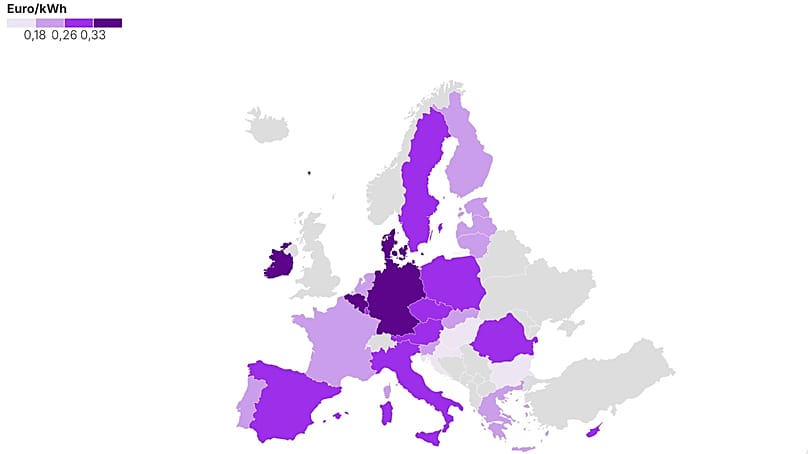
However, it is Ireland, which officially ended coal power generation in 2025, that tops the leaderboard, with electricity prices at a sky-high €0.40/kWh.
Below are the full EU rankings:
- Ireland: €0.40
- Germany: €0.39
- Belgium: €0.35
- Denmark: €0.33
- Austria: €0.33
- Czechia: €0.32
- Italy: €0.30
- Romania: €0.29
- Cyprus: €0.28
- Sweden: €0.27
- Poland: €0.27
- Spain: €0.27
- Luxembourg: €0.27
- France: €0.26
- Netherlands: €0.26
- Latvia: €0.25
- Portugal: €0.24
- Greece: €0.24
- Estonia: €0.23
- Finnland: €0.23
- Slovenia: €0.21
- Lithuania: €0.20
- Slovakia: €0.19
- Croatia: €0.17
- Bulgaria: €0.14
- Malta: €0.13
- Hungary: €0.11
Why is Germany’s electricity price so high?
Despite Germany’s renewables boom, the price of electricity remains tied to volatile fossil fuels due to what is known as the merit order principle. This ensures that electricity prices are based on the most expensive power plant still needed to meet demand.
So, if Germany’s electricity needs cannot be covered solely by clean energy, more expensive (and polluting) sources such as coal or gas step in.
Adding more renewables can tackle this problem, as proven in Spain – where wind and solar growth have reduced the influence of fossil generators on the electricity price by 75 per cent since 2019.
While Spain had a similar share of electricity from wind and solar as Germany in 2025, other clean sources such as hydropower and nuclear, have significantly reduced its reliance on fossil fuels. Last year, clean energy made up 75 per cent of Spain’s electricity mix, compared to 59 per cent in Germany.
However, the broader context is critical. According to Montel’s Clean Power Progress report, Germany’s power mix has undergone a huge transformation following its nuclear phaseout.
In 2022, nuclear generation – which is often categorised as clean energy despite environmental concerns around harmful waste – contributed to 6.6 per cent of Germany’s total power production.
“Removing that source of firm, low-carbon power created a sizable gap that needed to be filled quickly, either by fossil generation or by accelerating renewables," the report states.
Following its rapid growth in wind and solar, experts say that Germany’s “renewed momentum” could become clearer in 2026, as fossil displacement continues to compete with demand.
Why does Germany waste clean energy?
But as Jannik Schall, co-founder of 1KOMMA5°, points out: “Germany does not have too much cheap wind and solar power, but too little flexibility in the system.”
Last year, Germany spent €435 million euros on renewable energy curtailment. This involves intentionally shutting down electricity production in areas of oversupply and ramping up supply elsewhere.
Compensation payments are given to suppliers who cannot feed their electricity into the country’s energy grid, and balancing payments are given to producers needed to close the supply gap.
Curtailment frequently occurs when a country sees ideal conditions for solar and wind (such as sunny, windy days) resulting in more electricity being produced than the grid can handle. When supply outstrips demand, this can result in negative energy prices.
Solving this issue is no easy feat, as Europe’s energy grid was never designed with the renewables boom in mind – and is instead set up for centrally-located plants. This means that wind and solar energy, which tend to be produced in remote areas, often can’t get to homes and offices.
Battery energy storage systems (BESS) have been touted as a silver bullet to fix this problem, and can help prevent huge amounts of clean energy from being wasted.
According to a 2026 Solar Power Europe report, despite a tenfold expansion of the EU battery fleet since 2021, reaching more than 77 GWh today, Europe remains “far from where it needs to be”.
To meet its 2030 targets, the EU must repeat its tenfold growth once again – scaling battery storage towards 750GWh within the next five years. Five EU markets delivered more than 60 per cent of all new BESS capacity in 2025, with Germany and Italy leading the race.
Germany’s expensive taxes
Germany’s electricity prices are also hugely influenced by costly grid fees and taxes.
1KOMMA5° found that households would only be paying €0.26/kWh if it weren’t for levies. This would make electricity prices cheaper than in Belgium, Luxembourg, and the Netherlands.
"We could significantly reduce grid charges if, for example, redispatch measures were better avoided, i.e. the short-term shutdown or start-up of power plants," Schall adds.
“Instead of shutting down generation plants for compensation, an intelligent control system enables the forward-looking shifting of electricity volumes between storage systems and flexible consumers. This reduces grid costs for everyone in the long term."