


















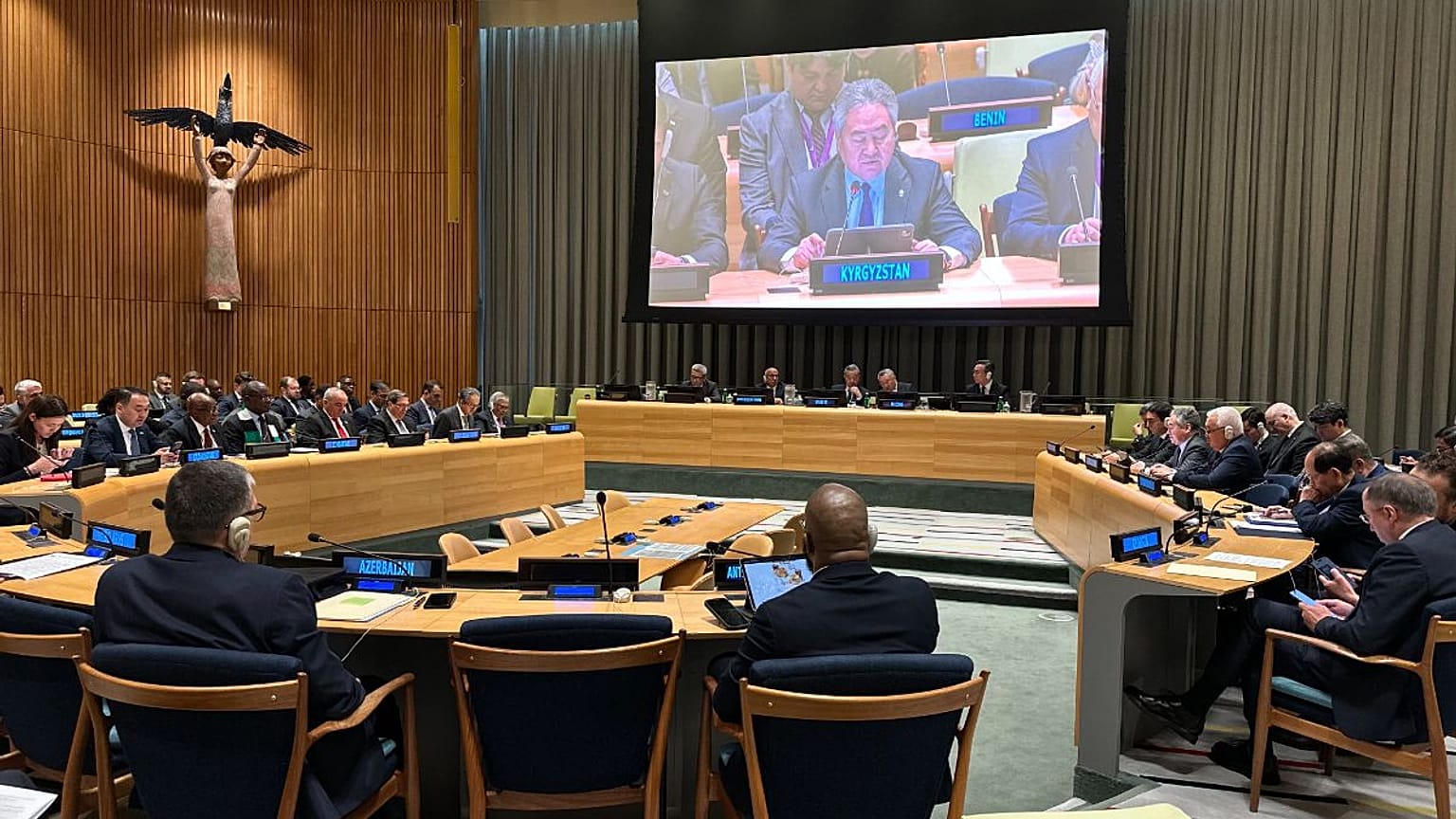













As he announced his country's candidacy for a non-permanent seat on the UN Security Council, Kyrgyzstan's Foreign Minister Jeenbek Kulubaev called for its reform to include greater representation from Asia, Africa and South America.
Kyrgyzstan's Foreign Minister Jeenbek Kulubaev has called for a broader representation and inclusion of smaller states in the United Nations Security Council, stating that his country would serve as a bridge-builder if the reform were implemented.
 ADVERTISEMENT
ADVERTISEMENT
ADVERTISEMENT
"The foreign minister advocated strengthening the central coordinating role of the UN, based on the principles of international law, sovereign equality of states, mutual respect, and non-interference in internal affairs," the Kyrgyz foreign ministry said in a statement.
"Special attention was given to the relevance of reforming the UN Security Council by expanding the representation of countries from Asia, Africa, and Latin America," the statement said.
Addressing the UNSC, Kulubaev called for reform of UN representation, an issue that has been raised repeatedly by other Central Asian countries.
He reaffirmed his country's general stance that, while the UN Charter has remained the foundation of international order for nearly eight decades, the world today faces new threats, from armed conflicts and violations of international law to climate risks, food and energy insecurity.
“No single state can address modern-day threats alone, that is why multilateral diplomacy is critical," Kulubaev said.
In its UN reform pitch, Kyrgyzstan advocated for more equitable representation of developing, small and landlocked countries. Kulubayev stated that the UNSC should not be perceived as a closed club, and its decisions should take into account the interests of all countries.
He noted that Kyrgyzstan has a strong determination to contribute to the maintenance of international peace and security and outlined Kyrgyzstan’s key priorities should it be elected to the UNSC, including advancing the agenda of sustainable peace, preventive diplomacy, the protection of vulnerable populations, climate security and the strengthening of trust among states.
"Kyrgyzstan views participation in the Security Council as an opportunity to make a practical contribution to strengthening multilateral cooperation, preventing conflicts, and enhancing joint international efforts to address traditional and emerging threats, including terrorism, transnational crime, cyber threats, climate change, and epidemics," the foreign ministry said.
Kulubaev further noted that, if entrusted by the international community, Kyrgyzstan would serve as a reliable partner committed to international law, the UN Charter and the dignity of every individual.
The UN General Assembly has been debating UNSC reform since 1993, and formal negotiations have been under way for nearly 30 years without producing agreement.
Africa and Latin America hold no permanent seats on the 15-member Council, despite Africa comprising roughly 25% of the UN's 193 member states.
Several proposals have emerged over the years, including expanding the UNSC to up to 26 seats with six more permanent ones reserved for Africa, Asia, Latin America and western Europe. Other initiatives have pushed for alternatives, such as longer rotating terms for more countries.
The current five permanent members — the US, UK, France, Russia and China — hold veto powers dating back to post-World War II agreements.
In October 2025, UN Secretary-General António Guterres told the UNSC that reform was "imperative and long overdue," saying expansion was key for Africa, Latin America, the Caribbean and the Asia-Pacific, which bear much of the burden of peacekeeping but have little formal power.