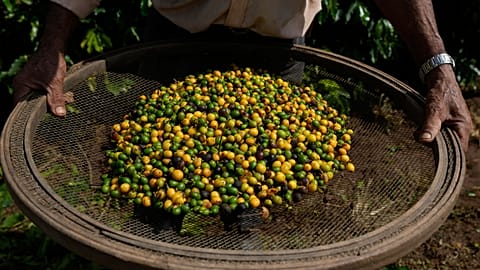































Mezcal production in Mexico has gone from about 1 million litres in 2010 to more than 11 million in 2024.
Thirty years ago, a single light bulb would illuminate the mezcal distillery owned by Gladys Sánchez Garnica's family in rural Oaxaca, where the agave-based spirit was made through the night.
 ADVERTISEMENT
ADVERTISEMENT
ADVERTISEMENT
As drops dripped from a clay oven, Garnica and her siblings listened to stories told by their parents while neighbours arrived by horse to get a taste of a drink known for its smoky flavour.
“We were taught when to harvest agave, how to care for the soil, and how much we could ask of the forest,” says Garnica, 33, speaking from a women-owned distillery in San Pedro Totolapam, a town of just over 3,000 residents in Mexico's Oaxacan Central Valleys, where much of the economy depends on mezcal.
Today, that small-scale tradition exists alongside a global boom that has transformed mezcal into a major industry dominated by international brands.
Mezcal's growing environmental cost
As mezcal has spread to bars around the world, so has its footprint on the land. Along the road to communities like San Luis del Rio, where celebrity brands such as Dos Hombres, created by actors Bryan Cranston and Aaron Paul from the hit series Breaking Bad, are made, agave plantations now blanket hillsides that were once forest. While the boom has brought economic benefits for many local producers, it's also led to rising environmental costs.
Production in Mexico has gone from about 1 million litres in 2010 to more than 11 million in 2024, according to COMERCAM, the country’s mezcal regulatory body. Nearly all is produced in Oaxaca, but less than 30 per cent remains in Mexico. About 75 per cent of exports go to the United States.
In two major mezcal producing areas of Oaxaca, more than 34,953 hectares of tropical dry and pine oak forests have been lost in 27 years to make room for agave, an area roughly equivalent to the size of the Belarusian capital Minsk, according to a study led by Rufino Sandoval-García, a professor at the Technological University of the Central Valley of Oaxaca.
The study found that agave plantations in the two areas have expanded by over 400 per cent the past three decades, increasingly replacing forests and farmland with a species of agave known as espadin, used in most commercial mezcal.
That is accelerating soil erosion, reducing by 4 million tonnes per year the amount of carbon dioxide captured by forests, limiting the land’s ability to recharge groundwater and creating heat islands in heavily planted areas, according to the study.
One litre of mezcal can require at least 10 litres of water for fermentation and distillation, and generates waste such as bagasse and vinazas, acidic residues often dumped untreated into rivers. Large quantities of firewood are also burned to roast agave pineapples and fuel distillation, much of which comes from illegal logging, according to Sandoval-García.
Water is a growing concern
For generations, the environmental impacts of the spirit remained limited by its small scale and the ability of surrounding forests and soils to recover. That balance is now fragile.
Water is an increasing concern across Oaxaca, which experienced its worst drought in more than a decade in 2024, according to Mexico’s National Water Commission.
While major companies highlight sustainability commitments, their third-party contracts with distilleries are typically limited to purchasing mezcal in bulk. Producers say those agreements rarely cover the costs of raw materials, workers’ wages or maintenance of their distilleries.
Del Maguey, one of the world’s top-selling mezcal brands, says they are working to reduce their environmental footprint by planting trees. Over the past five years, the company reused more than 5,000 tonnes of bagasse and 2 million litres of vinaza to build a raised platform at a distillery in San Luis del Rio to prevent flooding and contamination, according to its head of sustainability, Gabriel Bonfanti.
Mezcal income is a lifeline for communities
For many, the boom has been a lifeline in a region with some of the highest poverty rates in Mexico.
Luis Cruz Velasco, a producer from San Luis del Rio who works with Mexican brands like Bruxo, said the growth has created jobs for nearly every family in his town of about 300 residents. Where previous generations lived in thatched houses, mezcal income has helped his siblings to attend university.
“There are many people who criticise us for what we do to the forest, and yes, we know it affects it,” Velasco said. “But we have to look for a livelihood and food.”
For Velasco, the problem is not the entry of large brands, which he says have done more than the government to support marginalised areas like his, but the lack of public incentives for farmers to safeguard environments by planting native trees or maintaining traditional farming systems.
Bureaucracy fuels illegal land clearing for mezcal production
In Oaxaca, much land is communally owned and managed through local systems of self-governance. Converting forest into agave plantations requires federal approval from Mexico’s Secretary of Environment and Natural Resources.
The permitting process is so slow and bureaucratic that some communities choose to bypass it, said Helena Iturribarria from Tierra de Agaves, a conservation project to reforest parts of Oaxaca’s valleys and promote sustainable agave production.
The Secretary of Environment said in a statement it had not received requests for forest clearing for agave cultivation in the past three years in Oaxaca. The agency also said it was investigating nine public complaints filed since 2021 over illegal land clearing for mezcal production.
In 2018, Garnica founded a collective of women called the Guardians of Mezcal. The group is promoting mezcal produced by women using sustainable practices, including using only fallen trees for firewood and planting agave alongside other crops.
With help from Tierra de Agaves, Guardians of Mezcal and local community officials from Santa Maria Zoquitlan secured projected status for 26,000 hectares of forest surrounding the town.
“Mezcal is a way of life, like a form of work that our parents taught us, so it really means a lot,” Garnica said.