















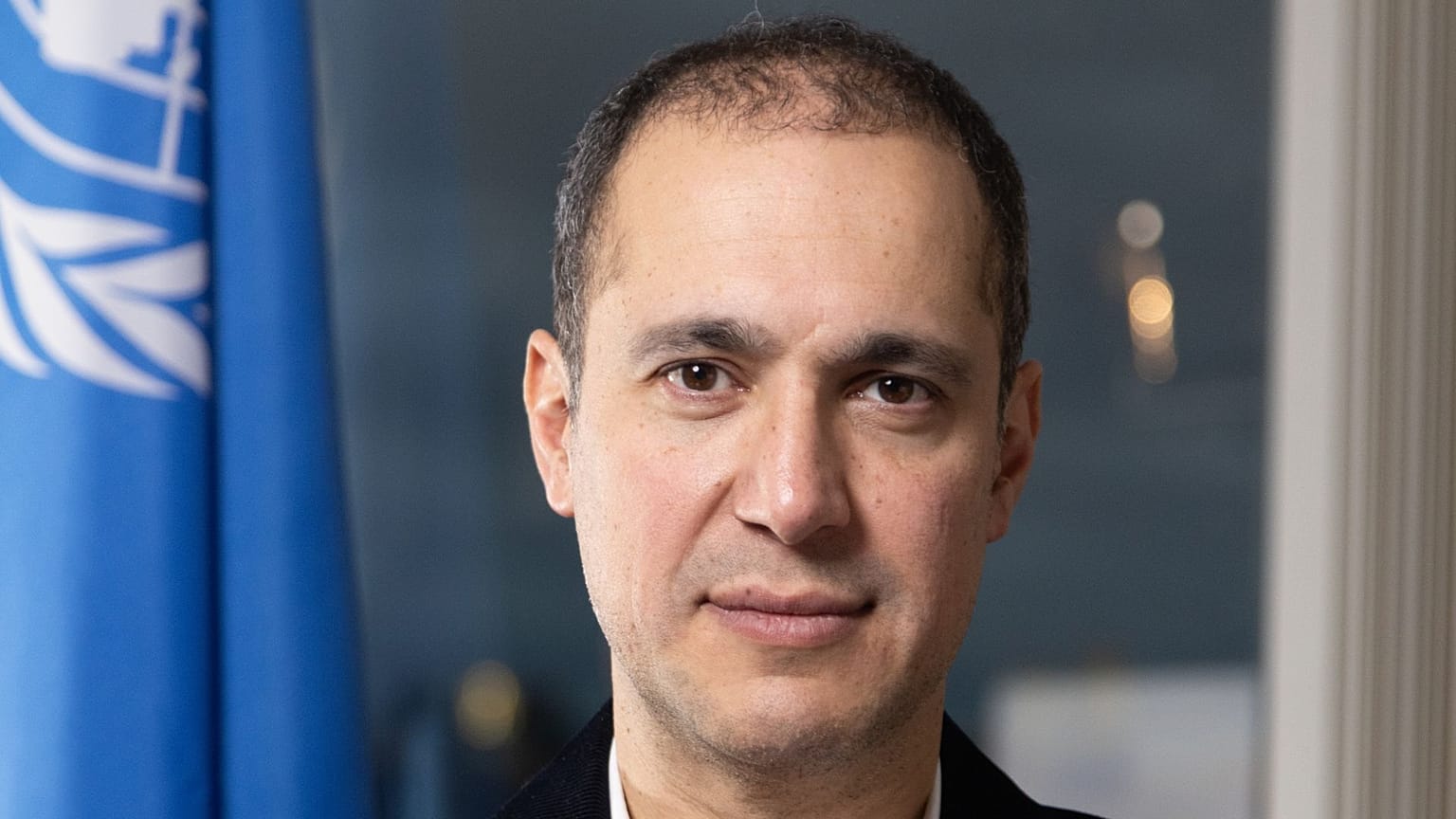













The Stockholm Water Prize, handed to Kaveh Madani, celebrates outstanding contributions to the sustainable use and protection of water resources.
Growing up in post-revolutionary Tehran, Kaveh Madani was exposed to water scarcity and war-strained infrastructure from birth.
 ADVERTISEMENT
ADVERTISEMENT
ADVERTISEMENT
So being awarded the prestigious Stockholm Water Prize – known as the ‘Nobel Prize of Water’– at just 44 seems like destiny.
Despite being the youngest ever recipient of the prize, Madani’s career has been long and winding. Having given up a respected academic career in Europe to return home as Deputy Head of Iran’s Environment Ministry, he was soon exiled as an enemy of the state.
Once labelled a “water terrorist”, he now serves as Director of the United Nations University Institute for Water, Environment and Health (UNU-INWEH) – the ‘UN’s Think Tank on Water’ – sharing his expertise with governments around the world.
Madani is the first UN official and first former politician to receive the prize in its 35-year history.
‘Water bankruptcy’: Exposing systemic failures in global water systems
Beyond his personal story, Madani's most significant contribution to global water science may be the concept of ‘water bankruptcy’ – a term he coined to replace the more commonly used ‘water crisis’.
His argument is subtle but important: a crisis implies a temporary shock that can be recovered from. Bankruptcy, on the other hand, is a state of systemic failure – and possibly a point of no return.
In a landmark UN report published in January 2026, he declared that the planet has now entered the era of global water bankruptcy, with many river basins and aquifers having lost their ability to recover to their historical conditions.
From ‘water terrorist’ to ‘Water Nobel’ laureate
Criticising systemic failures in Iran, however, landed Madani in hot water.
The country’s water mismanagement is a politically sensitive issue, with water-intensive crops viewed as necessary to national security in the face of international sanctions.
Madani’s environmental advocacy saw him swept up in the 2018 Islamic Revolutionary Guard Corps (IRGC) crackdown on Iranian environmental experts.
State-aligned media branded him a “water terrorist” and “bioterrorist”, accusing him of using water and environmental projects as a cover for foreign espionage.
Madani was forced to resign from his government position and flee the country that same year. His colleague, conservationist Kavous Seyed-Emami, died in custody under suspicious circumstances.
Having dismissed his warnings, Iran still faces an escalating water crisis that sparked water cuts and yet more protests earlier this year. The onset of the war on Iran is only deepening the disaster, with pollutants seeping into waterways and desalination infrastructure across the region under threat.
‘The most followed water scientist in the world’
With nearly a million social media followers, Madani's voice isn't being ignored the world over.
Using documentaries, viral digital campaigns and accessible storytelling, he has translated complex hydrological data into content that has mobilised a generation of younger climate activists.
This belief that ordinary people must be part of the solution shapes his scientific approach, too. Most water management models assume that farmers, governments and developers will cooperate to find the fairest outcome – but Madani argues that's rarely how it works in practice.
When a farmer isn't sure their neighbour will reduce water use, for example, they have no incentive to reduce their own. Both take more than they need, and the shared resource collapses.
By applying game theory – “the mathematics of cooperation and conflict”, as Madani once described it in a Reuters interview – to water governance, Madani's models account for this reality, making them far more useful for policymakers navigating real-world water conflicts.
In his role as a UN official, Madani advocates at the highest level for making water a central pillar of global climate negotiations, viewing it as the backbone of peace, security and sustainability.