

















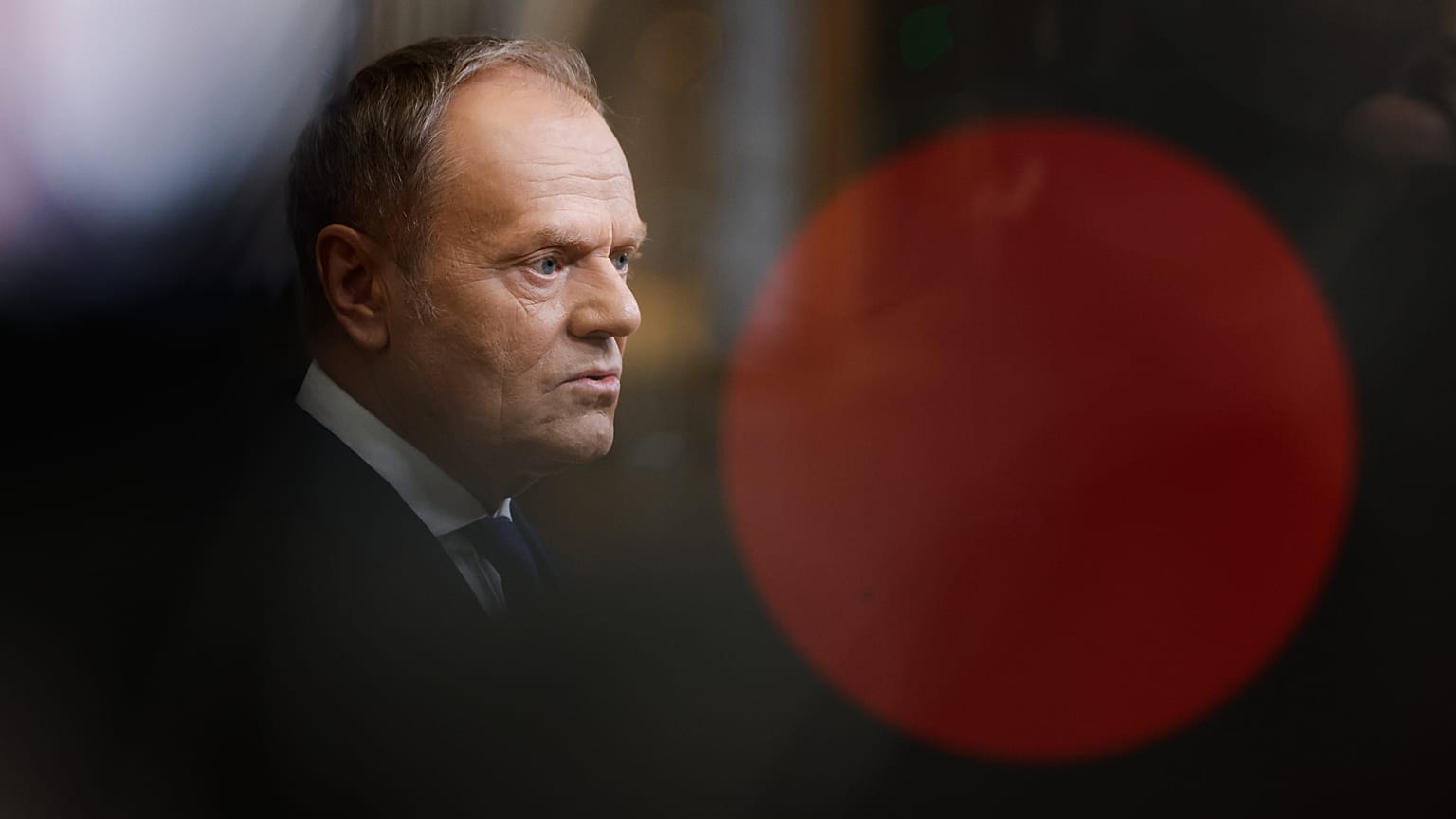













A power struggle erupted in Poland as Premier Donald Tusk insisted Friday he would access €43.7 billion in EU defence funds, defying President Karol Nawrocki’s veto over what he said was a decision going against Poland's sovereignty.
Polish Prime Minister Donald Tusk vowed Friday to access €43.7 billion in EU defence loans despite a presidential veto against legislation enabling the funds.
 ADVERTISEMENT
ADVERTISEMENT
ADVERTISEMENT
"Poland is in shock," Tusk said. "People are wondering if this is treason, the work of lobbyists, or a lack of common sense."
President Karol Nawrocki said Thursday he is vetoing the bill that would allow Poland to tap into the EU's Security Action for Europe (SAFE) initiative.
"I would never sign a law that strikes at our sovereignty, independence, economic and military security," Nawrocki said.
"At this point, I warn that any attempts to increase our country's foreign debt in an illegal manner, through the back door, will sooner or later be met with responsibility, both political and legal."
Poland was set to be the largest beneficiary of the EU's €150 billion programme designed to boost Europe's defence readiness as the US diminishes its role in the continent's security.
Nawrocki argued the loan would burden Poland for decades. "Politicians who now want a loan from SAFE must remember — this loan will burden our children and grandchildren for many years," he said.
He claimed interest costs could reach 180 billion złoty (€42.1 billion). "Poles will therefore have to pay back as much as the value of the loan granted, and Western banks and financial institutions will profit from this," the Polish president said.
Tusk said the veto will not prevent the government from accessing the defence funds, but "it will be more difficult, sometimes slower, and it will take much more effort to convince everyone involved in this project."
He assured that military modernisation would continue. "The president's veto will not stop us, we will not allow this opportunity to be wasted. The Polska Zbrojna programme will make us build full sovereignty," Tusk said.
A European Commission spokesman said Friday the EU was determined to continue implementing plans with Poland "without delay". An advance payment could be made as early as April, he said.
Nawrocki, who has positioned himself as Tusk's main opponent, argues that Poland's participation in SAFE will leave Poles indebted and increase the country's dependence on Germany.
On Tuesday, he proposed an alternative draft law suggesting national resources could be used instead of European loans for defence investments. Tusk dismissed the option as unrealistic. The government rejected the proposal as unsupported by concrete analysis.
"SAFE is a project written not in Brussels, but in Warsaw," Defence Minister Władysław Kosiniak-Kamysz said.
"The European Commission adopted the proposal at Poland's request and at our dictation, not the other way around," he added.
"None of the proposals made by the Polish army staff have been changed. It was the Polish generals who wrote the proposal for the modernisation of the army, for which we found the money."
"Withdraw from this because history will not forget you," Kosiniak-Kamysz said. "We will make the Polish army the strongest in Europe by 2030."
Przemysław Czarnek, PiS candidate for prime minister for the next election in November 2027, told the Sejm that "Poles will not repay this because it is an illegal loan". He argued that Poland must sign an international agreement approved by both the Sejm and the president to take out a loan of this size.
Tusk government's "Plan B" after the veto is a resolution to establish the Armed Poland programme, which would allow it to use existing defence funding mechanisms, such as the Armed Forces Support Fund.
The dispute moved to the Sejm, where a fierce argument erupted between MPs during the debate.
Successive Polish governments have boosted defence spending since Russia's full-scale invasion of neighbouring Ukraine in early 2022.
But while Tusk's liberal government seeks to coordinate with the EU, Nawrocki has been more sceptical of the 27-member bloc and has maintained friendlier relations with Washington, which has also openly criticised SAFE.
Poland already has one of the highest defence spending rates among NATO countries, exceeding 4% of GDP.