




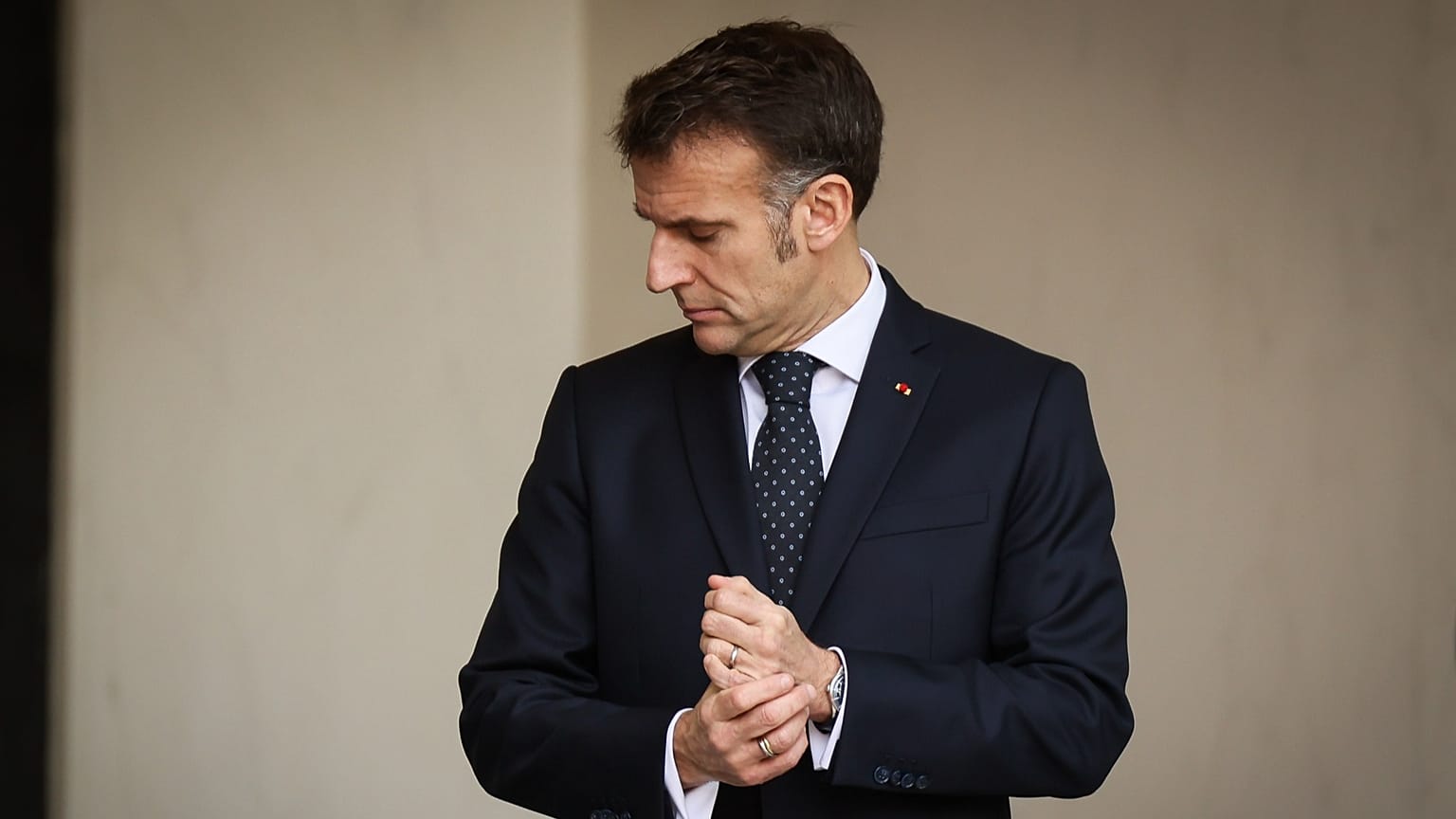














The French president's speech is expected by European partners, amid concerns about Russia and uncertainties regarding the reliability of the US nuclear umbrella.
French President Emmanuel Macron will outline France's nuclear deterrence doctrine on Monday at the Île Longue submarine base in an address expected to clarify how French nuclear weapons could protect European allies.
 ADVERTISEMENT
ADVERTISEMENT
ADVERTISEMENT
The speech, scheduled for next Monday at the base in north-western France that houses the country's four nuclear-armed submarines, comes as European leaders question the reliability of US security guarantees under the administration of US President Donald Trump.
The Élysée said the speech "will be an important moment in his term of office" with "undoubtedly some significant shifts and developments" expected, while stressing France's nuclear offer "is in no way in competition with NATO".
"There are high expectations from the allies and partners, and maybe also the adversaries, about how the French nuclear doctrine could evolve," said Héloïse Fayet, a nuclear deterrence specialist at the French Institute of International Relations.
Monday's speech represents an opportunity for Macron to "clarify everything and to propose real concrete ideas and suggestions for a greater role of French deterrence in Europe," Fayet added.
Decision remains French
Macron's address will be his second major speech on nuclear deterrence since his election in 2017, following a 2020 address in which he proposed a "strategic dialogue" with European partners on France's nuclear role.
The 2020 offer received little response at the time, but European attitudes have shifted since Russia's full-scale invasion of Ukraine and renewed doubts about US commitments under Trump's second term.
German Chancellor Friedrich Merz said earlier this month he had held "initial talks" with Macron about nuclear deterrence and theorised publicly about German Air Force planes possibly carrying French nuclear bombs.
France remains the only nuclear-armed member of the EU and has fewer than 300 warheads, which Macron said in 2020 is sufficient to inflict "unacceptable damage" to any country threatening France's vital interests.
Fayet stressed there is no plan to share the decision to use nuclear weapons.
"It will always be up to the French president to decide, and there is not the idea of the allies paying for the French nuclear deterrence," she said.
"If one day there is a reason that we cannot believe anymore in the US security guarantee, that all the forces, both nuclear and conventional, have withdrawn from Europe, in that regard, yes, France and the UK will really have to step up, maybe increase the number of warheads, but the most important thing, I think, is to prevent national proliferation," Fayet added.
Nuclear shift at play
The geopolitical context for nuclear weapons has shifted significantly in recent years.
Russia revised its deterrence policy in 2024, lowering its threshold for possible nuclear retaliation. China and North Korea are expanding their nuclear arsenals, while the US has considered resuming nuclear tests.
In October, Trump spoke about intentions to resume nuclear tests for the first time since 1992, although US Energy Secretary Chris Wright later said that such tests would not include nuclear explosions.
The UK has announced plans to buy nuclear-capable US-made F-35A fighter jets, restoring a capacity to deliver nuclear airstrikes that it phased out in the 1990s, leaving it with just submarine-based nuclear missiles.
The chosen site for Macron’s speech on Monday — the Île Longue base for France’s four nuclear-armed submarines — will drive home that French presidents also have nuclear muscle at their disposal in an increasingly unstable world.
Each can carry 16 M51 intercontinental ballistic missiles, each armed with multiple warheads.