




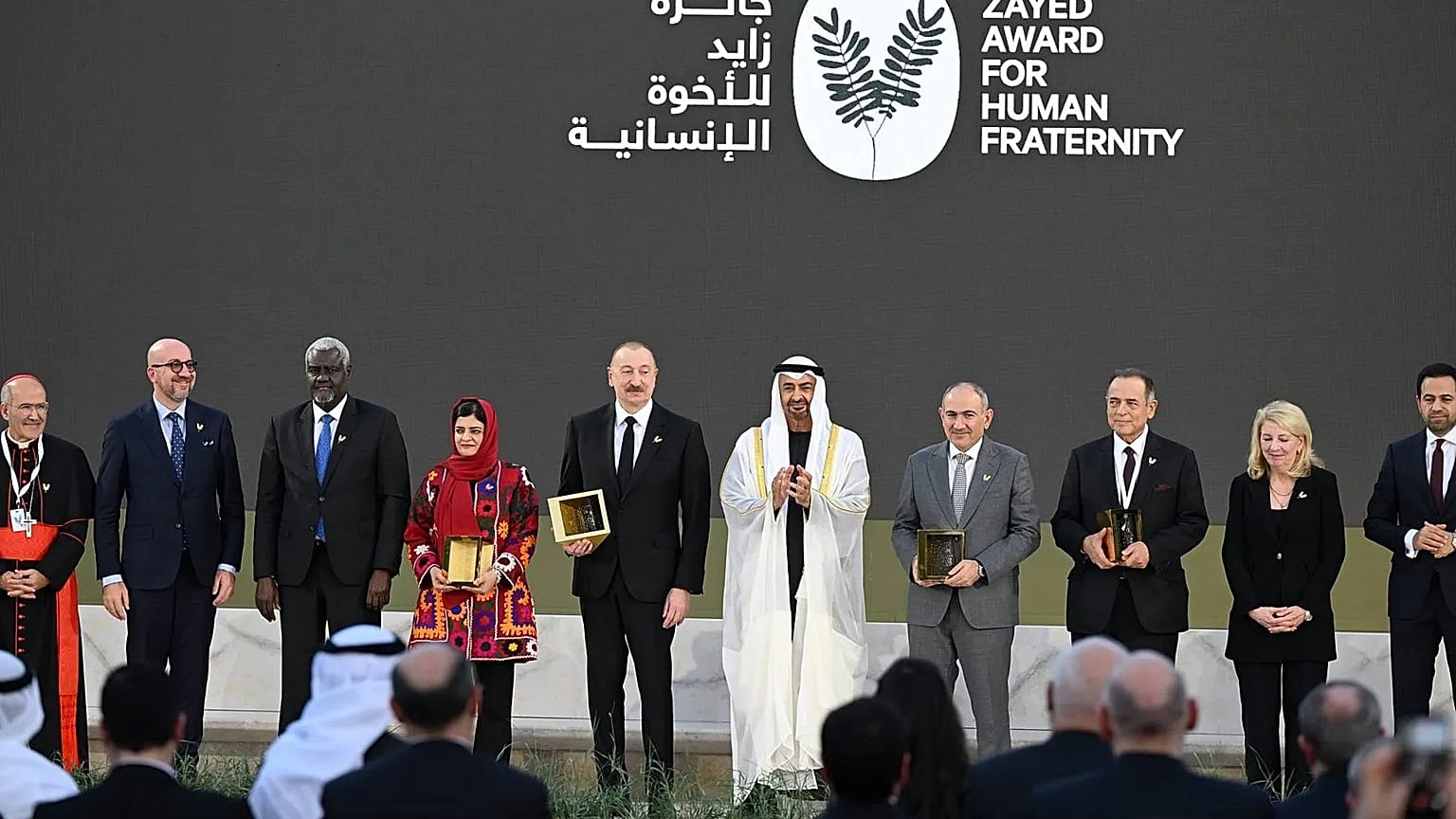













At the 2026 Zayed Award for Human Fraternity held in Abu Dhabi, world leaders highlighted dialogue, compromise and practical peace.
World leaders gathered this week at the 2026 Zayed Award for Human Fraternity in Abu Dhabi, where the landmark peace agreement between Azerbaijan and Armenia received recognition.
 ADVERTISEMENT
ADVERTISEMENT
ADVERTISEMENT
The ceremony, hosted by UAE President Sheikh Mohamed bin Zayed Al Nahyan, honoured Azerbaijani President Ilham Aliyev and Armenian Prime Minister Nikol Pashinyan for their roles in ending decades of conflict between their countries.
"True peace is measured in the everyday lives of our people, in the freedom to travel, trade and interact without fear," Aliyev said, noting that six months of cooperation have brought stability and optimism to communities.
Aliyev said ordinary citizens are witnessing change through reopened roads, renewed trade flows and improved energy access.
"When dialogue is translated into action, every market, every street and every home feels the difference," he said.
Aliyev stressed that leadership is judged by results, not documents.
"An agreement becomes meaningful when it delivers visible benefits — jobs, services and opportunities for our people," he said, pointing to transport, trade and energy initiatives.
Aliyev thanked international partners for helping transform negotiations into improvements for citizens, saying lasting peace requires implementation, not just agreements.
"Leadership is not just about decisions in meetings; it is about creating conditions where people feel safe, secure and optimistic every day," Aliyev said.
Addressing the event, Armenian Prime Minister Nikol Pashinyan emphasised that in the past, it would have been unthinkable for such a prestigious award to be presented simultaneously to the leaders of Azerbaijan and Armenia.
He stated that the presentation of this award also confirms that both Armenia and Azerbaijan have turned the page on the conflict.
The Armenian prime minister described the award as an expression of international community support for both countries.
He noted that the decision of the judging committee, which includes highly respected members from around the world, would further strengthen peace in the region. He stressed that efforts would continue to ensure peace and trust between the two peoples.
Pashinyan also expressed special gratitude to US President Donald Trump for his contribution to achieving the peace agreement and for his efforts in this direction.
He further conveyed his sincere thanks to the president of the United Arab Emirates for the award and expressed appreciation to all participants in this important event.
Mirziyoyev: Peace needs courage, dialogue and compromise
Uzbekistan's President Shavkat Mirziyoyev said in a video message that peace requires political courage, dialogue and compromise.
He congratulated Aliyev and Pashinyan, calling their joint work toward peace "a vivid example of a responsible approach" and "a historic step toward ensuring stability in the region."
"In today's volatile world, peace does not come on its own. It requires the courage to listen, to compromise and to take responsibility," Mirziyoyev said, adding that lasting trust between nations could only be built through political and diplomatic solutions based on international law and good neighbourly relations.
He thanked the UAE leadership for promoting humanitarian initiatives and strengthening dialogue, describing Abu Dhabi as an emerging global centre for peace.
Saida Mirziyoyeva, head of the Presidential Administration of Uzbekistan, attended the ceremony as a member of the award's jury and congratulated the 2026 laureates, noting the Azerbaijan-Armenia agreement showed even complex conflicts could be resolved.
Tokayev fetes conflict resolution through dialogue
Kazakhstan's President Kassym-Jomart Tokayev, speaking via video message while on a state visit to Pakistan, congratulated Pashinyan and Aliyev.
"The progress Azerbaijan and Armenia have made toward a peace agreement marks a turning point. This step demonstrates that even long-standing conflicts can be resolved through dialogue, responsibility and restraint," he said.
He noted Kazakhstan's role in hosting peace talks in Almaty.
"This fact reflects our shared conviction that there is no alternative to constructive dialogue as a tool for sustainable development," he said.
The Zayed Award for Human Fraternity, named after UAE founder Sheikh Zayed bin Sultan Al Nahyan, recognises efforts in coexistence, tolerance and human dignity.
Alongside the Caucasus leaders, Afghan women's rights activist Zarqa Yaftali and Palestinian humanitarian organisation Taawon were also honoured.
The Armenia-Azerbaijan peace agreement, brokered by the US in 2025, ended decades of conflict between the two countries. The agreement included provisions for reopening transport corridors, establishing diplomatic relations and resolving territorial disputes.