






























Six people died as Storm Kristin battered Portugal with winds reaching record speeds, causing widespread destruction and leaving around 1 million people without electricity.
Six people died as Storm Kristin swept across mainland Portugal with winds reaching 202 kilometres per hour, leaving a trail of destruction across eight districts and affecting electricity supply to around 1 million customers.
 ADVERTISEMENT
ADVERTISEMENT
ADVERTISEMENT
Three people died in Leiria, one in Marinha Grande, one in Silves and another in Vila Franca as the storm entered Portugal from the Leiria area on Wednesday before progressing inland.
The National Emergency and Civil Protection Authority recorded 5,400 incidents by 10 pm local time (11 pm CET) Wednesday.
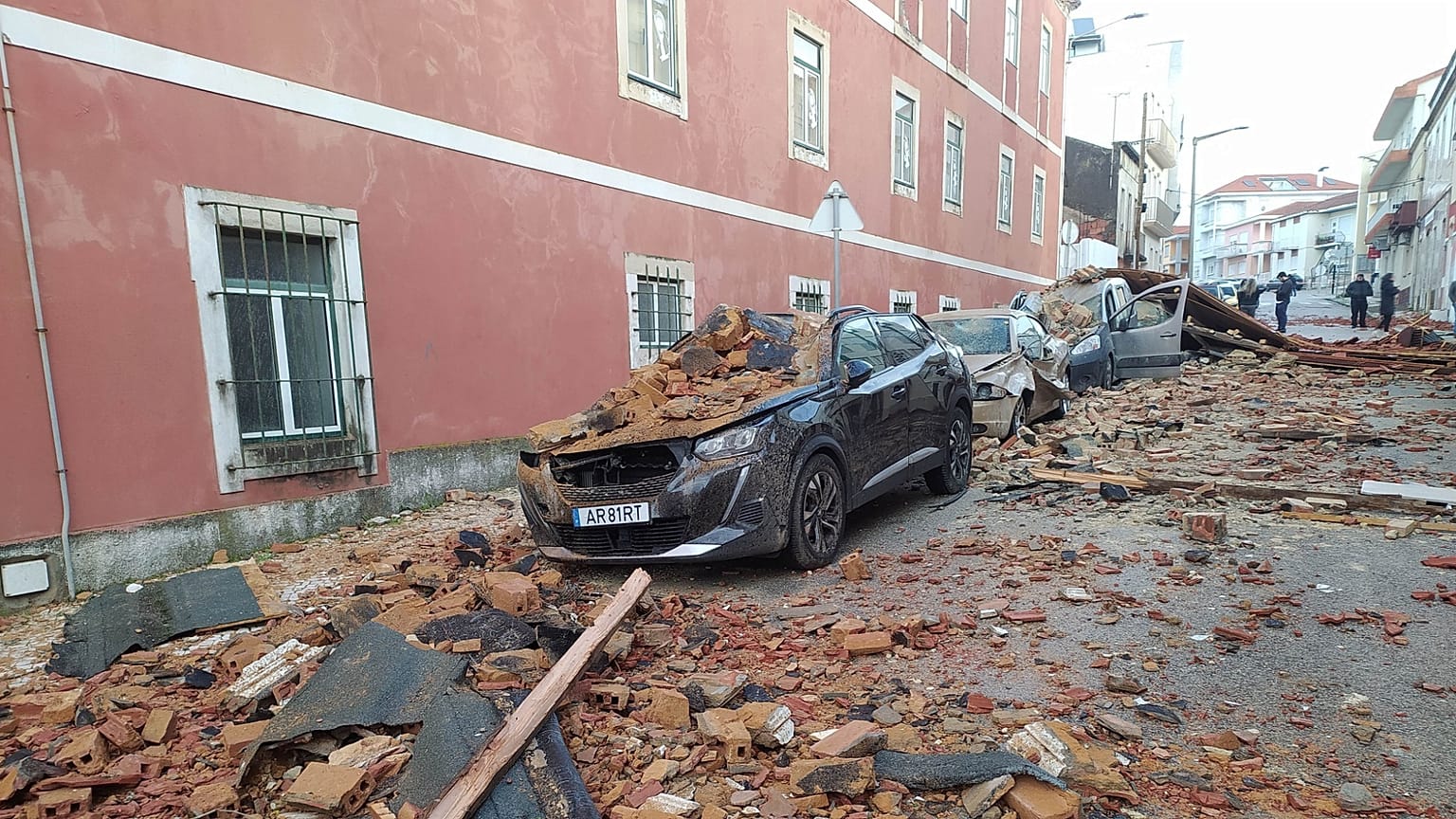
People were left homeless, stadiums damaged, roofs torn off, aircraft destroyed, a Ferris wheel toppled and railway lines suspended.
The highest wind gust reached 202 kilometres per hour at the peak of the storm's passage through municipalities including Coimbra, Figueira da Foz, Mira and Cantanhede, according to Carlos Tavares, Coimbra sub-regional commander of Civil Protection.
This broke Portugal's national record of 176.4 kilometres per hour set in Figueira da Foz on 13 October 2018 during Storm Leslie.
Monte Real Air Base recorded a gust of 178 kilometres per hour before being destroyed by the wind. Cabo Carvoeiro saw gusts of 150 kilometres per hour, whilst Ansião reached 146 kilometres per hour. In the Algarve, Faro recorded gusts of 100 kilometres per hour.
According to these figures, Kristin has reached either category 2 or even category 3 on the Saffir-Simpson Hurricane Wind Scale, which runs from 1 to 5.
Lisbon, Leiria, Coimbra, Castelo Branco, Portalegre, Santarém, Setúbal and Guarda were the worst-affected districts, according to the Portuguese Institute for the Sea and Atmosphere (IPMA).
'Dantesque scenes' in Leiria
Leiria was among the municipalities most affected by the storm. Mayor Gonçalo Lopes said recovery could take a year, emphasising that damage surveys were still being carried out.
"The damage hasn't been calculated yet, but it's unpredictable to calculate the damage it causes to people's lives," Lopes told Lusa news agency.
"We have Dantesque scenes of churches without roofs, sports centres without roofs, many houses without roof tiles, houses and cars completely destroyed, cranes overturned."
"It's a post-disaster scenario, very similar to what we usually see on television in a war," Lopes added.
An alert situation has been declared in the municipality. Lopes called for a "national response" from the government and urged authorities to decree a situation of calamity.
Portuguese Prime Minister Luís Montenegro visited the headquarters of the National Emergency and Civil Protection Authority on Wednesday. He expressed sorrow for the fatalities and said the government was in contact with local authorities in affected regions.
"An assessment is already being made of all the consequences on the ground and all the instruments we can use to restore the situation more quickly," Montenegro said. He did not rule out declaring a situation of calamity.
Any EU member state can request activation of the European Civil Protection Mechanism to help overcome catastrophic situations.
Rare meteorological phenomenon
The IPMA is treating Depression Kristin as a rare phenomenon, comparable only to storms that occurred in 2009 and 2018.
"This situation we sometimes call a small meteorological bomb. These small cores sometimes have an associated secondary zone of great intensity, which we call a 'sting jet'," Nuno Lopes from IPMA said during a press conference Wednesday at the Civil Protection Centre.
"It's a rare phenomenon, and unfortunately it fell in an area that had already been affected by Leslie and with the consequences that we saw," Lopes added.
The IPMA is predicting weather improvements as the Kristin depression moves away from Portugal towards Spain.
However, Porto, Viana do Castelo and Braga remain under red warning for sea turbulence during the night and early hours of Friday. The entire west coast is under an orange warning.
Wind will calm over the coming days, but rain will continue and could affect the Centre and North regions particularly hard. Eleven districts are under a yellow precipitation warning: four until 9 am local time Thursday (10 am CET), and the rest until noon.
The IPMA forecasts snow falling on the highest points of Serra da Estrela from mid-afternoon Thursday.
Despite the improvement in the weather, authorities warn that vigilance should be maintained.