




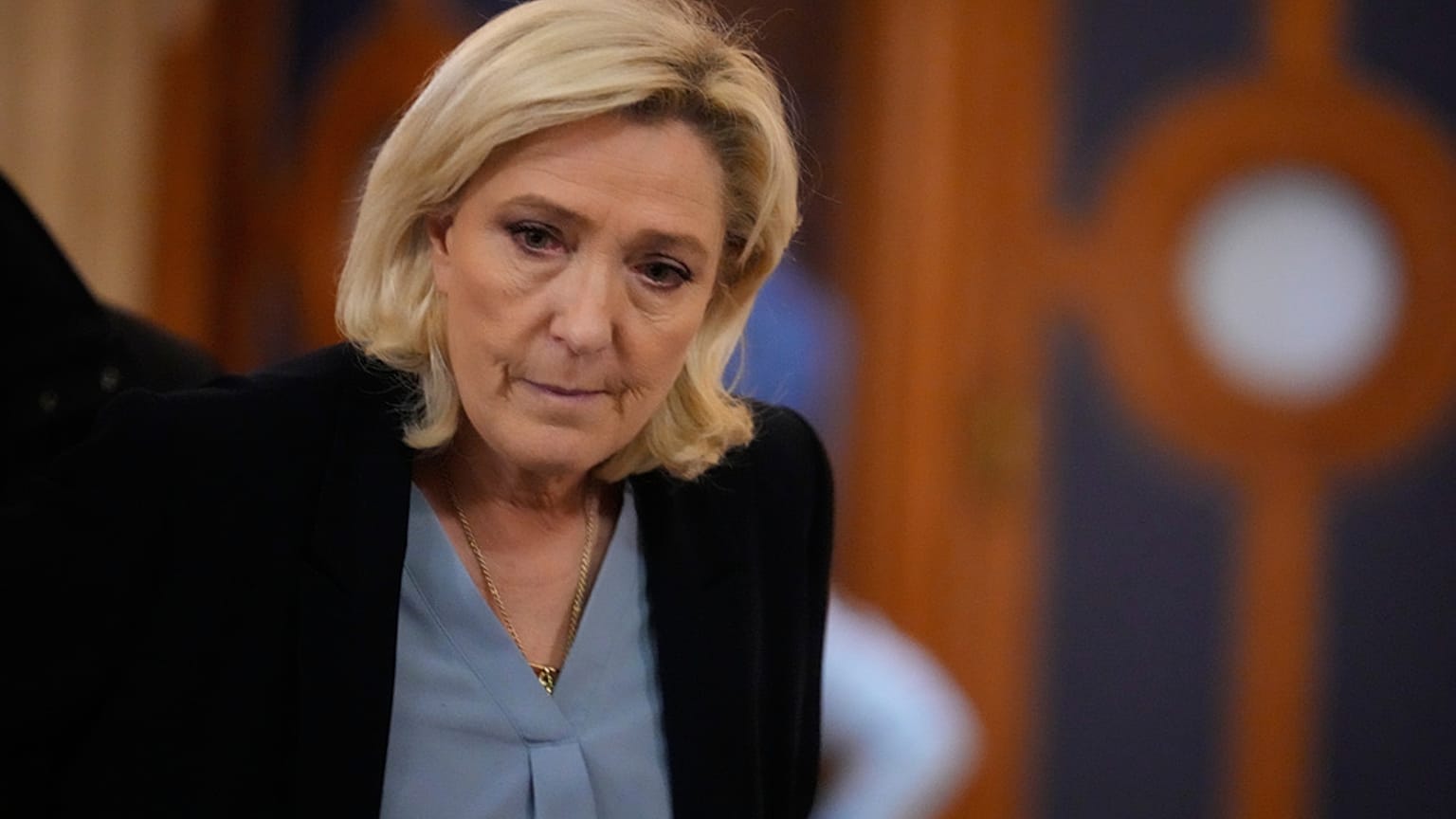













Back on the stand after a first day of hearings on Tuesday, Marine Le Pen continues to deny having run a coordinated scheme to misuse European Parliament funds.
Marine Le Pen spent more than ten hours at the stand on Wednesday, for a second consecutive day of questioning before a Paris court, as part of a crucial appeal trial that will determine whether she can run in next year's presidential election.
 ADVERTISEMENT
ADVERTISEMENT
ADVERTISEMENT
As on the previous day, she repeatedly defended her position and said she “formally” contests the existence of any generalised fraudulent system set up by the party to siphon EU funds between 2004 and 2016.
Prosecutors accuse Le Pen and ten other defendants of employing parliamentary assistants who were paid with EU money even though their actual work primarily benefited the French National Front party (renamed the National Rally in 2018).
During the initial investigation, magistrates accused the National Front of having put in place, starting in 2004, “a system of fraud” aimed at paying individuals who were in reality working for the party and not for the European Parliament.
On Wednesday, the court focused in particular on the case of Catherine Griset, a former parliamentary assistant to Marine Le Pen at the European Parliament.
As an accredited parliamentary assistant, Catherine Griset was required under European Parliament rules to be based in Brussels.
However, the investigation established that she had spent only around twelve hours there over the course of an entire year.
The former National Front leader acknowledged that Catherine Griset should have been working in Brussels, but insisted that she did carry out parliamentary assistant duties. According to Le Pen, Griset’s work for the party itself was merely “residual”.
Judges also examined the case of Thierry Légier, a bodyguard for the National Front who was paid as a European parliamentary assistant. Convicted at first instance, he did not file an appeal.
Le Pen accuses the European Parliament of acting 'in bad faith'
Marine Le Pen strongly criticised the European Parliament’s handling of the case. “I fully understand that this is my trial, not that of the European Parliament. But what I would like the court to note is that the European Parliament is not acting in good faith by bringing these contracts back into the discussion,” she said during the hearing.
She argued that it was widely known that Thierry Légier worked as a bodyguard and said the European Parliament could — and should — have raised concerns much earlier, noting that his first contract dated back to 1995.
Le Pen was also questioned by Patrick Maisonneuve, the European Parliament’s lawyer, about the combative statements she made following her conviction during the first trial.
Last year, Marine Le Pen slammed her initial conviction, claiming that she was a target of a "witch hunt".
She was sentenced to four years in prison, of which two aresuspended, a €100,000 fine, and, most importantly, a five-year ban from running for public office, effective immediately.
“Do you still hold the same view?” asked the EU Parliament lawyer. “You said this was not a judicial decision but a political one. Was it a political decision that undermined the rule of law?”
“Incontestably, I considered — and I still consider — that the decision to impose ineligibility with immediate effect, whether it affects me or someone else, is something eminently contestable,” she replied.
The stakes in this case are clearly very high. If her conviction is upheld, the National Rally leader will be unable to run in France’s 2027 presidential election.
Since her initial trial, the defence strategy of Le Pen has changed in tone. She now adopts a much calmer and more measured approach when facing the judges.
In response to a final question from the presiding judge, the National Rally leader summed up her defence in a composed manner.
“The analysis must be carried out on a case-by-case basis. The situations vary greatly depending on the assistants,” she explained.
Marine Le Pen said she was “convinced that none of those involved had any intention of committing an offence”.
The hearings are scheduled to conclude on 12 February, with a ruling expected before the summer.