


















As the appeal trial is set to begin on Tuesday, the president of the judicial tribunal is concerned that the United States may be influencing its outcome.
The appeals trial of Marine Le Pen, leader of France's far-right National Rally (RN) party, begins on Tuesday, and the outcome could significantly affect the country's next presidential election.
 ADVERTISEMENT
ADVERTISEMENT
ADVERTISEMENT
Le Pen was found guilty of misappropriating public funds and barred from running for office for five years "with immediate effect," a Paris court ruled in March.
Eight MEPs for the RN and their 12 assistants were also found guilty and barred from running for office. The party was fined €2 million.
The prosecutor also demanded that Le Pen be fined €300,000 and serve up to 10 years in prison.
The three judges were not obliged to follow the prosecutor's recommendations.
Instead, the Paris Criminal Court handed down a four-year prison sentence — two years suspended and two to be served with an electronic bracelet — along with a €100,000 fine.
Le Pen described the verdict as a "political witch-hunt" and declared she would exhaust all legal avenues to overturn it.
The first victim is the taxpayer
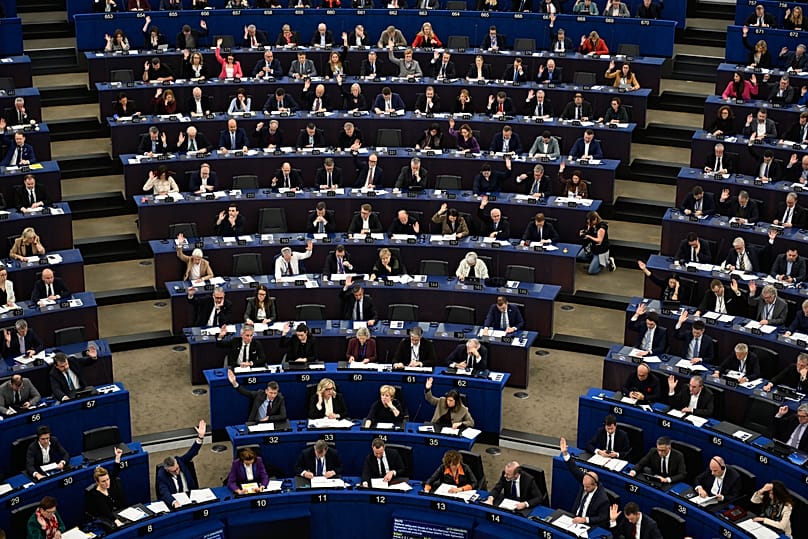
Following the initial court ruling last year, Patrick Maisonneuve, a lawyer for the European Parliament, criticised some reactions and questioning of the judges.
"I've heard the word 'victim' used by the RN. But the first victim, declared as such by the courts, is the European Parliament and therefore the taxpayer," he said.
In his view, the status of victim had been "politically hjacked" by the RN's leaders and supporters.
"I've heard people here and there express their astonishment or their confusion. What is disturbing is that €4m of European funds could be misappropriated," he added.
Later, he said he was convinced of the guilt of those connected with the part and is in no doubt as to what will happen next.
"There are now two things: the conviction will be confirmed and the European Parliament will have to be reimbursed. The European Parliament is the victim, so we mustn't reverse the roles," he insisted.
A decision by the Court of Appeal is expected to be handed down before the end of the summer. The timing will allow Le Pen to announce, or not, her candidacy for the 2027 presidential election.
If her conviction is upheld, she is expected to give up her bid and potentially hand over to RN party President Jordan Bardella.
For Marine Le Pen, cassation as a last resort
However, Le Pen may have one final option to secure her political ambitions if her sentence is upheld and that is to file an appeal with the Supreme Court.
Christophe Soulard says that the Court of Cassation, which he chairs, will issue its ruling "if possible" before the presidential election.
"The judges are not out of touch with reality. They are well aware that there will be a presidential election in 2027 and that MarineLe Pen is obviously an important candidate, so the timing of the ruling may have an impact," he told reporters last week.
"If there is a ruling upholding the case and there is an appeal to the Court of Cassation, which has not yet happened, then the Court of Cassation will, as far as possible, try the case fairly quickly," he explained, adding that this is "something we do regularly" and that this treatment would not be "especially for Marine Le Pen."
However, in November, Le Pen said she would "obviously not" stand for election if she were convicted again.
US interference?
As the appeal trial is set to get under way, the president of the judicial tribunal is concerned that the United States may be playing a role to influence its outcome.
In March, the German news magazine Der Spiegel reported that the Trump administration was considering imposing sanctions on the three judges who presided over the initial trial. The US administration is alleged to have criticised them for "censoring" Le Pen.
"If such facts were proven or were to come to pass, they would constitute unacceptable and intolerable interference in the internal affairs of our country," Paris Judicial Court President Peimane Ghaleh Marzban said.

A few days after Le Pen's initial conviction, US President Donald Trump said that Le Pen was the victim of a "witch-hunt" by "of European leftists using lawfare to silence free speech."
The Trump administration was considering sanctioning German officials after the Federal Office for the Protection of the Constitution classified the Alternative for Germany (AfD) as a right-wing extremist organisation that poses a threat to democracy and the constitutional order, domestic media reported.