

















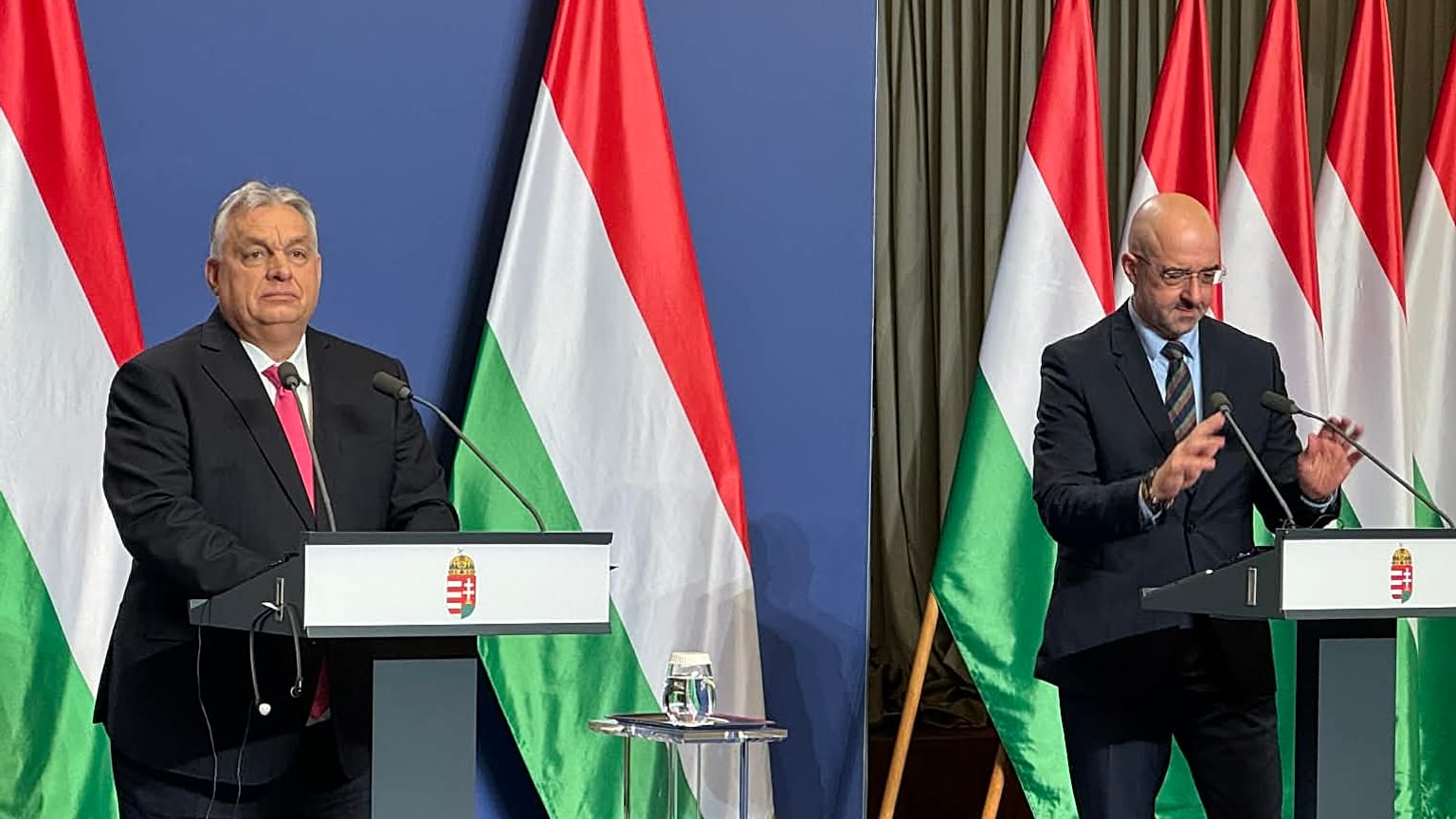














In his international press conference on Monday, the Hungarian PM also praised Trump's Venezuela operation, and said Hungary will not fund Ukraine or accept migrants.
Hungarian Prime Minister Viktor Orbán predicted the European Union would "fall apart on its own" due to "leadership chaos" and said Brussels aimed to cut Hungary off from Russian energy supplies during a press conference on Monday.
 ADVERTISEMENT
ADVERTISEMENT
ADVERTISEMENT
Orbán rejected the possibility of Hungary leaving the EU, saying the country lacked the size to make such a decision sensible. However, he stressed Hungary's future lay within the bloc and NATO but with "a sovereign foreign policy and economic policy".
He said: "EU membership is an important opportunity, but if we were to get stuck in this single bloc, we would drink the juice. It makes sense to have the best possible relations with all blocs, including America, Russia, China, the Arab world and the Turkish world."
Orbán has clashed repeatedly with Brussels over rule of law concerns, blocked EU support to Ukraine and maintained ties with Moscow despite Russia's all-out war, now nearing the four-year mark. The EU has withheld billions of euros in funding over concerns about democratic backsliding in Hungary.
On energy policy, Orbán said Brussels aimed to cut Hungary off from Russian oil and gas supplies.
He said the government was defending itself through legal action against the European Commission while politically opposing EU regulations, hoping sanctions would be lifted by 2027, when the war ends.
Hungary has secured exemptions from EU sanctions on Russian energy and remains heavily dependent on Russian oil and gas.
Orbán said US President Donald Trump's seizure of Venezuela's Nicolas Maduro marked a new era in international politics, claiming the operation could allow the US to control up to half the world's oil reserves.
He told reporters that 2025 had been "a very eventful year" and Trump's inauguration "gave the coup de grace" to what he called the "liberal world order". He said the new era is "the era of nations" and described himself as a harbinger of this shift since 2010.
Venezuela operation 'powerful manifestation of the new world'
On Venezuela, Orbán said the US military operation represented "a powerful manifestation of the new world".
"Together with Venezuela, the United States can control 40-50% of the world's oil reserves, a force capable of significantly influencing the price of energy on the world market." He added that this could benefit Hungary by creating cheaper global energy prices.
Orbán has cultivated close ties with Trump and is one of the few European leaders to openly support the US military action in Venezuela, which most EU member states have criticised as violating international law.
Orbán said Hungary would not provide financial support to Ukraine, stating, "We have money if we don't give it to others, so we are not giving our money to Ukraine."
"We are not giving them a loan either, because everyone knows that the Ukrainians will not pay it back," he added.
Hungary has been the primary obstacle to EU military and financial support for Ukraine since Russia's full-scale invasion in early 2022, forcing the 27-member bloc to find workarounds to bypass Budapest's vetoes.
On migration, Orbán said Hungary would not accept Brussels dictating "who we should live with", rejecting an EU regulation due in June requiring member states to admit 350 people and process over 20,000 applications.
Hungary has refused to participate in EU asylum schemes and built border fences to keep out migrants, leading to ongoing legal battles and trading barbs with Brussels.
Asked about a reported financial agreement with Trump, Orbán confirmed: "I asked for it, we agreed that there would be one."
Trump denied Orbán's previous claims about such an agreement, telling Politico in November: "I didn't promise him anything like that, but he asked me very much."
Meanwhile, the Hungarian PM said details of the "defence shield" were still being worked out, adding Hungary has needed "some kind of protective shield" since World War I and "cannot rely on Brussels".
Orbán said he would not debate Tisza party leader Péter Magyar in the April elections, claiming he could only debate with "sovereign people" and that "those who have masters abroad are not sovereign". He said his ruling party, Fidesz, aimed to repeat its 2022 election result.
Magyar and his party have surged in polls and pose the most substantial electoral challenge to Orbán's rule in two and a half decades. Orbán has governed Hungary since 2010 and is the EU's longest-serving leader among the current heads of state.