


















In a surprise attack overnight on Saturday, the United States launched strikes against Venezuelan capital Caracas and other cities. US President Donald Trump stated that Nicolas Maduro and his wife were "captured and flown out of the country". Follow for live updates.
US will "run" Venezuela until "safe" transition, President Donald Trump said as he hailed the operation in Caracas on Saturday dubbed "Absolute Resolve," in which Nicolás Maduro was captured and flown out of the country after months of stepped-up pressure by Washington.
 ADVERTISEMENT
ADVERTISEMENT
ADVERTISEMENT
The extraordinary surprise nighttime strike was announced by Trump on social media hours after the attack.
It was not immediately clear who was running the country, with Venezuelan Foreign Minister Yvan Gil claiming Maduro remains in charge.
At the same time, his Vice President Delcy Rodriguez was reportedly sworn in, according to Trump, while other reports claimed she left the country for Russia. Rodriguez then appeared on state-run television to state Maduro is Venezuela's "only president".
Initial reports claimed the US has struck multiple targets in Caracas and several cities across the South American country.
Revisit the latest developments in our blog below:

 ${title}
Live ended
Maduro's capture in Venezuela: Key things to know
US forces struck Venezuela early Saturday, capturing Nicolás Maduro. Here is how the day developed:
- Multiple explosions hit Caracas around 2 am local time, striking La Carlota airfield and Fuerte Tiuna military base. Residents reported at least seven blasts as low-flying aircraft swept through the capital.
- Trump announced Maduro and his wife Cilia Flores were "captured and flown out of the country" in an operation conducted with US law enforcement. Details remained scarce, although a news conference was scheduled for 5 pm CET at Mar-a-Lago.
- Venezuelan Vice President Delcy Rodríguez demanded "proof of life" for Maduro, stating Caracas did not know their whereabouts. Venezuela activated all defence capabilities.
- Trump published the first photo of Maduro after arrest while aboard USS Iwo Jima on his way to New York, where he faces narco-terrorism charges.
- Trump announced at a Mar-a-Lago press conference that the United States will "run the country" until a safe transition can be arranged. "We're going to run it, essentially, until such time that we can do a safe, proper and judicious transition," he stated, adding the US would rebuild Venezuela's oil infrastructure using US companies.
- US General Dan Caine said at the press conference that Maduro and his wife were apprehended by Delta Force soldiers accompanied by FBI agents on the ground in an operation planned for several months dubbed Absolute Resolve. Trump said that the operation was delayed by four days due to bad weather, and that he offered Maduro to surrender "a week ago".
Maduro Venezuela's 'only president,' his vice president Rodriguez says
Confusion over who was running the country following Nicolas Maduro's capture by US forces in Caracas persisted on Saturday evening, after his Vice President Delcy Rodriguez said Maduro was Venezuela's "only president" on national television.
"We are ready to defend Venezuela," Rodriguez added, after what she described as Maduro's "kidnapping," in a stark contrast to US President Donald Trump's statement that Rodriguez offered to work with Washington.
During his Mar-a-Lago press conference, Trump hinted that Rodriguez -- who he revealed was in talks with US Secretary of State Marco Rubio over possibly taking part in Venezuela's new government -- was "sworn in" albeit "picked by Maduro".
Trump also revealed that after the strikes on Saturday, Rodriguez "had a long conversation with Marco, and she said, ‘We’ll do whatever you need.'"
Rodriguez, once branded by Maduro as a "tiger," has been one of his fiercest loyalists.
At the press conference, Trump announced that the US will now "run the country". "We're going to run it, essentially, until such time that we can do a safe, proper and judicious transition," he stated, adding the US would rebuild Venezuela's oil infrastructure using US companies.
Reports previously said Rodriguez left the country for Russia. Earlier on Saturday, Venezuelan Foreign Minister Yvan Gil claimed Maduro remained in charge despite the arrest.
Merz and Macron slam Maduro's 'dictatorship' that led Venezuela 'into ruin'
German Chancellor Friedrich Merz offered a scathing remark on Nicolas Maduro after US forces captured him in Caracas earlier on Saturday, signalling an end to his reign as president of Venezuela.
In a post on X, Merz said that "Maduro has led his country into ruin."
"The most recent election was rigged. Like many other countries, we have therefore not recognised his presidency. Maduro has played a problematic role in the region," he added.
French President also welcomed Maduro's arrest, saying "people could only rejoice."
"The Venezuelan people are today rid of the dictatorship of Nicolas Maduro," Macron wrote on X on Saturday evening.
"We hope that President Edmundo Gonzalez Urrutia, elected in 2024, will be able to ensure this transition as quickly as possible," he added.
What we know about Delcy Rodriguez, Maduro's vice president?
As a reminder, US President Donald Trump has hinted that Venezuela's Vice President Delcy Rodríguez is part of the "group of people" Washington is talking to as potential partners in running the South American country following Nicolas Maduro's capture.
Delcy Rodríguez, Venezuela's executive vice president since June 2018, is next in line to assume the presidency, according to the country's constitution.
She is one of the few officials from the Maduro regime to appear publicly following Saturday's strikes, when she demanded proof of life for Maduro and his wife.
Known for fiercely defending Maduro's government, Rodríguez has worked closely with her brother Jorge Rodríguez, the current National Assembly president. In the past, Maduro has described her as a "tiger" for her loyalty.
Rodríguez is the daughter of Jorge Antonio Rodríguez, a founder of Venezuela's Socialist League who died in 1976 while imprisoned for his role in kidnapping an American executive.
She entered government in 2003, rising rapidly through senior positions including communications minister, foreign minister and president of the National Constituent Assembly before Maduro appointed her vice president.
Since 2020, Rodríguez has simultaneously served as finance minister, and notably assumed the petroleum ministry portfolio in mid-2024, making her central to managing Venezuela's economy and oil industry.
In his Mar-a-Lago press conference on Saturday, Trump emphasised the US has an interest in Venezuelan oil, stating, "We’re going to be taking out a tremendous amount of wealth out of the ground."
"That wealth is going to the people of Venezuela and people from outside of Venezuela that used to be in Venezuela."
"And it goes also to the United States of America in the form of reimbursement for the damages caused us by that country,” Trump pointed out.
Rodríguez's whereabouts remain unclear, although Trump hinted that she was already "sworn in" as Venezuela's next president albeit "picked by Maduro". Earlier reports on Saturday said she left the country for Moscow.
What are the charges Maduro now faces?
As mentioned by US Secretary of State Marco Rubio during the Mar-a-Lago press conference, Nicolás Maduro faces charges from a March 2020 superseding indictment filed in New York's Southern District.
According to a document seen by Euronews, federal prosecutors charged Maduro with leading a narco-terrorism conspiracy spanning 1999 to 2020. The indictment alleges he managed the Cartel de los Soles or Cartel of the Sons, using cocaine to deliberately flood America with drugs.
Maduro was indicted alongside senior Venezuelan officials including Interior Minister Diosdado Cabello and former intelligence chief and retired General Hugo Carvajal Barrios, also known as El Pollo.
Prosecutors alleged collaboration with Colombia's FARC rebels, with the groups cultivating coca and shipping cocaine through Caribbean and Central American routes.
The indictment cites incidents including a 2006 DC-9 jet carrying 5.6 tonnes of cocaine seized in Mexico and 2008 agreements using state oil company funds to support FARC trafficking.
Maduro faces narco-terrorism conspiracy, cocaine importation conspiracy, and weapons charges carrying potential life imprisonment.
In a letter made public in early December, Barrios accused Maduro and his government of being a "narco-terrorist organisation". Read more in our article on the subject here.
Trump hints at working together with 'sworn in' Vice President Delcy Rodriguez
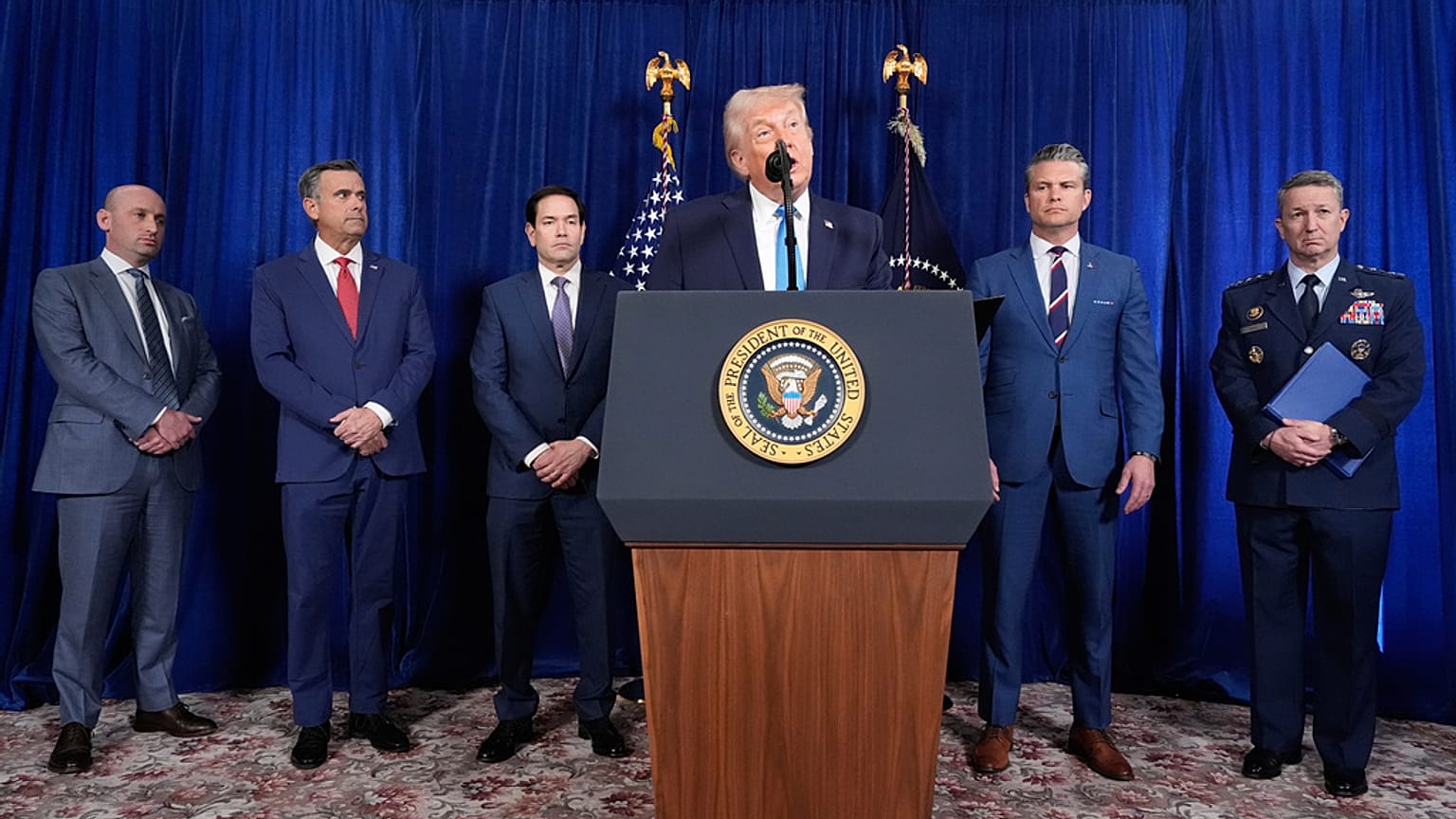
Answering questions following his statement that the US would run Venezuela after Nicolas Maduro's capture, Trump said Washington is already in talks with potential partners, although "it’s largely going to be, for a period of time, the people that are standing right behind me."
"We’re going to be running it. We’re going to be bringing it back,” Trump explained, standing in front of Secretary of State Marco Rubio, Secretary of Defence Pete Hegseth and Chairman of the Joint Chiefs of Staff General Dan Caine.
Asked about Venezuelan Vice President Delcy Rodriguez and whether she was the person the US is in talks with to take the country forward, he said Rodriguez told US Secretary of State Marco Rubio she was prepared to work with the US.
"I think she's just been sworn in, right," Trump asked, albeit "picked by Maduro," hinting that the transition of power has already taken place in Caracas. This is contrary to earlier reports that Rodriguez might have departed for Russia following the Saturday strikes.
Trump also said he is "not afraid of boots on the ground" after a question over whether US troops would partake in the Washington-led transition of power. The US will have "a presence in oil" where US military might play a role, he later clarified.
"We'll run it properly, we'll run it professionally," Trump said. "The biggest beneficiaries witll be the people of Venezuela."
Trump said Washington was not in touch with opposition leader Maria Corina Machado, adding it would be "very tough" for her to run the country, as she does not have the "support or respect" of Venezuelans to do so.
Trump also answered a question regarding Colombian President Gustavo Petro’s concerns over the safety of Venezuela’s neighbour, to which Trump said Colombia hosts drug production and distribution facilities and that Pedro should “watch his *ss”.
Planning and 'rehearsal' for Maduro's capture lasted months, US general says
The US military operation to extract Nicolas Maduro in a nighttime raid in Caracas took "months of planning and rehearsal" with intelligence officials tracking Maduro's movements, top US General Dan Caine told reporters Saturday.
More than 150 US aircraft were used, General Caine said.
"The word integration does not explain the sheer complexity of such a mission, an extraction so precise -- it involved more than 150 aircraft launching across the Western hemisphere," he told a joint press conference with President Donald Trump.
In the end, "Maduro and his wife, both indicted, gave up and were taken into custody by the Department of Justice, assisted by our incredible US military with professionalism and precision, with no loss of US life," General Caine explained.
Trump says US 'will run' Venezuela until 'safe' transition
In a press conference at his Mar-a-Lago property in Florida, US President Donald Trump lauded the military and Washington's "extraordinary" operation conducted in the capital of Venezuela on Saturday, dubbed "Absolute Resolve".
Trump then said that following the arrest of Nicolas Maduro, who is to face charges in New York, the US will "run" Venezuela until "such a time that we can do a safe, proper and judicious transition."
“We don’t want to be involved with having someone else get in, and we have the same situation that we had for the last long period of years. So we are going to run the country," he said. "Venezuelan people are free again."
He also warned the military and political top in Venezuela that the same thing that happened to Maduro could happen to them.
"We are ready to stage a second and much larger attack if we need to do so," Trump said.
On the subject of Maduro's capture, Trump said the "extraordinary" US forces faced "a heavily fortified military fortress" during the Caracas operation. He also said the US shut down power in the Venezuelan capital "due to a certain expertise that we have.”
“No nation in the world could achieve what America achieved yesterday, or frankly, in just a short period of time, all Venezuelan military capacities were rendered powerless as the men and women of our military, working with us, law enforcement, successfully captured Maduro in the dead of night," he explained.
The US lost no personnel or equipment in the operation, according to the US President. Maduro and his wife now "face American justice," Trump said.
President Donald Trump said the US is "going to run" Venezuela until a safe transition of power can take place and the US will have a "partnership" with Venezuela's oil industry. pic.twitter.com/tVPHagZVbL
— euronews (@euronews) January 3, 2026
Trump posts first image of Maduro in US custody
US President Donald Trump has just released the first photograph of Venezuelan leader Nicolas Maduro in US custody in a post on his social network Truth Social.
In the image said to show Maduro onboard USS Iwo Jima on his way to the US, the Venezuelan president is seen in a tracksuit, handcuffed, wearing a blindfold and sound cancelling headphones, and holding a bottle of water.
See the image here:

Maduro remains Venezuelan leader, foreign minister says
Captured Venezuelan leader Nicolas Maduro will remain the country' president, Foreign Minister Yván Gil said, amid growing speculation on the South American country's future and questions over who might take over following the US operation on Saturday.
“The constitution is clear: the elected president – the constitutional president is President Nicolás Maduro Moros, whose physical presence in Venezuela must be restored immediately by the US government because this is a violation,” Gil said on Venezuelan state-run TV.
“Our armed forces are deployed, the police deployed, the public deployed. Everything is active in the defence of the homeland and its sovereignty. Have faith that this is a strong state," he stated.
The hour of freedom has arrived, Machado says
Venezuelan opposition leader María Corina Machado declared Saturday that Nicolás Maduro now faces international justice after the US captured him during strikes on Caracas.
"Venezuelans, the hour of freedom has arrived," Machado wrote in a statement hours after the operation. "The time has come for popular sovereignty and national sovereignty to reign in our country."
The Nobel Peace Prize laureate, who has lived in hiding for 15 months, said Venezuela would restore order, free political prisoners, build an exceptional country and bring exiled citizens home.
Machado called on Venezuelans inside the country to prepare for instructions through official opposition channels, whilst urging those abroad to mobilise and pressure governments worldwide to support Venezuela's reconstruction.
"We have fought for years, we have given everything, and it has been worth the pain. What had to happen is happening," she wrote. "Venezuela will be free."
South American leaders split along ideological fault lines over Maduro's arrest
South American leaders issued sharply divided responses to Saturday's US strikes on Venezuela and the reported capture of President Nicolás Maduro, amid singificant ideological divide over Washington's intervention.
Brazilian President Luiz Inácio Lula da Silva delivered one of the harshest condemnations, describing the strikes as crossing "an unacceptable line".
"Attacking countries, in flagrant violation of international law, is the first step toward a world of violence, chaos and instability, where the law of the strongest prevails over multilateralism," Lula wrote on X.
He said the attacks recalled "the worst moments of interference" in Latin American politics and threatened regional peace. "The international community, through the United Nations, needs to respond vigorously to this episode," Lula added.
Colombian President Gustavo Petro condemned the strikes and deployed forces to the Venezuelan border while promising additional support "in the event of a massive influx of refugees".
"Alerting the whole world that they have attacked Venezuela," Petro wrote on X, calling for an emergency meeting of the Organisation of American States and United Nations.
"The Republic of Colombia reiterates its conviction that peace, respect for international law, and the protection of life and human dignity must prevail over any form of armed confrontation," Petro said. He later announced Colombia "rejects the aggression against the sovereignty of Venezuela and of Latin America".
Chilean President Gabriel Boric expressed "concern and condemnation" of the military actions, calling for peaceful resolution.
"Chile reaffirms its commitment to basic principles of International Law, such as the prohibition of the use of force, non-intervention, the peaceful settlement of international disputes, and the territorial integrity of States," Boric wrote on X.
"The Venezuelan crisis must be resolved through dialogue and the support of multilateralism, and not through violence or foreign interference."
Mexican President Gloria Sheinbaum issued a brief statement condemning the intervention, quoting UN Charter provisions requiring member states to refrain from "the threat or use of force against the territorial integrity or political independence of any State".
In stark contrast, Trump ally Milei celebrated the operation with his signature slogan: "Freedom advances! Long live freedom, damn it!"
Ecuadorian President Daniel Noboa welcomed Maduro's capture.
"To all the narco Chavista criminals, your time is coming. Your structure will completely collapse across the entire continent," Noboa wrote, urging Venezuela's opposition leaders and public to reclaim the country.
US president says Washington to 'have a look' into Machado leading Venezuela
According to the US president, the US will "have to look" at whether Maria Corina Machado — the famed opposition leader who won the 2025 Nobel Peace Prize — could lead Venezuela following the arrest of Nicolas Maduro.
"They have a vice president, as you know," Donald Trump said. "I don't know what kind of an election that was, but, you know, the election of Maduro was a disgrace."
Latest reports claim that Venezuelan Vice President Delcy Rodríguez has since left the country for Russia.
Maduro and wife on their way to New York, Trump says as he revealed details of the operation
Venezuelan President Maduro and his wife are on their way to New York after capture in Caracas, US President Donald Trump said.
"They killed a lot of people and a lot of American people, even people in their own country," Trump said.
In an interview with Fox News, the US president said the two were indicted in New York and will be taken there by helicopter and ship.
Trump said that he told Maduro he had to surrender "a week ago," telling him "you have to give up, you have to surrender."
Then the call was made to do "something much more surgical, much more powerful," Trump explained.
He also stated he watched Maduro's capture -- reportedly conducted by a US Delta Forces unit -- "literally like I was watching a television show."
"We were going to do this four days ago but the weather was not perfect," the US president said. "The weather has to be perfect ... all of a sudden it opened up and we said go."
Maduro was apprehended "in a house that was more like a fortress than a house ... solid steel all around."
"If you would've seen the speed, the violence, it was an amazing thing," Trump said. "There's no other country on Earth that could do such a manoeuvre."
Who could succeed Maduro? Three regime loyalists in the frame
With Venezuela's Nicolas Maduro reportedly captured by US forces on Saturday, speculation has emerged on the country's future, with most of the focus currently on three senior regime figures who could assume power in Caracas.
Vice President Delcy Rodríguez
Rodríguez serves as executive vice president, the first in line to succeed Maduro, at least according to theconstitution.
A loyal Chavista and former foreign minister, she survived Saturday's strikes. However, she lacks military backing, which may prove decisive.
However, reports have emerged that Rodríguez might have left the country for Russia, one of Maduro's top allies together with Iran.
Interior Minister Diosdado Cabello
One of Venezuela's most powerful figures, Cabello was named in the 2020 US indictment as a leader of the Cartel de los Soles or Cartel of the Suns.
Washington offered $10 million for his capture, reportedly further raised to $25 million. Cabello oversees substantial security forces through the interior ministry and maintains deep military and intelligence ties.
His cartel links make him a prime US target, potentially limiting his chances. Euronews has learned that most Venezuelans believe that, unless the opposition manages to mobilise citizens for a democratic push in the country, Cabello has the best chance of taking over in Maduro's absence.
However, insiders have told Euronews that Cabello has not been seen in public since the Saturday strikes.
Defence Minister Vladimir Padrino López
Padrino commands Venezuela's armed forces and survived Saturday's attacks. While not explicitly named in US indictments, the military's alleged role in the Cartel of the Suns implicates senior commanders, meaning he is also among those involved and possibly facing further action by Washington.
He is said to have the army's loyalty, which might prove critical as whoever controls the armed forces likely determines the outcome. Whether he would use the upper hand in his favour or someone else's remains unclear at this time.
Does the opposition stand a chance?
The US President Donald trump said on Saturday that Washington will "have to look" at whether Maria Corina Machado — the famed opposition leader who won the 2025 Nobel Peace Prize — could lead Venezuela following Maduro's arrest.
Observers note that Spain, which successfully carried out the extraction of opposition leader Edmundo González Urrutia from Venezuela as he faced constant threats from the Maduro regime, could potentially help him get back into the country again with US backing.
It should be noted that Urrutia’s son-in-law remains a political prisoner there, which complicates any decision for him to go back or push for a bid at Venezuela’s presidency.
We stand by the people of Venezuela, von der Leyen says
European Commission President Ursula von der Leyen has responded to the news out of Venezuela, stating that the EU is supportive of "a peaceful and a democratic transition" in the country and is there for its people following the arrest of Nicolas Maduro.
"Following very closely the situation in Venezuela. We stand by the people of Venezuela and support a peaceful and democratic transition. Any solution must respect international law and the UN Charter," the EU executive chief said in a post on X.
"With HRVP Kaja Kalas and in coordination with EU member states, we are making sure that EU citizens in the country can count on our full support," she added.
Venezuelans go to the stores as uncertainty mounts
Venezuelans Euronews contacted have now told us that many residents have decided to go to the stores to stock up on food and other household necessities, as uncertainty grips the country following news of Nicolas Maduro's capture.
Footage shared with Euronews shows long lines in supermarkets, while others reported that some stores were already running out of basic food items such as chicken or beef by midday on Saturday.
The government in Caracas has asked the citizens of Venezuela to take to the streets following this morning's air strikes.
However, Euronews has learned that only some responded, with most citizens concerned about what comes next for the roughly 28.5 million people still residing in the Latin American country.
Timeline: How Trump's anti-drug campaign led to Venezuela strikes
The surprise military action in Venezuela on Saturday is the latest move by Washington in a series of escalations against Nicolas Maduro and his government, in what US President Donald Trump said was a crackdown on drug trafficking stemming from the Latin American country.
Here is a brief timeline of events that led to Maduro's arrest:
September 2025: US forces began striking suspected narcoboats in the Caribbean and Pacific, killing over 115 people in 35 operations by early January. US President Donald Trump said the campaign was an "armed conflict" with drug cartels.
November 2025: The US designated the Cartel of the Suns, which it accused Maduro of leading, as a terrorist organisation.
10-20 December: The US seized two oil tankers — Skipper and Centuries — off Venezuela's coast. Trump ordered a blockade of sanctioned tankers.
21 December: Third tanker, the Iran-linked Bella 1, fled US Coast Guard interception, sparking a weeklong pursuit, later resulting in the crew painting a Russian flag on its hull and Moscow asking Washington to end its attempts to seize it.
29 December: Trump says a CIA drone struck a Venezuelan dock facility, marking the first known US land operation.
3 January: The US banned flights over Venezuela. Hours later, explosions hit military sites in Caracas. Trump announced a "large-scale strike" and Maduro's capture, claiming Venezuela's president was removed from the country.
Milei backs Trump's actions in Venezuela
Argentinian President Javier Milei praised his US counterpart and close ally Donald Trump on Saturday, following the news of Nicolas Maduro's capture.
"Freedom advances, long live freedom, damn it," Milei said, repeating his trademark slogan in a brief message on X.
In a separate post on Instagram, Milei shared an earlier TV interview in which he said Maduro was a "narcoterrorist and a dictator who is infecting an entire continent."
"I hope that he falls and that Venezuela recovers its freedom, and I hope everything he's done becomes known," Milei said at the time.
At the World Economic Forum in Davos in January, our Euronews reporter asked Milei whether Buenos Aires planned to find a way to free the political prisoners held by Maduro inside the Argentinian embassy in Caracas.
Milei responded that his government was actively working on it. Months later, Trump and Milei reportedly quietly collaborated to secure the prisoners’ release, right under the noses of Maduro's security officers stationed at the embassy.
Maduro's arrest echoes 1989 capture of Panama's Noriega
The reported arrest of Venezuelan President Nicolás Maduro bears similarities to the US 1989 military operation in Panama that resulted in the capture of General Manuel Noriega.
Both leaders faced US drug trafficking indictments before military action and both operations were justified partly on counter-narcotics grounds.
US forces invaded Panama in December 1989 to remove Noriega from power. He surrendered to US troops in January 1990 and was transported to Florida, where he was convicted on trafficking and racketeering charges.
Panama required years to achieve political and economic stability following the intervention, despite the country's relatively small size and geographic proximity to the US.
The context in Venezuela differs due to the country's larger population and a much more established regime with stronger ties to the likes of Russia and Iran.
Under Maduro, most of its opposition has been either silenced or forced into exile, and it is not immediately clear whether the US strikes on Saturday could lead to a political shift.
Maduro to 'face full wrath of American justice,' US attorney general says
Following Trump's announcement on the capture of Nicolas Maduro, Washington has now confirmed the Venezuelan leader is to stand trial in the US.
US Attorney General Pam Bondi said Maduro and his wife Cilia Flores would face charges after an indictment in New York.
Bondi vowed in a social media post that the couple would “soon face the full wrath of American justice on American soil in American courts.”
She also thanked "our brave military who conducted the incredible and highly successful mission to capture these two alleged international narco traffickers."
What we know about 'Cartel of the Suns'
The US has also accused Venezuelan President Nicolas Maduro of being on of the main figures behind the so-called "Cartel de los Soles" or Cartel of the Suns, designated a foreign terrorist organisation by Washington in late November 2025.
The term was first used by journalists in early 1990s to report on a scandal involving high-ranking officers, and gets its name from the sun-shaped stars worn on the uniforms of Venezuelan military generals.
US prosecutors allege that this is not merely a criminal organisation operating within Venezuela — it is the Venezuelan state itself, or at least its highest echelons of military and political power.
According to the indictment against Maduro, the cartel has existed since the late 1990s, growing in power and sophistication under both Hugo Chávez and his successor, Maduro.
The organisation allegedly coordinates the production and trafficking of massive quantities of drugs destined for the US, using Venezuela's military infrastructure, airfields, and territorial control to facilitate the drug trade.
Europe reacts to news of Venezuela strikes
As Europe woke up to the news of US strikes on Venezuela and the alleged capture of President Nicolas Maduro, several European governments have reacted by saying they are keeping an eye on the developing situation.
Spanish Prime Minister Pedro Sánchez has called for "deescalation," stating Madrid is “closely monitoring events in Venezuela.” Spanish embassy and consulates are working, he said in a post on X.
The Netherlands was also in contact with its embassy there, with Dutch Foreign Minister David van Weel saying the situation was "still unclear.
Belgium’s embassy in Colombia was “fully mobilised” and "the situation is being closely monitored, in coordination with our European partners,” Belgian Foreign Minister Maxime Prévot said in a post on X.
Venezuela 'will overcome' US attacks, interior minister says
Venezuela's Interior Minister Diosdado Cabello said on Saturday his country "will overcome" a wave of US military strikes which Washington said also included the capture of President Nicolas Maduro.
Cabello, considered one of the most powerful men in Caracas, told a local television broadcast that "at the end of these attacks, we will overcome," adding that "this is not our first battle against our people ... we have managed to survive under all circumstances."
Washington has not offered any updates on the strikes and Maduro's capture at this time.
What is Maduro accused of?
In March 2020, the US Department of Justice took the unprecedented step of indicting a sitting head of state, charging Maduro and more than a dozen current and former Venezuelan officials with narco-terrorism, drug trafficking and firearms offences.
The indictment remains one of the most significant legal actions ever taken by Washington against a foreign leader.
According to federal prosecutors, Maduro and his co-conspirators flooded the US with cocaine for more than two decades, using drug trafficking as a tool to maintain power while enriching themselves and damaging communities.
The US Justice Department initially offered a $15 million reward for information leading to Maduro's arrest.
Biden and Trump administrations then raised it to $25 million and $50 million — the highest bounty ever placed on a head of state by US authorities.
Maduro and the Venezuelan government have denied all allegations, characterising it as a pretext for regime change.
Caracas asks for snap UN Security Council meeting
Caracas demanded an emergency meeting of the UN Security Council to discuss the US strikes and the whereabouts of President Nicolas Maduro.
"Faced with the criminal aggression committed by the US government against our homeland, we have requested an urgent meeting of the United Nations Security Council, which is responsible for upholding international law," Venezuelan Foreign Minister Yvan Gil wrote on Telegram.
EU's Kallas asks for 'restraint,' respect of international law
EU foreign policy chief Kaja Kallas on Saturday called for restraint following a conversation with officials in Washington over US strikes in Venezuela.
"I have spoken with Secretary of State Marco Rubio and our ambassador in Caracas. The EU is closely monitoring the situation in Venezuela," Kaja Kallas said in a post on X.
International law must be respected "under all circumstances," she added.
Situation in Caracas calm, authorities set up checkpoints, locals tell Euronews
Caracas residents Euronews spoke to said that the situation in the Venezuelan capital has "calmed down" following the strikes.
However, the authorities have established various checkpoints throughout the city and have deployed security personnel, they say.
Euronews has asked for further details and will update the blog with the latest as they come in.
Rubio 'anticipates no further action in Venezuela,' Maduro to stand trial in US, senator says
The United States has completed its military action in Venezuela after capturing Nicolas Maduro, a US senator said Saturday, quoting Secretary of State Marco Rubio.
"He anticipates no further action in Venezuela now that Maduro is in US custody," Senator Mike Lee, a Republican initially critical of the operation, wrote on X after what he said was a telephone call with Rubio.
Maduro "has been arrested by U.S. personnel to stand trial on criminal charges in the United States.”
The Venezuelan leader was indicted in March 2020 on “narco-terrorism” conspiracy charges in the Southern District of New York.
The strikes were "deployed to protect and defend those executing the arrest warrant," Lee explained.
Venezuelan vice president demands proof of life for Maduro
Venezuela's Vice President Delcy Rodríguez said that Caracas does not know "the whereabouts of President Nicolás Maduro and First Lady Cilia Flores.”
“We demand proof of life," he added.
As a reminder, Trump said Maduro “has been, along with his wife, captured and flown out of the country. This operation was done in conjunction with US law enforcement. Details to follow.” He set a news conference for later on Saturday.
Colombia deploys troops to Venezuela border
Colombian President Gustavo Petro said Saturday he ordered the deployment of military forces to the Venezuelan border, following US strikes that is said to have ended with the capture of Venezuelan President Nicolas Maduro.
Petro described Washington's actions as an "assault on the sovereignty" of Latin America and said they would result in a humanitarian crisis
While proposing that the situation could be resolved through "dialogue," Petro said on X that he had also ordered the "deployment of the security forces" to the Venezuelan border.
Petro made no mention of Maduro's capture, despite the Venezuelan leader being one of his government's closest allies in the region.
Petro has been a vocal critic of military deployments ordered by Trump in the Caribbean to fight alleged drug trafficking vessels.
Colombian Defence Minister Pedro Sanchez said the security forces had activated "all capacities" to prevent "any attempted terrorist attack" at the border by illegal groups such as the National Liberation Army.
As part of his anti-drug strategy, Trump recently said he would not rule out striking drug-production laboratories in Colombia, which Petro condemned as a threat of invasion at the time.
Moscow and Tehran decry US actions in Venezuela
Both Moscow and Tehran condemned US strikes on Venezuela on Saturday, in a show of solidarity with its key South American ally, Nicolas Maduro.
Russia’s Foreign Ministry labelled Washington's actions “act of armed aggression” in a statement posted on its Telegram channel Saturday.
“Venezuela must be guaranteed the right to determine its own destiny without any destructive, let alone military, outside intervention,” the statement said.
The Iranian foreign ministry in a statement said it "strongly condemns the American military attack on Venezuela and the flagrant violation of the national sovereignty and territorial integrity of the country."
Russia has counted on Iran's backing, particularly its supply of drones, in its all-out war against Ukraine, now nearing its four-year mark. Venezuela and Iran have maintained close strategic ties for over two decades, collaborating on weapons systems and military technology transfers, while Iranian tankers have delivered petrol to Venezuela during fuel shortages caused by economic collapse and US sanctions.
The ties between the three after the US attempted to seize an Iran-linked tanker said to be carrying sanctioned oil — Washington's third seizure of its kind in recent weeks.
After the crew painted a Russian flag on its hull, Moscow asked Washington to stop its pursuit, according to reports.
Press conference to follow, Trump says
US President Donald Trump has confirmed US strikes on Venezuela on Saturday and said President Nicolás Maduro and his wife were "captured and flown out of the country," in a post on his social media platform Truth Social.
"The United States of America has successfully carried out a large-scale strike against Venezuela and its leader, President Nicolas Maduro, who has been, along with his wife, captured and flown out of the country," Trump said.
Trump said details were "to follow".
"There will be a news conference today at 11 am (5 pm CET) at Mar-a-Lago. Thank you for your attention to this matter! President Donald J Trump."
All Venezuelan armed forces to deploy, defence minister says
Venezuela will launch a "massive deployment of all land, air, naval, riverine and missile capabilities ... for comprehensive defence," Defence Minister Vladimir Padrino Lopez said in a video statement shared on social media.
Lopez also accused the US of hitting residential areas in a wave of strikes early Saturday.
The "invading" US forces "have desecrated our soil, going so far as to strike, using missiles and rockets fired from their combat helicopters, residential areas populated by civilians," he claimed.
US strikes on Venezuela: What we know so far
The United States dramatically escalated its confrontation with Venezuela in the early hours of Saturday morning, conducting what US President Donald Trump described as "large-scale strikes" against military targets in and around Caracas.
In a post to his Truth Social platform, Trump announced that Venezuelan President Nicolás Maduro and his wife had been "captured and flown out of the country" following the operation, which he said was conducted jointly with US law enforcement agencies.
Residents of Caracas reported hearing at least seven explosions around 2 am local time, with eyewitnesses describing strikes on key military installations including the La Carlota airfield and the Fuerte Tiuna military base.
The Venezuelan government called it an “imperialist attack” and urged citizens to take to the streets.
The strike came as the Trump administration has escalated pressure on Maduro, who has been charged with narco-terrorism in the United States. The CIA was behind a drone strike last week at a docking area believed to have been used by Venezuelan drug cartels — the first known direct operation on Venezuelan soil since the US began strikes in September.
Trump for months had threatened that he could soon order strikes on targets on Venezuelan land following months of attacks on boats accused of carrying drugs. Maduro has decried the U.S. military operations as a thinly veiled effort to oust him from power.