

















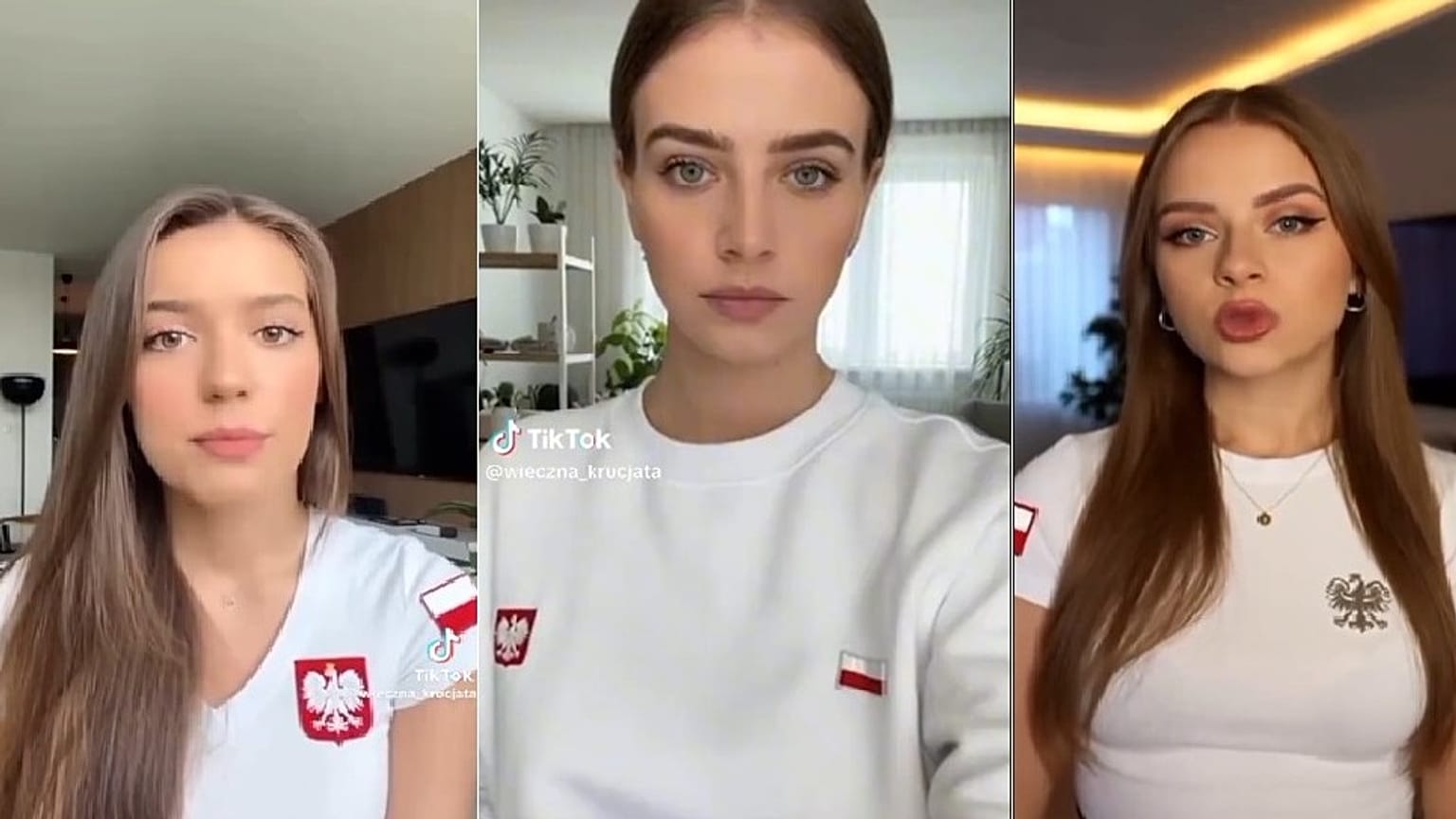













They are beautiful, eloquent — and do not exist. AI-generated girls from the 'Prawilne_Polki' profile called for Polexit and preached right-wing views. The TikTok account has been deleted, but disinformation and propaganda in Poland persist.
AI-generated videos promoting Poland's exit from the European Union have appeared on Polish-language social media, featuring non-existent, attractive young women advocating for "Polexit".
 ADVERTISEMENT
ADVERTISEMENT
ADVERTISEMENT
One TikTok account called "Prawilne Polki" published content showing women dressed in T-shirts bearing Polish flags and patriotic symbols, European analytics collective Res Futura said. The content targeted audiences aged 15 to 25.
The videos featured statements including: "I want Polexit because I want freedom of choice, even if it will be more expensive. I don't remember Poland before the European Union, but I feel it was more Polish then."
Another video stated: "When I talk about Polexit, I hear: 'scaremongering', 'catastrophe', 'end of the world'. Always the same pattern. Zero conversation about who really decides for us and why. Maybe it's high time we started talking about it calmly."
Some videos appeared authentic while others showed clear signs of artificial intelligence use, with desynchronised vision and audio.
"The recordings were actually generated using a generative artificial intelligence tool. They are not of good quality at all," Aleksandra Wójtowicz, senior analyst for new technologies and digitalisation at the Polish Institute of International Affairs, told Euronews.
"If you look at them for a while, you can see that the facial expressions are unclear, the phrases spoken by the characters in the recordings are not completely natural."
The "Prawilne_Polki" profile has been removed, but similar accounts may emerge, Wójtowicz said.
"For now, it is not clear who is behind the content. At the moment there are several groupings that run various campaigns with the help of artificial intelligence," said Wójtowicz, who has researched online disinformation for years.
"They often take place on YouTube, but also on TikTok."
'Hydra effect' in motion
Similar content on YouTube imitates news services using synthetic voices or voices combined with generated faces, repeating pro-Russian narratives including claims that elections were rigged or Ukrainians are stealing, Wójtowicz said.
"From the research interviews I conducted, it appears that this AI mannerism, which for a large part is obvious, annoying, evident, for a certain audience is completely unnoticeable," Wójtowicz said.
The account was blocked after reports from organisations and individual users. Wójtowicz said TikTok may now better detect disinformation content about Poland potentially leaving the EU. When searching "Polexit", the platform displays a warning about disinformation.
"On TikTok it is quite typical that if such an action appears, there is a 'Hydra effect'. When these profiles are reported, several new ones may appear," Wójtowicz said.
"Now their creators know very well that this is inefficient, that it is not worth putting them up again when there is full interest in the phenomenon, because they will be deleted."
Wójtowicz outlined two possible scenarios: either the operation tested reactions, or disinformation actors began creating accounts to launch a campaign that was quickly detected. "Therefore, they will go underground and come back in the future."
Why young and beautiful women?
The content targeted young women specifically, Wójtowicz said.
"We have such a trend when it comes to the far right that young girls are targeted. And who better to appeal to young women if not other young women," she added.
"We are seeing phenomena on social media such as the tradwives movement, or traditional wives. There's a lot of this in the US, but it's making its way into Poland."
During Poland's presidential campaign, numerous AI-generated videos persuaded women to vote for right-wing candidates Sławomir Mentzen of Confederation or Karol Nawrocki, supported by Law and Justice or PiS party.
"This group is clearly very important, it can be a fundamental vector of political change. It is no coincidence that it was women who played such an important role in 2023," Wójtowicz said, referring to parliamentary elections in which PiS lost power after eight years.
'You can always count on the Russians'
"Righteous Poles! Russians can always be counted on. They forgot to translate 'prawilne'," Civic Platform MP, Jarosław Urbaniak wrote, referencing the Russian word "prawilnyj" meaning "proper" or "correct".
The term is used in Polish prison slang to describe a respected prisoner or someone who follows community rules.
Independent web developer Radek Karbowski said the content demonstrated the need for AI regulation. He calculated that the "Prawilne_Polki" profile generated 200,000 impressions and nearly 20,000 likes within two weeks, a 10% ratio that affects content spread and drives algorithmic recommendations.
The TikTok channel was established in May 2023 and operated under a different name, likely belonging to an English-speaking user publishing entertainment content unrelated to Poland, according to Polish portal Kontakt24.pl.
On 13 December, the account underwent a major transformation, receiving the new name "Prawilne_Polki" with a description reading: "Here speak beautiful Polish girls who speak straightforwardly, their own opinion. Patriotism, sovereignty and normality in one place. NO TO EUROCALCHOZ #polexit."
The takeover occurred when the account already had an established follower base. Three materials in the new style were published on 13 December: two videos with generated women and a graphic asking: "If the election were tomorrow - which party is number one for the right?"
Research conducted by UCE Research for Onet found that, in 2025, TikTok was the primary source of information about Poland's presidential election for 43.7% of respondents aged 18 to 25.
A United Surveys poll by IBRiS for Wirtualna Polska dated 22 December showed 24.7% of respondents favoured Polexit, while 65.7% opposed it.
A survey from early December conducted by French magazine Le Grand Continent showed 25% of Poles supported Polexit, while 69% opposed such a move.