




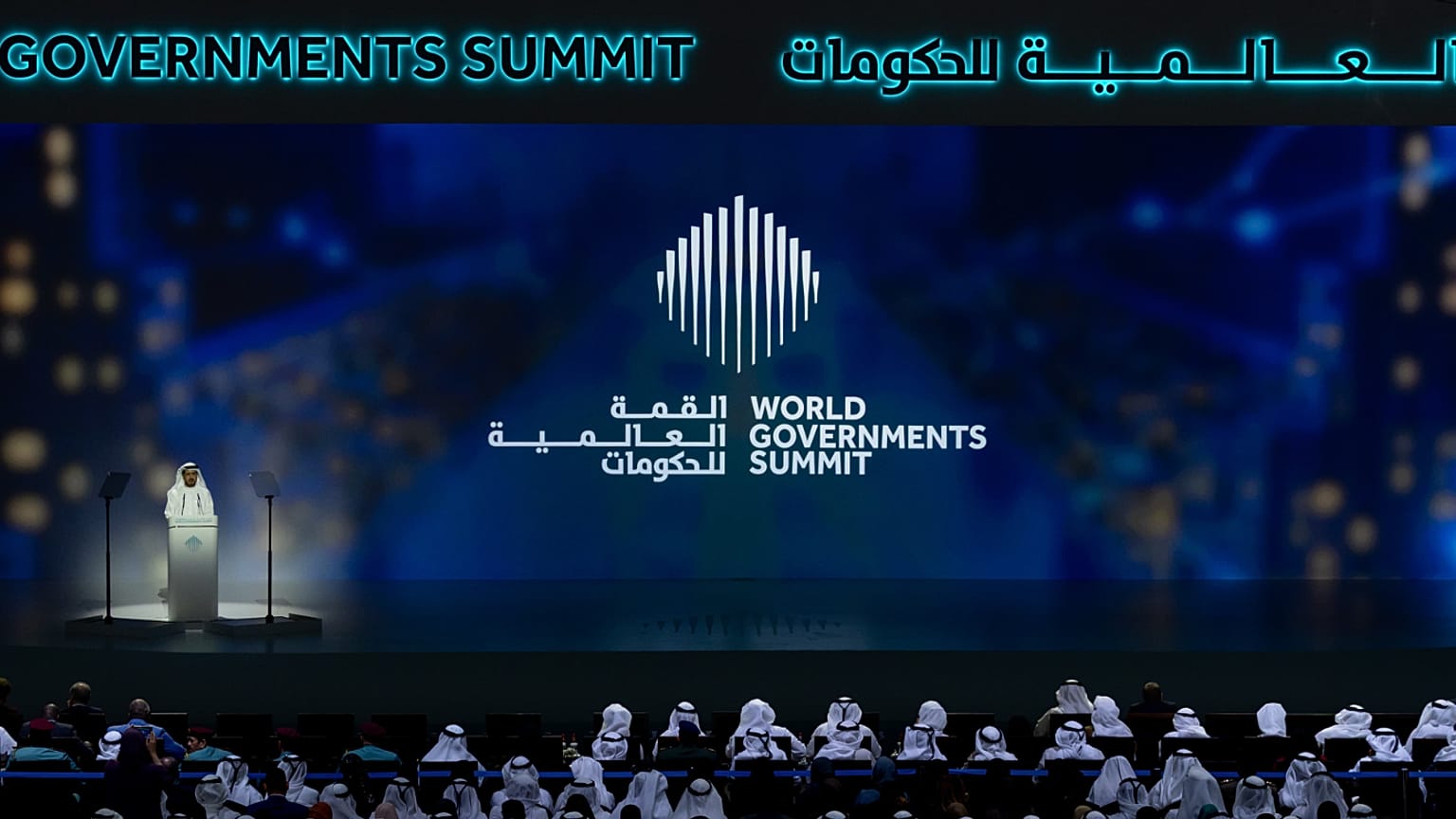













The UAE is using AI to cut bureaucracy, speed up public services and test new technologies, presenting their work at the World Governments Summit in Dubai, which promoted global dialogue.
The United Arab Emirates has set out to be an innovator in implementing artificial intelligence and related new technologies to develop reforms in government services.
 ADVERTISEMENT
ADVERTISEMENT
ADVERTISEMENT
On the sidelines of the recent World Governments Summit in Dubai, where AI was one of the central focuses, Chief of Government Services of the United Arab Emirates Government Mohammed Bin Taliah, told Euronews that the global forum was a stage for governments to compare approaches to refining public services.
AI was the dominant theme across sessions on governance and digital transformation. Governments are increasingly using AI not only to automate workflows but to redesign how citizens interact with the state.
As reducing bureaucracy in public services has always been an objective for the UAE, the UAE government launched the zero-bureaucracy programme in 2023 as a practical attempt to remove unnecessary processes from public services.
“In 2023, the UAE launched the zero-bureaucracy program,” Bin Taliah said, adding that “this program is focused on eliminating bureaucracy and government procedures and processes in public services.”
From one week to 10 minutes
According to Bin Taliah, the programme's initial phase exceeded its targets.
Technology, particularly artificial intelligence, has played a growing role in enabling those changes, he said, allowing processes that once took days to be completed in minutes.
“With AI today, we have achieved improvement in services,” he said. “And in some cases, the services that take around one working week to be completed are now completed in less than 10 minutes.”
He said tools such as facial recognition and optical character recognition are now being used to automate processes that previously required multiple manual steps.
He pointed to everyday examples, such as airport processing, to illustrate how digital systems can reshape interactions between governments and the public.
“If you pass through Abu Dhabi or Dubai airport, you see that today our airports are queue-less,” he said. “Everything, you can pass through smart gates that use spatial biometrics, which allows you to pass through this.”
Bin Taliah told Euronews that the recent World Government Summit has grown into a convening platform for practical strategies to improve government services.
“The World Government Summit is a platform that brings everybody together in one place on a neutral platform to discuss how to make people's lives better, how to make governments more efficient, to serve people faster and deliver better value to citizens around the world," he said.
Not only innovate, accelerate
Meanwhile, UAE Minister of State for Artificial Intelligence, Digital Economy and Remote Work Applications and Vice-Chair of the World Governments Summit Omar Sultan Al Olama told Euronews that the UAE want to deploy AI at record pace.
“Well, if the UAE has to be in the same conversation or in the sentence, I'll say the UAE innovates, but not just innovates, it accelerates,” he said. “We want to deploy AI the fastest.”
He said the country’s diversity and agile governance model enable it to serve as a testing ground for new technologies while remaining open to collaboration across geopolitical divides.
“We can work with east, west, north, and south,” he said. “To be a common place where everyone brings their best AI tools and deploys, and sees how they can compete with the others, but also collaborate with others.”
On the UAE’s wider diplomatic role, Al Olama said the country aims to act as a neutral convener amid increasingly fragmented global dialogue.
“The world requires a place where, whether it's adversaries, whether it is different geographies, to at least have dialog,” he said. “The UAE prides itself on being that, being a place where the world can convene.”
He pointed to past and continuing diplomatic efforts as evidence of that approach.
“All of these things are possible because the UAE does not choose sides,” he said. “We try to be in the middle. We try to work with everyone.”
'We don't preach'
Asked how the World Governments Summit can help navigate worldwide turbulence, Al Olama said sustained dialogue remains the only viable route forward.
“So, if we think about turbulence, the only way through turbulence is, especially when it comes to geopolitical turbulence, is increased dialogue, trying to find the commonalities between leaders, between countries, trying to understand where the pain points are, and finding the bridges to that gap.”
He said the scale of participation at the summit shows a global demand for such engagement.
“A platform like the World Governments Summit that brings together more than 45 heads of state and government, that brings hundreds of ministers, so we have around 600 ministers from around the world participating this year, and thousands of CEOs and international organisations and others, is a platform for dialogue.”
Al Olama added that the event is designed to expose governments to policy approaches and solutions from across the world, encouraging learning and adaptation rather than prescription.
“We don't preach,” he said. “We want to make sure that everyone's point of view is represented, that we have the best-in-class ways of solving problems, the best-in-class government opportunities that exist in every corner of the world presented at the World Governments Summit.”
AI, climate intervention, flying cars, and education reforms dominated discussions at the World Governments Summit 2026, where more than 45 heads of state and around 600 ministers, plus over 500 CEOs gathered in Dubai.