


















Israel has long relied on a multilayered missile defence system, including the Arrow, to protect communities around the country from rocket barrages from militants in Gaza and Lebanon.
Germany inaugurated on Wednesday the first elements of the sophisticated Arrow 3 missile defence system, which it has purchased from Israel as it moves to strengthen its air defences following Russia’s full-scale invasion of Ukraine.
 ADVERTISEMENT
ADVERTISEMENT
ADVERTISEMENT
Arrow 3 is designed to intercept long-range ballistic missiles. The first part of the system was deployed at the Schönewalde base south of Berlin with further sites to follow.
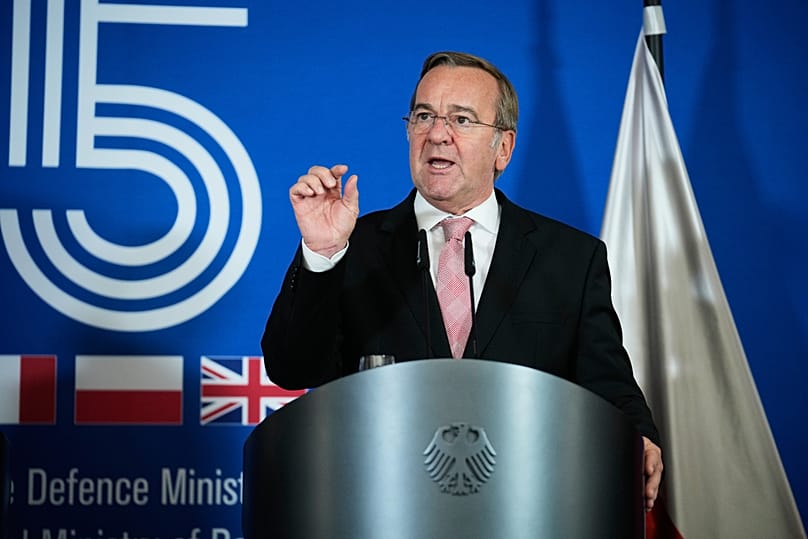
Defence Minister Boris Pistorius said that, with the new system, Germany is obtaining for the first time early-warning and protection capability against long-range ballistic missiles.
"With this strategic capability, which is unique among our European partners, we are securing our central role at the heart of Europe," Pistorius said in a statement.
"So we are protecting not just ourselves but also our partners."
Germany and Israel signed an agreement for Berlin to buy the system in September 2023, weeks after Israel secured US approval for the deal.
That was needed because the system was developed jointly with the United States.
Pistorius put the project's total cost at €3.8 billion. Spokesperson Mitko Müller said the plan is to put further elements in place step by step.
Germany aims to integrate the system into wider NATO and European air defence efforts.
Israel has long relied on a multilayered missile defence system, including the Arrow, to protect communities around the country from rocket barrages from militants in Gaza and Lebanon and more recently from rebels in Yemen and Iran.
German officials warned recently that they expect Russia could be ready to attack NATO in 2029.
Foreign Minister Johann Wadephul stated that new intelligence assessments showed Moscow is preparing for the option of a future attack against the EU and NATO.
"Our intelligence services are issuing urgent warnings: at the very least, Russia is creating the option for itself to wage war against NATO by 2029," according to a Foreign Ministry statement.
"We have to deter further Russian aggression, together with our partners and allies," the statement added.
Suspected hybrid Russian attacks
European countries have registered a surge of suspected Russia-linked activities and Moscow-orchestrated hybrid attacks, including cyber attacks, sabotage attempts and drone and missile incursions into the European airspace.
Unidentified drones have caused airport closures in the Baltic states and Eastern European countries, as well as in Belgium and Germany. Russian fighter jets have also crossed into Estonian airspace.

European Commissioner for Defence Andrius Kubilius told Euronews on Tuesday that Russia’s suspected provocations — including drone incursions and the recent bombing of a Polish rail line —are changing warfare doctrines.
"What we have seen from a technical point of view is that we do not have enough detection capabilities, we have no cost-effective means to destroy drones."
Kubilius also admitted that the EU’s response to this remains inadequate.
"It shows that our way of how we are preparing, how we can change our understanding of modern warfare doctrines, is again not at the required level."