





























Although around 66 per cent of Germans feel the world is faster, more connected, respondents also find it more stressful than it used to be, particularly with the thoughts of war, the TK Stress Report shows.
At least 62 per cent of Germans experience excessive stress, with some eight percent saying they experienced no stress at all, this year's TK Stress Report shows.
 ADVERTISEMENT
ADVERTISEMENT
ADVERTISEMENT
According to the 2025 Stress Report issued by Germany's statutory health insurance fund Techniker Krankenkasse (TK), the wars in Ukraine, Gaza, and Sudan, alongside uncertainty due to trade tariffs and restrictions, pandemics, and authoritarian systems, were among the multiple crises characterising present times, something respondents say has a strong or very strong burden on them.
Around 1,407 persons across Germany participated in the representative survey, which was carried out in May 2025 by polling firm Forsa on behalf of TK.
According to the report, less than half of the stressed respondents (47 percent) stated that the threat to Germany as a business location contributed to their stress, while around 44 per cent of respondents felt stressed by the effects of climate change and environmental problems.
Looking at all respondents as a whole, however, political and social problems, which include factors of war, polarisation and security, were only the third biggest cause of stress, and overall, the report shows Germans are primarily preoccupied with themselves.
The TK report showed the biggest factor that triggers stress is high expectations of oneself. For women in particular, their own demands make them feel stressed, while the biggest trigger for stress for men remains their work situation. Overall, school, studies, and work came in second place.
Stress has increased
According to survey data, back discomfort, fatigue, inner restlessness, sleep difficulties, and irritability are considerably more common among stressed people.
The TK report has been around since 2013 and is the fourth edition. There is a recognisable trend that the perception of stress has continuously increased in recent years. In 2013, more than 10 years ago, 57 per cent felt stress.
Analysts attribute this to an increase in external influences such as political crises and wars.
In comparison, the perception of stress among men has decreased again after the coronavirus crisis, but it has continued to rise among women.
According to the new TK Stress Report, stress is not fundamentally negative, but there must be enough phases of relaxation. A healthy level of stress can then motivate and increase concentration.
People who experience a lot of stress also notice this physically and in terms of their health. People who are often or sometimes stressed suffer significantly more frequently from muscle tension and back pain, exhaustion, inner restlessness, sleep disorders, and irritability. This can be avoided by building and training resilience. Other strategies have also proven effective in coping with stress.
TK CEO appeals to employers
"Employers are also called upon to act. Because work is clearly named as one of the main triggers for stress," explained Dr Jens Baas at the press conference on the report. "Many respondents can no longer switch off properly after work and feel worn out and exhausted. This is where we need to start," he warns.
Stress cannot always be avoided, says Baas, and it is important that "we learn to set ourselves apart in an increasingly fast-paced world and find a healthy way of dealing with it," says Baas.
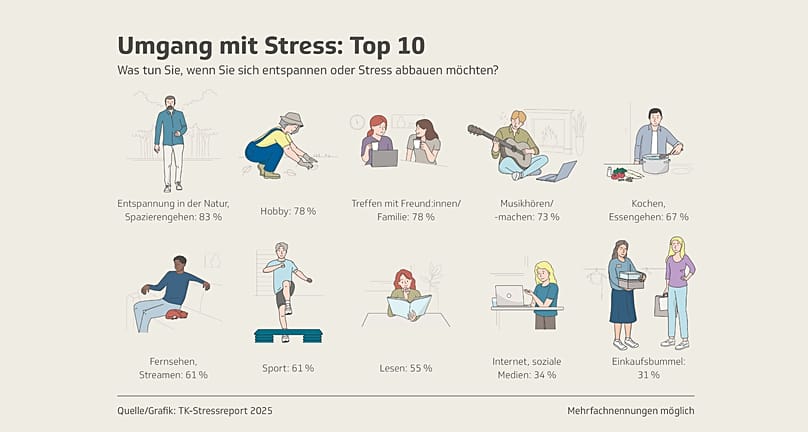
Most of those surveyed stated that going for a walk or spending time in nature helps them to alleviate stress (83 per cent). Having their own hobbies helps 78 per cent to cope with stress. Just as many socialise with family and friends.
Listening to music, cooking for yourself, or going out to eat are also effective methods of initiating the relaxation phase.
"The big difference between personal crises, such as losing your job, and major political and social issues is the sense of control," explains happiness researcher and psychologist Prof. Dr. Judith Mangelsdorf in the TK Stress Report.
If you can influence the situation that is stressing you out, you demonstrate your ability to act and take control. In the case of external influences, you can at least limit how much access you give yourself.
According to happiness researcher Mangelsdorf, we are not evolutionarily designed to deal with the crises of the entire planet all day long.
"This means we have to learn again to control when I inform myself and for what reason, so as not to overload ourselves with unchecked news consumption and doomscrolling."