




























During the night shift, there was an almost total walkout in several National Health Service hospital units. Many schools are closed and flights have been cancelled.
The government has already responded to Wednesday’s general strike, downplaying its overall impact.
 ADVERTISEMENT
ADVERTISEMENT
ADVERTISEMENT
At a press conference at 11.30 a.m., the Minister for Labour, Maria Rosário da Palma Ramalho, said that “the overwhelming majority of workers are at work” and therefore “the country is functioning normally.”
According to the minister, provisional data from CIP (the Portuguese Business Confederation) show that “in the private sector, participation is absolutely residual and in some areas even non-existent”.
In a detailed rundown of sectors, she began with industry: “all factories are operating,” she said.
In retail too, “shops are open”; in banking, “no branches are closed”; and in tourism “there is no disruption, not even in travel agencies” – despite disruption at airports due to cancelled flights.
The minister also said that private hospitals are “operating as normal”, while acknowledging “higher participation” in the public sector.
However, despite greater disruption in the public sector, Maria Rosário Ramalho stressed that “services are being maintained” and reiterated that “the government listens to everyone and fully respects the right to strike”.
This reading by the government clashes with remarks made earlier in the day to reporters by the secretary-general of the CGTP-IN (General Confederation of Portuguese Workers – National Inter-union), Tiago Oliveira. The union leader said that “the figures point to a major strike”.
“The aim is to denounce the labour package, to see the labour package withdrawn,” said Tiago Oliveira outside Nuno Gonçalves primary school in Lisbon, which is closed because of the general strike.
“For ten months, workers have shown that they do not want the labour package and the prime minister (Luís Montenegro) has shown arrogance and a lack of respect for workers,” he added.
The walkout is a protest against a proposed reform of labour legislation, also known as “Trabalho XXI”, put forward by the PSD/CDS-PP government and comprising more than 100 changes to the Labour Code. The package was discussed in the framework of Social Concertation, but the government led by Luís Montenegro failed to reach agreement with the social partners, prompting the CGTP-IN to go ahead with the strike notice it had already announced.
Hospitals affected since yesterday
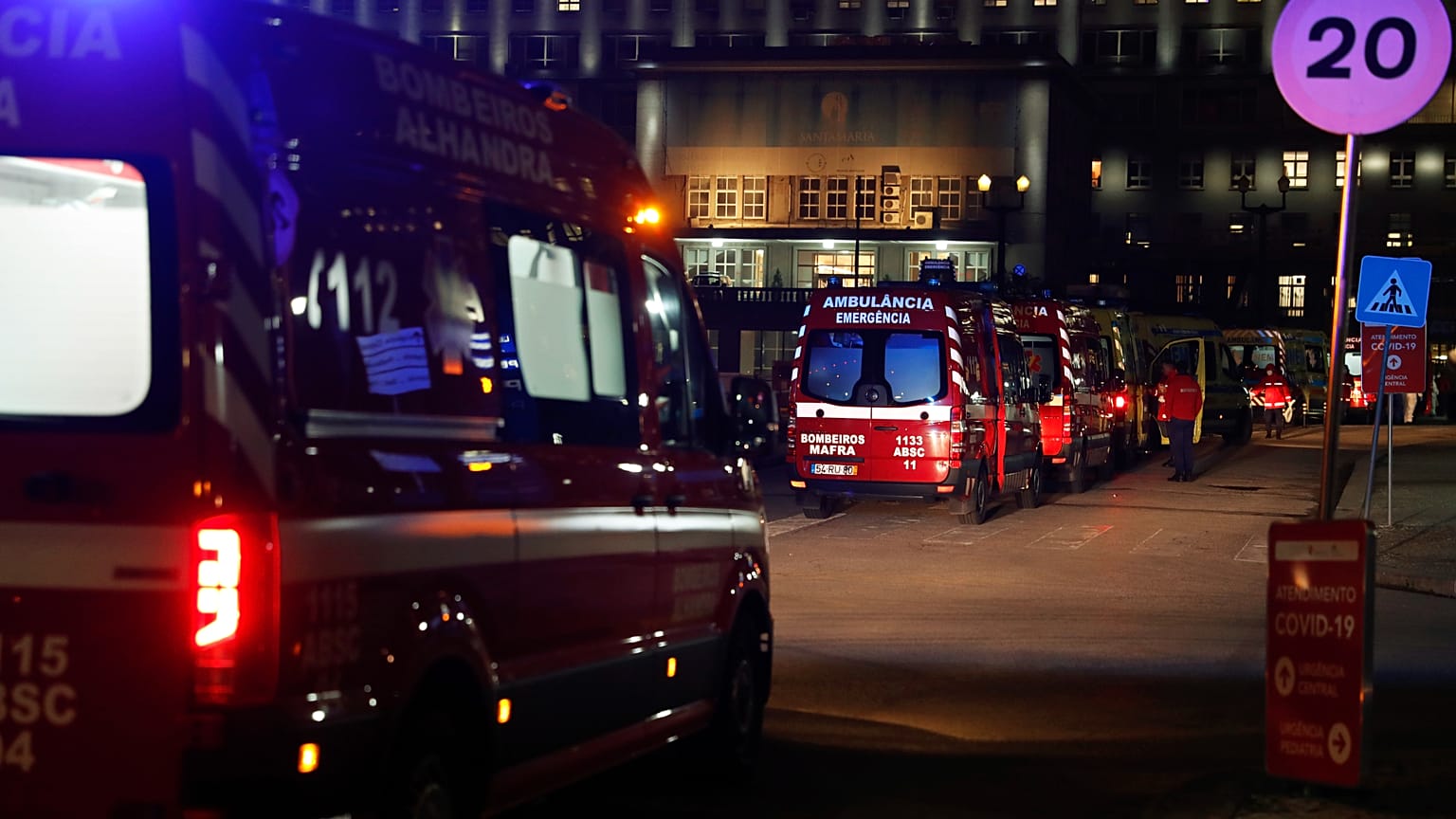
The general strike led to an almost total shutdown on the night shift in National Health Service (SNS) hospitals.
According to the National Federation of Trade Unions of Public and Social Service Workers (FNSTFPS), participation by SNS staff in last night’s strike was between 95% and 100%, reflecting strong opposition to the labour package.
The impact of the strike has been felt in several health units across the country. São Francisco Xavier Hospital, part of the Lisbon Ocidental Local Health Unit (ULS), and São José Hospital, in the Lisbon Oriental ULS, both saw 100% participation. At Santa Maria Hospital, also in the Lisbon Ocidental ULS, participation was 90%, while at Vila Franca de Xira Hospital, in the Estuário do Tejo ULS, it stood at 71%.
In Porto, there was full adherence to the strike at the Viseu Dão Lafões ULS hospital and at São João Hospital. The Portuguese Oncology Institute in Porto recorded 90% participation.
The Bissaya Barreto Maternity Hospital and the University Hospitals campus, both part of the Coimbra ULS, reported a total shutdown by their staff. At Santarém Hospital, in the Lezíria ULS, participation in the strike was 74%.
According to SIC Notícias, outpatient consultations at Portalegre Hospital are not taking place, although minimum services are being ensured.
This is the first time that SNS 24 (source in Portuguese) staff have joined a general strike, which means it may be harder today to speak to a health professional via this helpline. Waiting times could reach three hours. The stoppage comes at a time when the SNS 24 line is already under heavy operational pressure.
Schools closed on the day of the Year 6 Portuguese exam
Many schools are also closed across the country, affecting the Year 6 Portuguese exam scheduled for Wednesday.
Speaking to SIC Notícias, the secretary-general of FENPROF, José Feliciano da Costa, said there was “significant participation” in the strike in Sintra, Olivais, Fundão, Coimbra, Moita, Castelo Branco and Mafra. He argued that the Education Minister’s decision not to postpone the exam shows that “the exams are not a priority” and “can be held on any other day”.
Almost 190 flights cancelled, metro at a standstill and river links suspended
As for international flights, almost 190 have been cancelled so far at Lisbon, Porto and Faro airports.
The ANA – Aeroportos de Portugal (source in Portuguese) website shows that at least 43 arriving flights have been cancelled at Lisbon airport, along with 46 departures. At Francisco Sá Carneiro airport in Porto, 29 arrivals and 27 departures have been cancelled. In Faro, 21 arrivals and 23 departures have been called off.
The Lisbon Metro (source in Portuguese) is also at a standstill, as it has no minimum service. In the Porto Metro (source in Portuguese), which has no service on four lines – Green, Red, Purple and Orange – only the Blue and Yellow lines are running.
Tejo River services operated by Transtejo (source in Portuguese), which connect the two banks of the river, have seen multiple connections suspended. CP – Comboios de Portugal (source in Portuguese), for its part, is forecasting disruption to train services.
More than twenty companies across the country have also suspended operations.
The Labour Code stipulates that, in the event of a strike, minimum services must be guaranteed in companies or institutions providing essential services to meet pressing social needs. These include postal and telecommunications services, medical, hospital and pharmaceutical care, public health and hygiene – including funerals – as well as energy and mining services, particularly fuel supply.
Story being updated