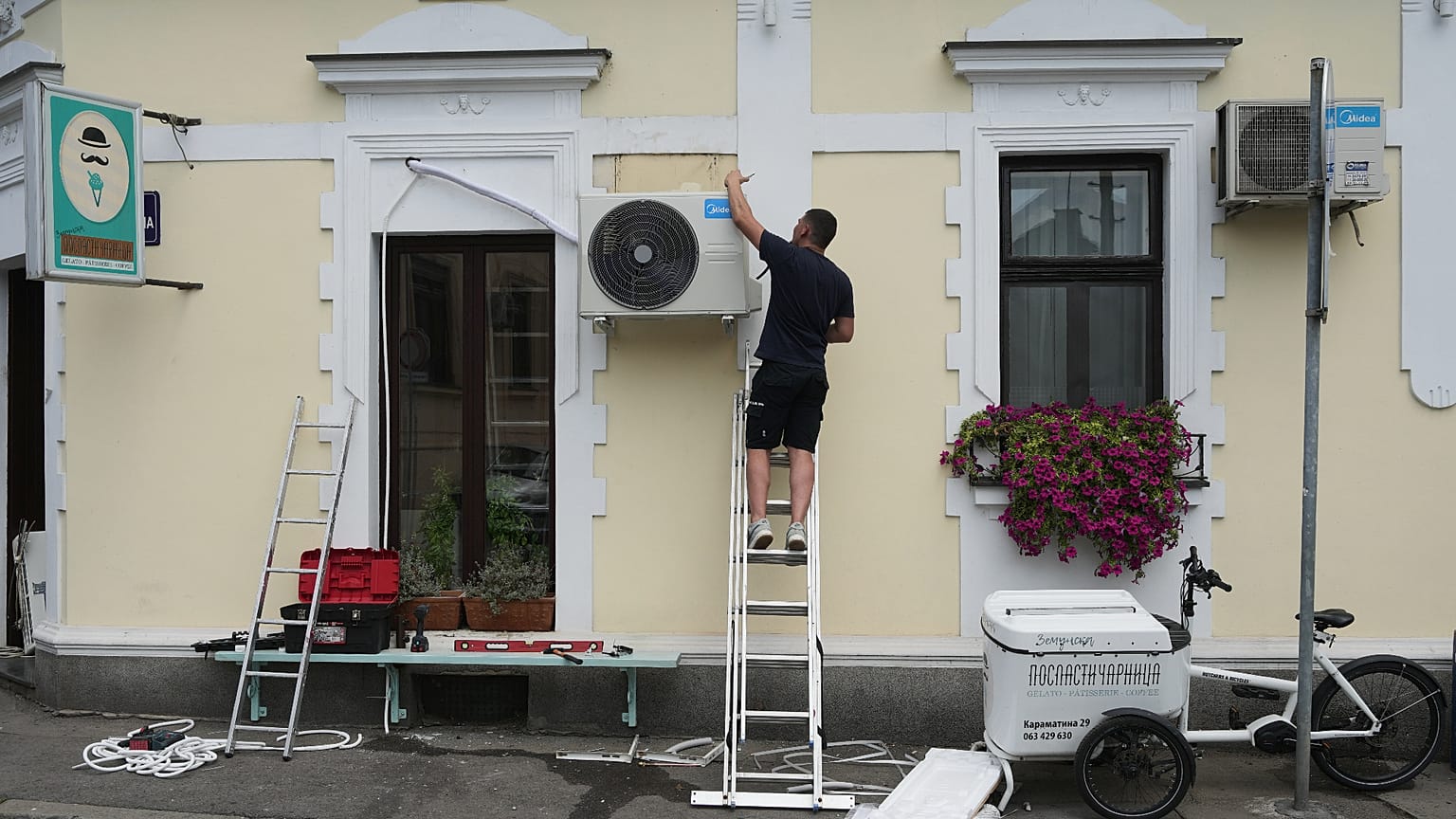













Household air conditioning prevents over 5,000 heat-related deaths every year in the United States alone, a new study found.
As rising temperatures take a toll on human health, air conditioning at home is about more than comfort. A recent study published on Monday in Nature Health found that it also saves thousands of lives.
 ADVERTISEMENT
ADVERTISEMENT
ADVERTISEMENT
Over 5,260 heat-related deaths are prevented every year in the US, reducing heat-attributable mortality by more than half, according to a new study by Yale School of Public Health and the Yale School of the Environment.
“Everyone agrees that air conditioning works, but knowing that it works for one person is not the same as knowing how much death it prevents across an entire population,” Kai Chen, senior author of the study and an associate professor of epidemiology at Yale School of Public Health, said in a press release.
But turning the air conditioning up to maximum does not necessarily save more lives, the study found. Maximum cooling offered no additional health benefits compared with average use, highlighting the need to balance the health benefits of air conditioning against the environmental costs of excessive use, including higher energy consumption and greenhouse gas emissions.
Lower-income and heat
The researchers analysed nearly 30 million death records from 2010 to 2020, matching each death with the daily temperature in the county where it occurred. They then compared those patterns with estimates of household electricity consumption for cooling in each county.
The researchers focused on actual cooling use rather than air-conditioning ownership. Knowing whether a household has an air conditioner says little about whether residents can afford to run it, or how often they do so, Chen said.
The findings shed light on how lower-income households cope with extreme heat, said Narasimha Rao, a study co-author and professor of energy systems at the Yale School of the Environment.
“While some choose to turn on their ACs, others make the uncomfortable choice of bearing the heat to save money for food,” Rao said.
Furthermore, the findings could also have implications for housing policy, said Robert Dubrow, a study co-author and founding faculty director of the Yale Center on Climate Change and Health.
“Landlords in the United States are required to provide heating in the winter, and our study contributes to a compelling body of literature that indicates they also should be required to provide cooling in the summer,” Dubrow said.
The study comes as, across the Atlantic, in Europe, the question of air conditioning has become a political battle. French politicians have drawn ideological battle lines over air conditioning as Europe struggled with record-breaking temperatures, reaching over 40°C.
Meanwhile, the European Commission advocates a "holistic" approach that combines passive and efficient cooling technologies. Rather than encouraging mass installation of air-conditioning units, Brussels wants Europe to prioritise cooler buildings and cities through design, insulation and passive measures, using efficient air conditioning where it is genuinely needed.