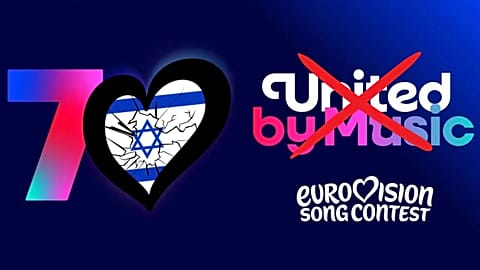






























"We do not accept complicity with the violation of Human Rights," the Portuguese artists said in a joint statement, referencing Israel's actions in Gaza -which an independent United Nations inquiry found to be a genocide.
Could Portugal’s participation in next year’s Eurovision Song Contest be at risk?
Following the news that Iceland has joined Ireland, Spain, the Netherlands and Slovenia in dropping out of Eurovision 2026, 17 Portuguese artists and performers in the country’s song selection contest, Festival da Canção, have announced they are refusing to represent Portugal if they win.
The entrants in the internal contest to elect a representative put forward a statement, protesting Israel’s controversial participation in the contest.
The signatories include Cristina Branco, Bateu Matou, Rita Dias, DjoDje, Beatriz Bronze (Evaya), Francisco Fontes, Gonçalo Gomes, Inês Sousa, Jorge Gonçalves (Jacaréu), Marquise, Nunca Mates o Mandarim, and Pedro Fernandes.
“With words and with songs, we act within the possibilities we are given. We do not accept complicity with the violation of Human Rights,” they said.
“Despite Russia’s ban from Eurovision 2022 for political reasons (the invasion of Ukraine), we were surprised to see that the same stance was not taken towards Israel, which, according to the United Nations, is committing acts of genocide against Palestinians in Gaza.”
Portugal’s broadcaster RTP has issued a statement in response to the artists’ words, saying: “Regardless of the decision of the artists who subscribe to the statement, RTP will once again organise Festival da Canção and reaffirms its participation at the Eurovision Song Contest 2026.”
Salvador Sobral, the only Portuguese artist to win Eurovision, criticised RTP's position in a video on social media, in which he accused of the Portuguese broadcaster of "political cowardice."
The outrage has also reached the Portuguese public, who have launched a petition calling for Portugal's immediate withdrawal from Eurovision.
Already signed by more than 22,000 people, the document highlights RTP's vote in favour of Israel's participation "puts Portugal on the wrong side of history".
"This stance is unacceptable in the face of the ongoing humanitarian catastrophe and military offensive in the Gaza Strip, and in the face of the vote rigging scandals that marred the 2025 edition in Basel, proving the inability of the organisation (EBU) to curb the politicisation of the event," it reads.
Last week, Israel’s participation in Eurovision 2026 was confirmed by the EBU. There was no vote held on Israel’s participation at the EBU’s general assembly, and as a result, Ireland, Spain, the Netherlands and Slovenia confirmed they would boycott the event for good.
Yesterday, following a board meeting of the broadcaster RÚV, Iceland became the fifth country to join the boycott.
They said in a statement that Israel’s participation “has created disunity among both members of the European Broadcasting Union (EBU) and the general public.”
The broadcaster went on to add that participating would be “neither be a source of joy nor peace” considering public opinion in Iceland and the reaction to the EBU’s general assembly last week.
Next year’s Eurovision – the 70th edition of the contest – will take place in Vienna on 16 May 2026.