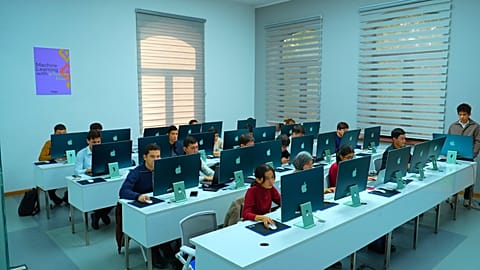






























Uzbekistan has signed an agreement with South Korea’s ROBOTIS to launch humanoid robot production, marking a major step in its high-tech ambitions. At the same time, students across the country are learning robotics and programming, gaining skills that could prepare them for careers in the emerging
Uzbekistan is preparing to produce humanoid robots for the first time, as part of a new partnership with South Korea’s robotics company ROBOTIS – a move that signals the country’s ambitions to enter the global high-tech manufacturing sector.
 ADVERTISEMENT
ADVERTISEMENT
ADVERTISEMENT
The agreement, signed between the UzElTechSanoat Association and ROBOTIS, outlines plans to establish humanoid robot production inside Uzbekistan, develop manufacturing infrastructure and train specialists for the emerging robotics industry.

ROBOTIS, known for its humanoid platforms and smart robotic actuators, will support the creation of technological foundations and help prepare a workforce capable of designing and operating advanced robotic systems.
The initiative reflects Uzbekistan’s broader push to build a domestic innovation ecosystem, one that depends not only on industrial cooperation but also on a new generation learning robotics from an early age.
Where Uzbekistan’s robotics future begins
That long-term strategy starts far from industrial facilities, inside classrooms.
In a robotics classroom, 12-year-old Mirkomil Shodiev connects his robot to a laptop. A few lines of code later, the machine comes alive – its motor activates, wheels turning in response to commands he programmed himself.
Built from an EVO-3 educational robotics kit, which allows students to assemble and program their own machines, the robot can execute mechanical tasks based on coded instructions. Once connected to a computer, Mirkomil writes algorithms that control its motor functions, allowing it to move, respond to inputs and perform programmed sequences autonomously.
“This was created by me,” he says. “You connect it to a computer, write code, and it performs tasks using the motor.”
Mirkomil began attending IT classes just four months ago, driven by curiosity about robotics, websites and design. Since then, he has learned to build games on Scratch and is now studying Python, a programming language widely used in web development, automation and robotics.

“After learning Python, I want to create websites and earn money when I grow up,” he says.
His ambitions reflect a broader transformation underway in Uzbekistan, where digital skills are becoming increasingly important for employment and economic growth.
According to Uzbekistan’s Digital Uzbekistan-2030 strategy, the government is expanding nationwide training in programming and digital skills, as IT education centres and specialised academies grow rapidly to meet rising demand for technology careers.
Classrooms turning ideas into real systems
At the Robot Academy, where Mirkomil studies, children aged eight to fifteen learn programming, robotics and engineering through hands-on projects.
“Our students create scientific projects, develop games and build Telegram bots,” says teacher Navruz Shaydullayev. “Programming helps develop their thinking, logic and intellectual abilities.”
Lessons focus on platforms such as Scratch and EVO-3 educational robotics kits, modular systems that let students build and program their own robots allowing them to design, assemble and control machines independently.
Because robotics combines software and hardware, students learn how digital commands translate into physical movement – a key principle behind industrial automation, robotics and modern manufacturing.
“They are curious and ask many questions,” Shaydullayev says. “We help them turn their ideas into real projects and develop their skills step by step.”

From classroom experiments to national industry
Uzbekistan’s partnership with ROBOTIS could eventually create new career paths for students like Mirkomil, connecting education with industrial robotics production.
The agreement includes training programmes for specialists, ensuring that the country develops its own robotics engineers, programmers and technicians.
In the long term, the initiative could strengthen Uzbekistan’s technological competitiveness and create highly skilled jobs in one of the world’s fastest-growing sectors.
For Mirkomil, the future he imagines already feels within reach.
“In the future I want to continue in this field,” he says. “After finishing the courses, I would like to study in Tashkent as well.”
As Uzbekistan prepares to manufacture humanoid robots, classrooms like his are quietly training the people who may one day build them.
Read more