
















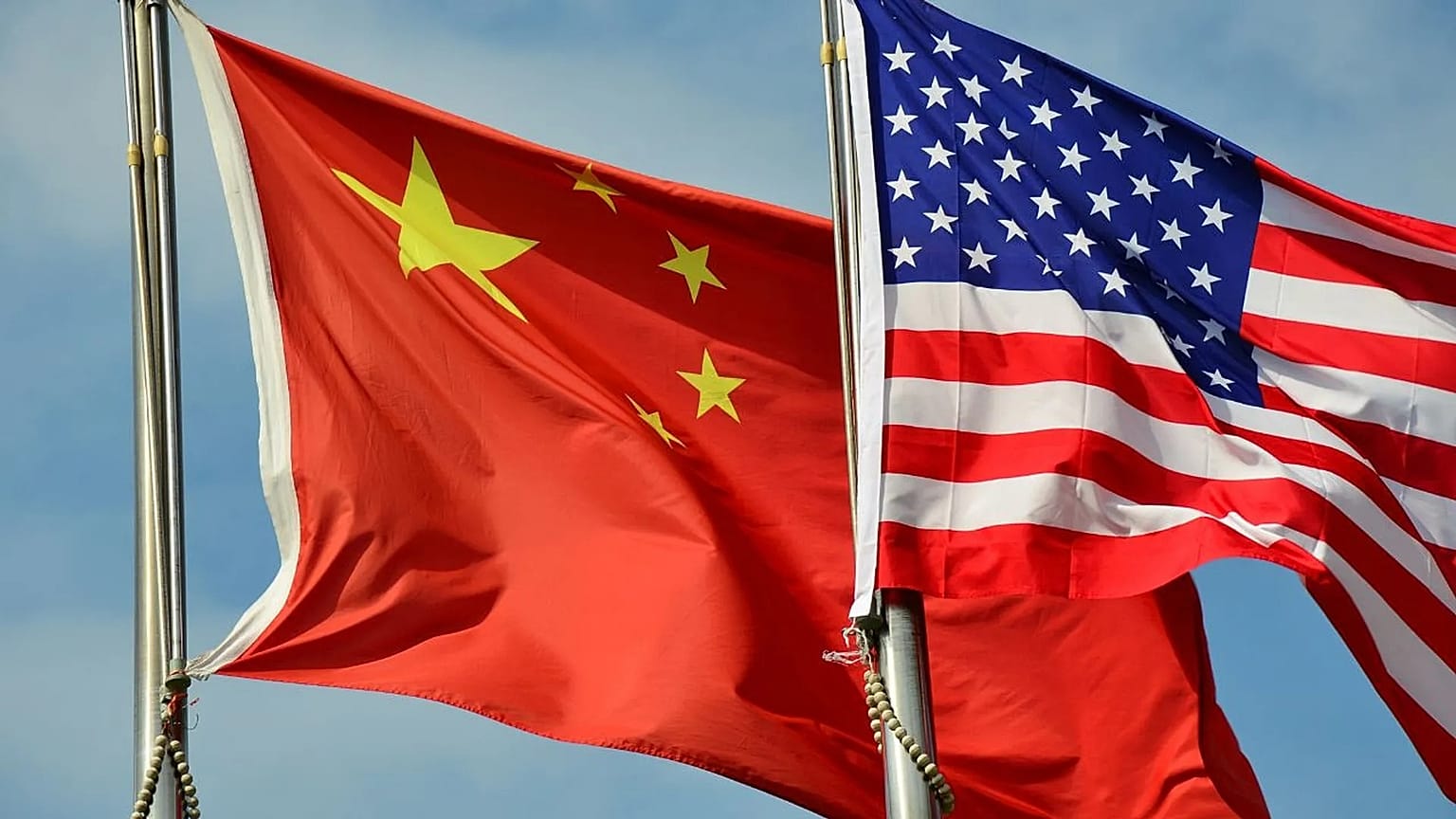













As Trump heads to Beijing for a summit with Xi Jinping, AI-enabled warfare, cybersecurity and the deepening US-China tech rivalry are set to dominate talks, even as a breakthrough deal on semiconductors looks unlikely.
Trade and geopolitics are expected to dominate the agenda, but United States President Donald Trump’s guest list for his trip to China suggests technology will also be on the table for talks on Thursday with his Chinese counterpart, Xi Jinping.
 ADVERTISEMENT
ADVERTISEMENT
ADVERTISEMENT
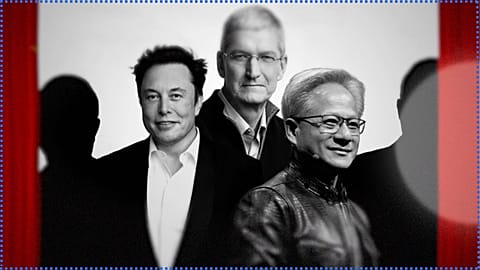
Among those making the trip alongside Trump are Apple’s CEO Tim Cook and Tesla CEO Elon Musk and Nvidia’s chief Jensen Huang.
An Nvidia spokesperson told Euronews Next that "Jensen is attending the summit at the invitation of President Trump to support America and the administration's goals".
But rather than semiconductors, the agenda is more likely to focus on Iran, Taiwan and artificial intelligence-enabled warfare - especially following its widespread use in conflicts in Gaza and Iran.
Artificial intelligence has become central to the US-China tech race and there are hopes that both leaders will talk about cooperating on the technology.
AI warfare
“The big top shelf items” on the agenda will be the geopolitical instabilities created by the conflict in Iran, and also the uncertainty now about whether the US can really be a protective factor in the tensions between China and Taiwan, said David Leslie, director of ethics and responsible innovation research at The Alan Turing Institute.
“In terms of how that might relate to AI, one dimension that I? think will have to be covered in one way or another is this new age of AI-supported warfare that we've kind of found ourselves in within the past eight months,” he told Euronews Next in reference to the Nicolás Maduro raid in Venezuela, Israel's ongoing military campaign in Palestine, and the broad deployment of AI across various applications in Iran.
“I think that there are these issues about AI-enabled warfare that will be salient and on the table in the discussions, because China and the US had already sort of opened up conversations about this, especially with regard to nuclear,” he added.
The Trump-Xi summit comes several weeks after the American AI company Anthropic released its cyber-focused model Mythos to several businesses and cybersecurity firms.
Anthropic said that the model could not be released to the public as it “poses unprecedented cybersecurity risks”.
Frontier AI models that expose vulnerabilities in national cybersecurity infrastructure are set to be a critical talking point between China and the United States, given the implications such weaknesses carry at the highest levels of national security, Leslie said.
But another factor that will be important is the outsized influence that Trump's Big Tech allies have wielded over this administration — to the point where it could be said that Silicon Valley has largely been driving policy rather than the other way around, Leslie added.
This could mean that the US stance on issues like cybersecurity and the alleged theft of American intellectual property by Chinese tech companies, allegedly copying American AI models, may be shaped less by diplomats and more by the tech executives who have become so central to this administration.
“I do think that one of the defining features of the way tech policy has evolved from the Trump administration side is that it has all been largely dictated by the interests of Silicon Valley,” Leslie said.
The AI race
While the US may have a more company-led approach to AI, China is pushing ahead with education and research ecosystems.
Beijing has a mandate to achieve an AI penetration rate of more than 70% in key industries by 2027.
China has also caught up with the US in AI companies, such as DeepSeek, which claim to have cheaper alternatives to ChatGPT and perform just as well. China is also pushing for its own chip industry, with Huawei, Alibaba, and ByteDance starting their own chip design businesses.
As such, China’s AI advances have closed the gap with the US, according to this year’s annual AI report by the Stanford Institute for Human-Centered Artificial Intelligence.
According to the report, the US has the edge over capital, infrastructure and AI chips. But China wins in patents, publications, and physical AI (otherwise known as robotics).
Coming together
But there are complex interdependencies between the two countries. China’s rare earth minerals, including metals such as cerium and lanthanum, are crucial for modern technologies, and mark one of these interdependencies that can create tension as well as leverage.
“I think it's a complex picture, and I think the US in a way is in less of a strong position now than it might have been before,” said Leslie.
Pointing to the US’s depletion of its own military stockpiles of equipment and hardware, the US will need more robust access to lots of different rare earth minerals just to build back, Leslie said there are “changing and weakening elements of the US's position that are also kind of at play and a factor in the relationship”.
There could, however, be a reasonable case that China could push for the US to ease some of its export restrictions on controlled technologies, which could also help address the trade deficit, according to Jacob Gunter, head of program of "economy and industry" at the MERICS think tank, said during a press briefing.
“But even Beijing has kind of shown when the Trump administration has lessened or made exceptions for things like certain Nvidia chips to be allowed to be sold to China, the response from the Chinese side has been basically, no, we don't want them, actually we find it more important in the long term to continue to plough all demand for chips in China to be focused on domestic producers,” he said.
That said, there is likely a point at which access to the most powerful, high-performance chips would offer China enough of an advantage in accelerating AI development to outweigh the benefits of propping up its domestic industry, he added.
Any attempt by Trump to broker some kind of semiconductor or AI agreement would almost certainly face fierce resistance from the national security wing of his administration, led by figures like Marco Rubio, United States Secretary of State.
“I think these are basically red lines where we're kind of locked in on these two fronts: AI and semiconductors are two of the many different fronts of the new Cold War that we exist in.
“They don't have to include measures on those. On AI and chips, in order to achieve a deal, and I think they'll probably end up leaving these to the side,” Gunter said.
It is also in humanity's own interest that the AI race is not one to the bottom that threatens human existence.
“I think that each nation, each state, finds itself in a very different context in terms of how the technology is evolving within their own environments. And how the innovation environment and the uptake of the technology is being received by the different populations,” Leslie said.
With the pace of AI taking off, there has already been backlash, or what is being called techlash 2.0 in the US, with data centres being built and straining energy and water resources, displacing entire neighbourhoods. Meanwhile, fears of AI disrupting jobs even in the tech sector continue.
In China, the more centralised nature of power has led to more aggressive industrial policies and more control on the large-scale direction, Leslie said.
“It's not only been that there's for a long time been a perception that China doesn't want to be left behind in this supposed technology race, but also a deeper sense that the kind of evolution of the technology as it applies within China, will be more in the service of the public interest in some ways,” he said.
“There have been certain enabling conditions or a greater degree of belief or confidence in that direction, because China's domestic policies on AI and AI governments have been relatively progressive vis-a-vis protecting the population against harm,” he added.
This story was updated to include that Nvidia's CEO, Jensen Huang, would also be attending.