














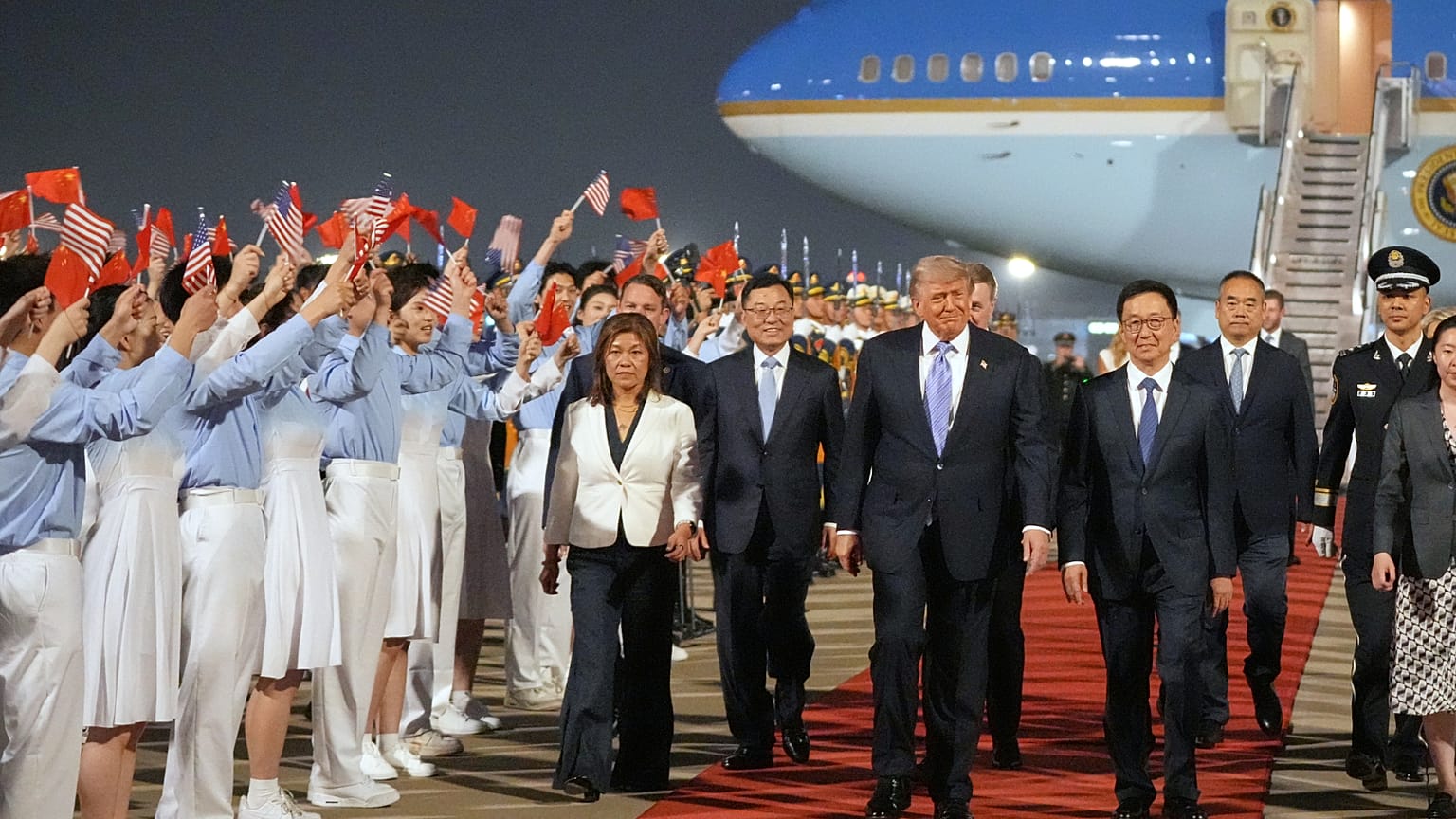













A handful of US tech titans are joining President Donald Trump in Beijing for the summit with Xi Jinping. Here’s a look at the ties that each tech company has in China.
A delegation of tech executives, including Nvidia’s Jensen Huang, Apple’s Tim Cook, and billionaire Elon Musk, is in Beijing with US President Donald Trump to meet with President Xi Jinping for a summit.
 ADVERTISEMENT
ADVERTISEMENT
ADVERTISEMENT
The goal of the summit is to get China to “open up” to American firms and to facilitate dialogue on critical economic issues such as trade barriers, artificial intelligence development and geopolitical stability, according to a White House official.
However, many of these tech leaders already have working relationships with China or do business there. We take a closer look at their ties to the world’s second-largest economy.
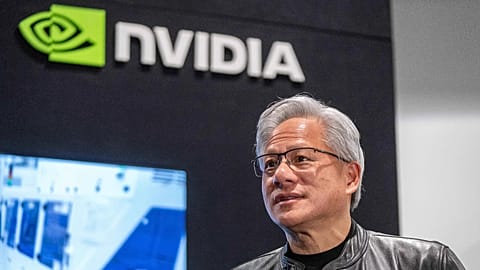
Jensen Huang
The CEO of Nvidia, the trillion-dollar semiconductor chip powering the artificial intelligence (AI) boom, has deep business and personal ties to both China and Taiwan.
Jensen Huang was born in Taiwan and was sent by his parents to live in the United States when he was nine years old.
But Nvidia’s business relationship dates back to 2011, when the company began teaching Chinese university students how to use its Compute Unified Device Architecture (CUDA) software for AI engineering.
By 2017, Nvidia announced it was supplying chips to many of China’s up-and-coming AI and cloud computing companies, including internet search engine Baidu, cloud provider Tencent, and Alibaba’s cloud computing branch, AliCloud.
TSMC, the world’s largest semiconductor manufacturing company in Taiwan, has been building Nvidia’s new chip designs since 1998.
But in 2022, former US president Joe Biden imposed export restrictions on two of Nvidia’s most advanced chips, the A100 and H100. The new rules prohibited Nvidia from selling its tech to China or Russia.
Nvidia reported in a tax filing to the US government that year that it expected to make $400 million (€341.7 million) in potential sales to Chinese companies, which could be lost to export restrictions.
Wang Wenbin, a spokesperson for China’s foreign ministry, reportedly said in 2022 that US export restrictions are a “sci-fi hegemony” move that will “hobble and suppress the development of emerging markets and developing countries”.
To comply with the export restrictions, Nvidia developed the H20 chip in 2023, an “AI accelerator” chip that could be sold in China. None of those chips has reached China, according to Nvidia in February.
Orders for Nvidia’s H20 chip skyrocketed after the debut of DeepSeek, China’s low-cost AI model seen as a major competitor to American AI companies like OpenAI, according to Reuters.
This led to an initial restriction of H20 chips by US President Donald Trump in April 2025, then a quiet reversal in July 2025.
During the initial 2025 H20 restrictions, Nvidia reported that it would lose approximately $5.5 billion (€4.7 billion) in sales to China based on its projected revenue.
Last September, Beijing launched an investigation into H20 chips, citing security concerns. This led to an import ban imposed by China, according to Chinese media.
Huang said at the end of 2025 that Nvidia lost all its market share in China, going from an all-time high of 95% down to zero.
Now, Chinese AI companies, including DeepSeek, are building models that can use built-in-China solutions instead of Nvidia, such as Huawei’s “Ascend” chip cluster. Other companies, including Alibaba and ByteDance, the owners of TikTok, have also started their own chip design businesses.
Apple and Tim Cook
Apple began its relationship with China in the late 1990s, when the company started looking for a local supply chain in Asia to build its computers, according to an interview with Patrick McGee, the author of Apple in China.
Tim Cook, a new hire at the time at Apple, approached Terry Guo, the founder of Foxconn, a Taiwanese multinational electronics manufacturer, with the idea of manufacturing in China, McGee said.
Back then, China was not known for quality production, and McGee argues that Apple helped them build higher-quality electronics.
By 2003, Apple started consolidating most of its manufacturing in China and away from regional offices in Europe and the US, because China adopted policies for companies such as Apple and was scaling companies quickly, McGee wrote.
However, multiple investigations into Apple’s Foxconn factories in the 2010s found that workers were subject to unpaid wages and excessive working hours.
The company’s factories were also described as “labour camps” by roughly 20 Chinese universities, local media reported.
Cook has played a role in mitigating US-China relations during tense times, warning President Trump during a 2018 trade war with China that a tough stance on the country could threaten Apple’s position in the country, according to the New York Times.
He has succeeded in getting his company spared from tariffs twice: 10 of his 15 requests for tariff exemptions were approved in 2019, then again in 2025, when Apple was spared a 25% tariff on iPhones not manufactured in the United States.
Cook has also poured much of Apple’s money into China, with a $275 billion (€235 billion) deal signed in 2021 to ease regulatory pressure on the company's operations. Later, in 2025, Cook unveiled plans for a $101 million (€86 million) energy fund, according to Reuters.
Elon Musk
The major business relationship between Musk and China is in his electric car company, Tesla.
In 2013, the company said it planned to launch its Model S sedan to customers in China through a flagship store in Beijing. However, plans were initially stalled due to copyright issues with a Chinese businessman.
The decision for Tesla to enter China was not well received by industry analysts at the time, who described China’s electric vehicle market as “in its infancy” and there was a lack of charging infrastructure, which would pose an issue for the brand.
More than half of the almost 5,000 Model S in China were not registered with the Chinese government in 2014, which reporting suggested meant they were lying idle. Media reports said that Musk’s China expansion was a “flop.”
Then the company turned around in 2016, when it tripled sales to over $1 billion (€854 million), according to media reports.
By 2019, Musk launched a $2 billion (€1.7 billion) gigafactory in Shanghai, which has produced over 4 million vehicles as of October 2025.