













Newsletter Newsletters Events Events Podcasts Videos Africanews
Loader
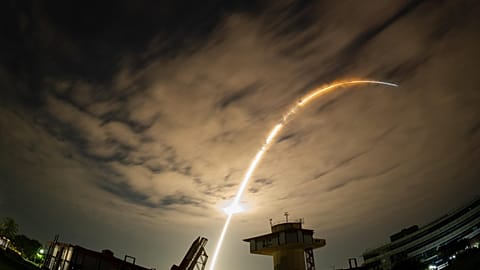
NASA's Artemis II moon rocket lifts off from the Kennedy Space Center's Launch Pad39-B Wednesday, April 1, 2026
NASA's Artemis II moon rocket lifts off from the Kennedy Space Center's Launch Pad39-B Wednesday, April 1, 2026 Copyright  Credit: AP Photo/John Raoux
Copyright Credit: AP Photo/John Raoux

In pictures: Artemis II astronauts embark on historic NASA mission to the Moon and back

By Theo Farrant & AP
Published on
Share
Share Close Button

Four astronauts have embarked on a high-stakes flight around the moon, marking humanity’s first lunar voyage in more than half a century.

After several delays - including months of postponements caused by hydrogen fuel leaks discovered during earlier countdown tests - NASA has finally launched its first crewed lunar mission in more than 50 years.

ADVERTISEMENT
ADVERTISEMENT

Four astronauts lifted off Wednesday (1 April) aboard Artemis II, marking humanity’s return to deep space exploration and the first crewed journey around the Moon since the Apollo era.

The 32-story Space Launch System rocket launched from Kennedy Space Center before tens of thousands of spectators. Crowds jammed the surrounding roads and beaches, reminiscent of the Apollo moonshots in the 1960s and ’70s.

Here are some spectacular pictures from the historic event:

Astronauts Jeremy Hansen, Victor Glover, Reid Wiseman and Christina Koch depart the Operations and Checkout Building en route to Launch Pad 39-B ahead of the Artemis II launch
Astronauts Jeremy Hansen, Victor Glover, Reid Wiseman and Christina Koch depart the Operations and Checkout Building en route to Launch Pad 39-B ahead of the Artemis II launch Credit: AP Photo/Chris O'Meara
NASA employees react as the Artemis II crew depart for Launch Pad 39-B ahead of liftoff at Kennedy Space Center, April 1, 2026.
NASA employees react as the Artemis II crew depart for Launch Pad 39-B ahead of liftoff at Kennedy Space Center, April 1, 2026. Credit: AP Photo/Chris O'Meara

a

The NASA Artemis II SLS (Space Launch System) rocket with the Orion spacecraft launches at the Kennedy Space Center, Wednesday, April 1, 2026
The NASA Artemis II SLS (Space Launch System) rocket with the Orion spacecraft launches at the Kennedy Space Center, Wednesday, April 1, 2026 Credit: AP Photo/Chris O'Meara
Spectators look on from the A. Max Brewer Bridge as NASA's Artemis II moon rocket lifts off
Spectators look on from the A. Max Brewer Bridge as NASA's Artemis II moon rocket lifts off Credit: AP Photo/Phelan M. Ebenhack

“On this historic mission, you take with you the heart of this Artemis team, the daring spirit of the American people and our partners across the globe, and the hopes and dreams of a new generation,” launch director Charlie Blackwell-Thompson told the crew right before liftoff. “Good luck, Godspeed Artemis II. Let’s go.”

The crew - Commander Reid Wiseman, pilot Victor Glover, mission specialists Christina Koch and Canada’s Jeremy Hansen - form the most diverse lunar team ever assembled, including the first woman, person of colour and non-U.S. astronaut to travel to the Moon.

Five minutes into the flight, Commander Wiseman saw the team’s target: “We have a beautiful moonrise, we’re headed right at it,” he said from the capsule.

NASA's Artemis II moon rocket lifts off from the Kennedy Space Center's Launch Pad 39-B Wednesday, April 1, 2026
NASA's Artemis II moon rocket lifts off from the Kennedy Space Center's Launch Pad 39-B Wednesday, April 1, 2026 Credit: AP Photo/John Raoux
Guests watch the launch of the Space Launch System (SLS) rocket and Orion spacecraft for the Artemis II mission
Guests watch the launch of the Space Launch System (SLS) rocket and Orion spacecraft for the Artemis II mission Credit: Bill Ingalls/NASA via AP
Spectators view NASA's Artemis II moon rocket launch from the A. Max Brewer Bridge.
Spectators view NASA's Artemis II moon rocket launch from the A. Max Brewer Bridge. Credit: AP Photo/Phelan M. Ebenhack)
Spectators at the Banana Creek viewing site watch the launch of the Space Launch System (SLS) rocket and Orion spacecraft for the Artemis II mission
Spectators at the Banana Creek viewing site watch the launch of the Space Launch System (SLS) rocket and Orion spacecraft for the Artemis II mission Credit: Keegan Barber NASA via AP
NASA's Artemis II moon rocket lifts off from the Kennedy Space Center's Launch Pad 39-B Wednesday, April 1, 2026
NASA's Artemis II moon rocket lifts off from the Kennedy Space Center's Launch Pad 39-B Wednesday, April 1, 2026 Credit: AP Photo/Terry Renna
The launch of NASA's Artemis II moon rocket from the Kennedy Space Center's Launch Pad39-B is seen on a monitor in the James Brady Briefing Room of the White Hous
The launch of NASA's Artemis II moon rocket from the Kennedy Space Center's Launch Pad39-B is seen on a monitor in the James Brady Briefing Room of the White Hous Credit: AP Photo/Alex Brandon
NASA's Artemis II moon rocket lifts off from the Kennedy Space Center's Launch Pad39-B
NASA's Artemis II moon rocket lifts off from the Kennedy Space Center's Launch Pad39-B AP Photo/Chris O'Meara

If the plan proceeds as expected, the astronauts will set a record by venturing farther from Earth than any human before.

They won’t pause for a stopover or orbit the Moon as Apollo 8's first lunar visitors did in 1968, but will zoom past the moon and continue another 6,400 kilometres beyond, before making a U-turn and tearing straight home to a splashdown in the Pacific.

Unlike Apollo, which focused on fast flags and footprints in a breakneck race against the Soviet Union, Artemis is designed to allow the United States to repeatedly return to the Moon, with the goal of establishing a permanent base that will offer a platform for further exploration.

The voyage should last approximately 10 days in total.

Go to accessibility shortcuts
Share

Read more