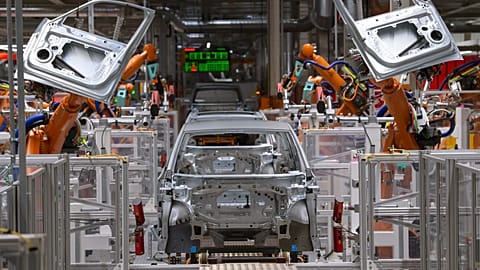





























While Germany’s automotive sector is coming under growing pressure, defence companies are increasingly eyeing its factories, skilled workers and industrial expertise.
In addition to cars and Formula 1 racing, could Mercedes-Benz also move into the defence sector in the future? According to CEO Ola Källenius, the idea is at least not off the table.
 ADVERTISEMENT
ADVERTISEMENT
ADVERTISEMENT
In an interview with the The Wall Street Journal, the Mercedes-Benz chief said the company would be open to supporting Europe’s growing defence efforts.
"The world has become more unpredictable, and I think it is quite clear that Europe needs to strengthen its defence capabilities," Källenius said. "If we can play a positive role in that, we would be prepared to do so."
Källenius did not outline any concrete plans. However, he stressed that any potential defence-related business would remain a small complementary activity compared with Mercedes-Benz’s core automotive operations.
The company had not yet issued an official statement on any possible projects.
Arms instead of cars?
Mercedes-Benz is not the first carmaker to consider a potential future role in the defence sector.
Volkswagen is also exploring possible opportunities linked to defence production. CEO Oliver Blume has said the company plans to decide later this year whether military transport vehicles could be produced at Volkswagen’s plant in Osnabrück. At the same time, Blume stressed that Volkswagen would not manufacture weapons or tanks.
Meanwhile, defence companies are increasingly turning toward the struggling automotive sector. Rheinmetall said it is examining whether some of its current automotive supplier sites in Neuss and Berlin could be converted for defence production.
The company is also reportedly considering taking over entire factories from carmakers facing economic pressure. Among the sites being discussed is Volkswagen’s Osnabrück plant, whose long-term future remains uncertain.
However, Rheinmetall CEO Armin Papperger has so far struck a cautious tone, noting that existing automotive plants are only partly suitable for defence manufacturing and that conversions would be expensive. Still, he said such options should be evaluated before building entirely new facilities.
Other defence firms are also benefiting from the downturn in Germany’s automotive industry. Aerospace and defence company Hensoldt has been actively recruiting skilled workers from suppliers such as Continental AG and Bosch.
Booming defence industry
Germany’s automotive industry is coming under growing pressure. High production costs, weak demand across Europe, rising competition from China and ongoing tariff threats from the United States are weighing heavily on manufacturers.
In February, Mercedes-Benz reported a roughly 49% drop in profits, from €10.4 billion to €5.3 billion for 2025 while revenue fell by around nine percent.
With the exception of BMW, all major German carmakers have announced job cuts at domestic sites in recent months.
While the automotive sector struggles, the defence industry is booming. According to the Stockholm-based peace research institute SIPRI, the world’s 100 largest arms manufacturers reached record revenues in 2024.
Even so, analysts question whether the defence sector could realistically offset the decline of the automotive industry. The scale of the two industries remains vastly different: Germany’s automotive sector generated more than €540 billion in revenue in 2024 alone.
By comparison, the country’s five largest defence companies generated combined revenues of just under €30 billion in 2023.