















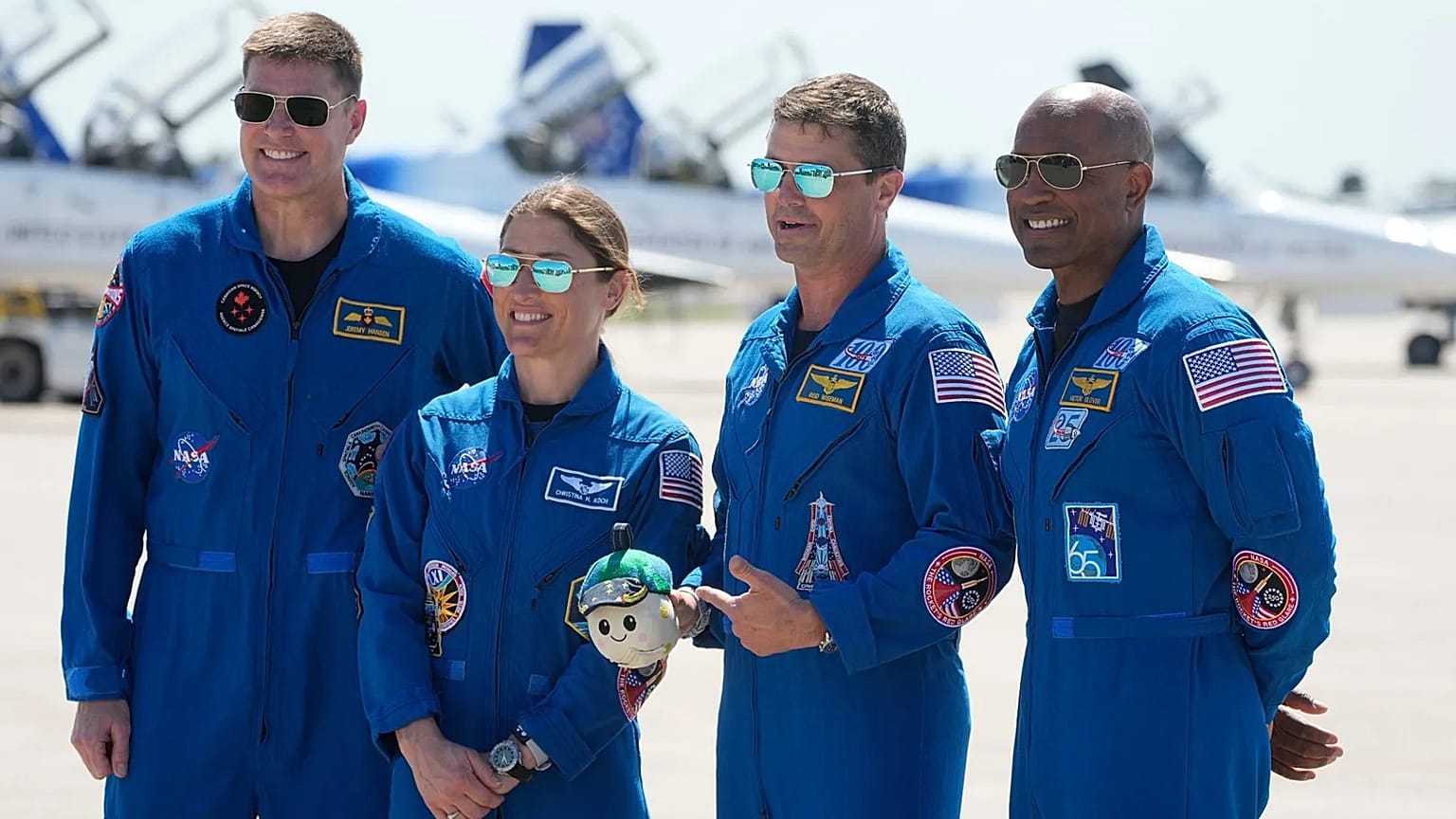














Four astronauts from the United States and Canada are about to take off on the Artemis II mission that will circle the Moon.
The Artemis II mission is set to take off as early as April 1, according to the US' National Aeronautics and Space Administration (NASA).
 ADVERTISEMENT
ADVERTISEMENT
ADVERTISEMENT
It will send four astronauts on an approximately 10-day journey around the Moon to test the Orion spacecraft, which will land on the Moon in future missions.
The astronauts who will take part will not land on the Moon this time, but their mission will take them thousands of kilometres deeper into space than the Apollo astronauts went for the original Moon landings of the 1960s and 1970s.
"We are getting very, very close [to launch], and we are ready," said Lori Glaze, acting associate administrator for NASA's Exploration Systems Development Mission Directorate, in a press conference over the weekend. "All of our operations have been going smoothly, it's been going very well."
Four astronauts from the United States and Canada make up the team for the Artemis mission. Ahead of the launch, they are reviewing emergency procedures and spending time with their families at the Kennedy Space Centre in Florida.
They are also staying in quarantine to make sure they stay healthy before liftoff, which could be any day between April 1 and 6.
This is who will go on the Artemis II mission.
Commander Reid Wiseman
Reid Wiseman, a retired Navy captain, was serving as NASA's chief astronaut three years ago when he was asked to lead the crew.
Wiseman had previously spent more than five months at the International Space Station in 2014 as part of the 40th launch. But his teenage daughters had "zero interest" in seeing him launch again.
“We talked about it and I said, ‘Look, of all the people on planet Earth right now, there are four people that are in a position to go fly around the Moon,” he said. “I cannot say no to that opportunity.”
The toughest part is not leaving his family, but “it's the stress that I’m putting on them,” he said. Wiseman has been a single father since 2020, when his wife Carroll passed away from cancer.
Wiseman was selected to join NASA as one of nine candidates in 2009 to start astronaut training after his military career. At the time, he was a lieutenant commander in the US Navy.
He has often said he wanted to be an astronaut after going to a Space Shuttle launch in person as a child.
Pilot Victor Glover
Before any launch, Victor Glover makes it a point to listen to two songs: Gil Scott-Heron’s “Whitey on the Moon” and Marvin Gaye’s “Make Me Wanna Holler” from the white-dominated Apollo era.
To Glover, they are songs from the white-dominated Apollo era of US space flight that "capture what we did well, what we did poorly."
Glover, one of NASA's few Black astronauts, said that he sees his place on the mission as a "force for good," and a chance to inspire others to get into space.
In 2018, Glover was assigned to fly on the first operational flight of SpaceX's Crew Dragon capsule to the International Space Station, where he stayed at the station for more than six months. He was the first African-American crew member to stay on the ISS, local media reported at the time.
In Glover's previous career as a fighter pilot for the US Army, he logged over 3,000 flight hours in 40 different types of aircraft and flew in 24 combat missions.
Before this launch, he said he's spent more time preparing his four daughters for his launch than he has preparing himself.
Mission specialist Christina Koch
Christina Koch, a 47-year-old electrical engineer from North Carolina, holds the record for the longest single spaceflight by a woman at 328 days.
That mission, which saw her blast off to the International Space Station on March 14, 2019, was also when Koch was part of the all-female spacewalk. She and Jessica Meir left the ISS to do a lengthy series of upgrades to the station's power systems and physics observatories.
Koch's 328-day mission is used to study the physical, biological and mental effects of long-term space travel on women, according to Reuters.
More than any one individual, the Artemis II mission is “about celebrating the fact that we’ve arrived to this place in history” where women can fly to the Moon, she said.
Koch spent a year at a South Pole research station before getting the call from NASA. Between that and her space stint, she feels she's “inoculated” most of her family and friends.
“So far, I haven't gotten too many nerves from folks. Maybe my dog, but I've reassured her that it's only 10 days. It's not going to be as long as last time.”
Canadian fighter pilot Jeremy Hansen
Jeremy Hansen, a Canadian fighter pilot and physicist, is making his space debut.
He will also be the first Canadian to ever go to the Moon.
“Maybe I'm naive, but I don't feel a lot of personal pressure," Hanson told the Associated Press.
Hansen, 50, grew up on a farm in rural Canada before joining the Royal Canadian Air Force as a captain. He piloted aircraft such as the CF-18 from his base in Alberta. He had been promoted to the rank of colonel before getting the call from the Canadian Space Agency (CSA) in 2009.
Hansen has also undertaken NASA missions underwater, serving as an "aquanaut," to the Aquarius underwater laboratory in 2014. He lived in an underwater environment for seven days to simulate what conditions would be like in space and to test NASA's remote guidance systems.
He realises only now how much effort it took to send men to the Moon during Apollo.
“When I walk out, and I look at the moon now, it looks and feels a little bit farther than it used to be,” he said. “I just understand in the details how much harder it is than I thought it was, watching videos of it.”