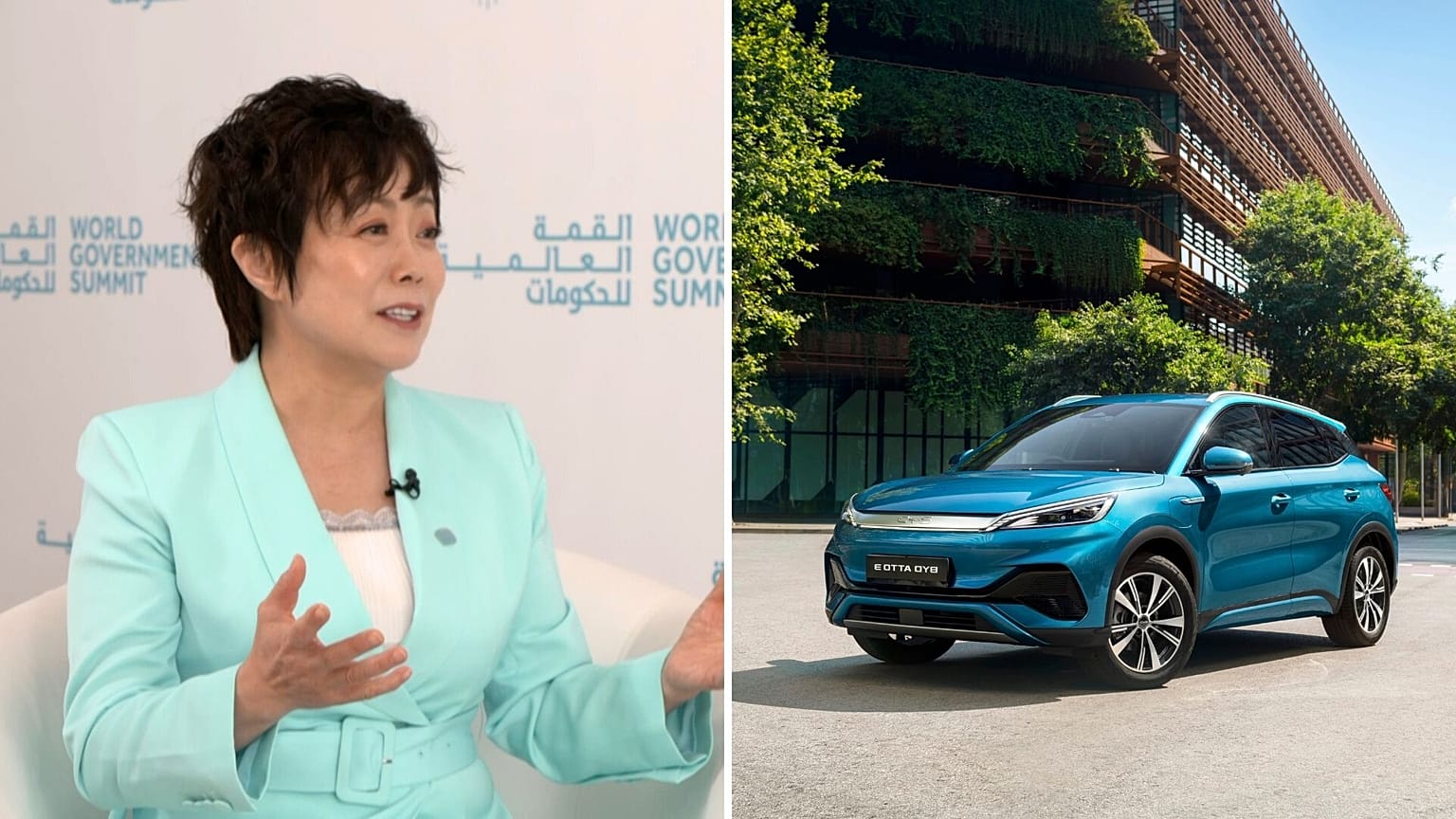














Euronews Next sat down with Stella Li, the executive vice president of Chinese electric vehicle giant BYD, at the World Government Summit 2026 to discuss the company’s rapid expansion and its European ambitions.
Once known primarily as a battery manufacturer, BYD has evolved into one of the world’s most influential electric vehicle makers, recently overtaking Tesla in global EV sales.
 ADVERTISEMENT
ADVERTISEMENT
ADVERTISEMENT
In 2025, BYD sold 2.26 million battery-electric vehicles, comfortably surpassing Tesla’s 1.63 million deliveries.
But according to BYD's executive vice president Stella Li, who last year was voted World Car Person of the Year, the company’s vision has always been clear.
"Our dream was always to produce electric cars,” she told Euronews Next at the World Government Summit in Dubai.
"While continuing to grow, we had the chance to buy a car company. Then we started a family - we could do electric cars inside BYD and realise every innovation we wanted for electric vehicles."
Today, the company employs more than 120,000 research and development (R&D) engineers.
Manufacturing muscle and model variety
Li credits BYD's manufacturing expertise as a key reason behind its global success. The company is deeply embedded in consumer electronics supply chains, producing components or assemblies for around a third of the world's smartphones.
"One third of global smartphones - either the components or the whole assembly - are made by BYD,” she said. “We are very strong in tuning, machinery, and precise manufacturing with high quality."
In Europe and the Gulf region, BYD now offers more than 13 car models, ranging from compact urban cars to high-performance vehicles.
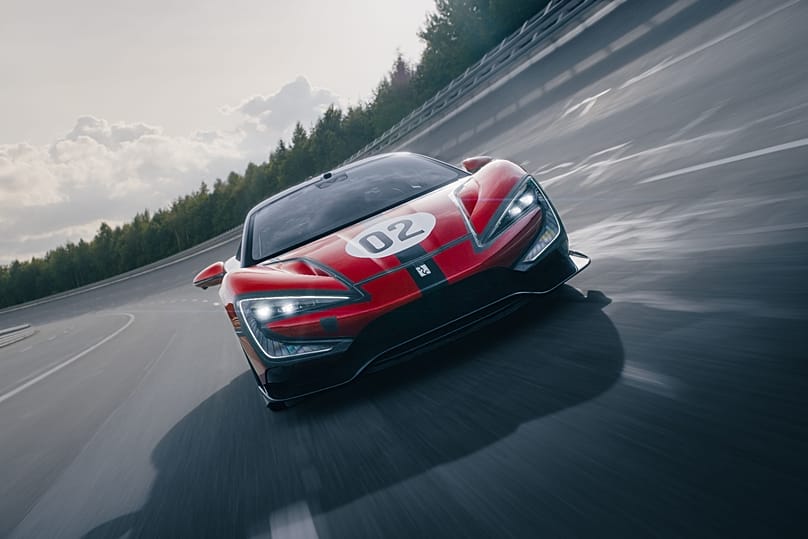
For customers seeking speed, Li highlighted the U9 Xtreme hypercar, which has a top speed of 308.4 mph, making it one of the fastest production cars in the world.
At the other end of the market, BYD has focused on safety and urban mobility. "For urban living and short daily mileage, we have the Dolphin, which performs very well in Europe,” she said.
The Dolphin model has received a five-star Euro NCAP safety rating and was named World Car of the Year 2025.
Charging, range and European expansion
One of the biggest barriers to EV adoption remains charging infrastructure - particularly in Europe, where electricity prices are higher than in China or the US.
BYD, Li said, is tackling this through a combination of battery storage, solar integration and ultra-fast charging.
"We have invented 1 megawatt charging. This technology is a game-changer. In five minutes, you can get 400 kilometres. Recharging is as fast as refuelling," she said, adding that the company plans to invest in around 3,000 fast-charging stations across Europe by the end of the year.
And while trade tariffs have created uncertainty for Chinese automakers, Li downplayed their long-term impact.“Trade is always a short-term play. We don’t support that. It also hurts the consumer,” she said.
Instead, BYD has focused on local manufacturing. A new production facility in southern Hungary, costing a reporter €4 billion, is expected to begin operations in the second quarter of 2026.
"For BYD, we have a long-term commitment to Europe and the GCC area,” Li said. “You need to make sure you bring good value, and most importantly, quality and good after-sales service."
Li also described the Middle East as a key growth market, particularly for autonomous driving, robotics and energy storage.
"We already have a national partnership with the UAE government for battery storage," she said. "BYD stands for Build Your Dreams. This is a dreamland. I tell my team, this is really the dreamland."