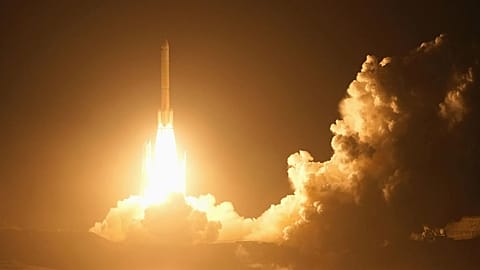














This will be the first crewed mission to travel around the Moon since the Apollo era, with astronauts flying past the far side of the Moon to test life support and navigation systems.
NASA is set to move its tallest and most powerful rocket from its assembly building to the launch pad on Saturday, marking one of the agency's key milestones - getting to the Moon.
 ADVERTISEMENT
ADVERTISEMENT
ADVERTISEMENT
In a slow and carefully choreographed operation, the Space Launch System rocket, topped with the Orion spacecraft, is set to launch on February 6.
The rollout this weekend allows engineers to begin final integration, testing and full launch rehearsals, including fuelling simulations and countdown procedures, before the rocket is cleared for flight.
Key to the mission is the Space Launch System, or SLS, a heavy lift rocket designed to send astronauts and large payloads beyond low Earth orbit.
Standing taller than the Statue of Liberty and producing more thrust at liftoff than any rocket before it, SLS is built to carry humans deeper into space than NASA has gone since the Apollo era.
Mounted on top of the rocket is the Orion spacecraft, a crew capsule designed to house astronauts for missions lasting weeks at a time.
Orion is built with a reinforced heat shield to survive the extreme temperatures of re-entry into Earth’s atmosphere, and systems to protect crews from radiation and deep space conditions.
Together, SLS and Orion form the backbone of NASA’s Artemis programme, a series of missions intended to return humans to the Moon and establish a long term presence there.
John Pernet-Fisher, a research fellow at the University of Manchester, says the upcoming mission marks an important step for human spaceflight.
“This is a massive milestone for NASA and the Artemis programme because this is going to be the first time that a crew of humans will see the far side of the moon, and is such an important milestone in NASA’s eventual goal of getting two feet, human feet, back on the lunar surface,” he said.
Artemis I, which flew in 2022, was an uncrewed test mission that sent Orion around the Moon to prove the rocket and spacecraft could operate safely in deep space and return to Earth.
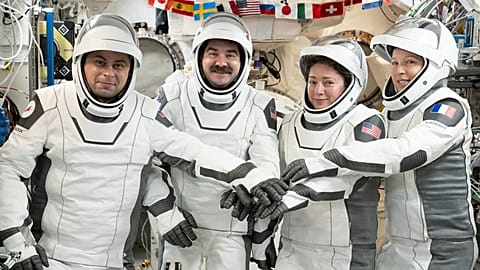
Artemis II, the mission now approaching launch, will be the first to carry astronauts.
The crew will not land on the Moon, but will travel on a looping path around it before returning home, testing life support, navigation and communication systems with humans onboard.
Pernet-Fisher explains how the new system builds on earlier spaceflight programmes.
“SLS and the Orion module that’s going to sit atop it is basically the next generation of rocket technology. So back in the Apollo days, we had the Saturn V with the Apollo module on top," he said.
"These are the modern equivalents, and specifically the SLS, the Space Launch System, is designed to be such a large rocket that it’s actually capable of perhaps even going a bit further eventually in the future. If NASA continues in this trajectory, it could well see missions to Mars, it could see things going deeper into space, for instance, it's been suggested that it's powerful enough to reach Jupiter, for instance," he added.
Later missions will move beyond lunar flybys.
Artemis III is expected to land astronauts on the Moon’s surface, targeting the lunar south pole, an area thought to contain water ice that could be used for drinking water, oxygen and rocket fuel.
Artemis IV and subsequent missions are planned to help assemble the Lunar Gateway, a small space station that would orbit the Moon and act as a staging point for surface missions and scientific research.
NASA sees the Moon as a proving ground for future journeys to Mars.
By operating farther from Earth for longer periods, the agency hopes to test the technologies, habitats and life support systems needed for deep space travel.
“It’s designed to primarily get people to the Moon, but as I said, it’s got that extra capability with potential to go further than the Moon itself. So as I’ve said, potentially to Mars, potentially to places like Jupiter, it has the potential to carry telescopes, for instance, into deep space for deep space observations. Primarily, the focus is integration with Orion... and getting to the Moon with this particular configuration.”
Beyond exploration, researchers say programmes like Artemis often deliver wider benefits.
Technologies developed for space missions have historically led to advances in materials, safety systems and engineering used on Earth.
“We definitely saw that through Apollo... there are huge technological innovations that then filtered down to the general public. A lot of things that we take for granted today, like fire suppression technology, just simple things, things like safety blankets, for instance," he said.
"And so by pursuing big lofty goals, we do see a technological benefit to society at large, and new innovations can happen. So that’s a big reason for continuing to explore in the way that we do like this.”
With the rollout to the launch pad now imminent, NASA’s focus shifts from assembly to final checks, bringing the next chapter of human exploration one step closer to liftoff.