




























A military robotics plant in rural Spain has become a key player in the European defence industry, exporting technology to more than 20 countries and transforming the economy and employment in a small Aragonese town.
Binéfar, an Aragonese town of just over 10,000 inhabitants, located between Huesca and Lérida in northeastern Spain, is home to the largest military robotics plant in the country. This town in the Alto Aragon region designs and manufactures ground robots that are now used in war scenarios, explosive ordnance disposal operations and logistical support missions in more than 20 countries.
 ADVERTISEMENT
ADVERTISEMENT
ADVERTISEMENT
The plant belongs to the EM&E Group (Escribano Mechanical & Engineering) and is one of the key players in the growth of the Spanish defence sector in a context marked by the war in Ukraine and the rise of unmanned technologies.
Although it is now a European benchmark, the history of the Binéfar plant began far from the battlefield. As Rafael de Solís, director of EM&E Group's Robotics Unit, told Euronews, the factory was created in 1988 and was initially dedicated to bank security systems.
"The origin of the plant is completely local. It was founded by three local inventors with a lot of technical concerns," he explained. "One of them is still linked to the company as engineering manager."
The turning point came in 2001, in the midst of the ETA terrorist threat in Spain. "The National Police could not handle the explosives that ETA placed in vehicles because of their weight. They asked us to design a new robot, and that's when our specialisation in robotics really began," said De Solís.
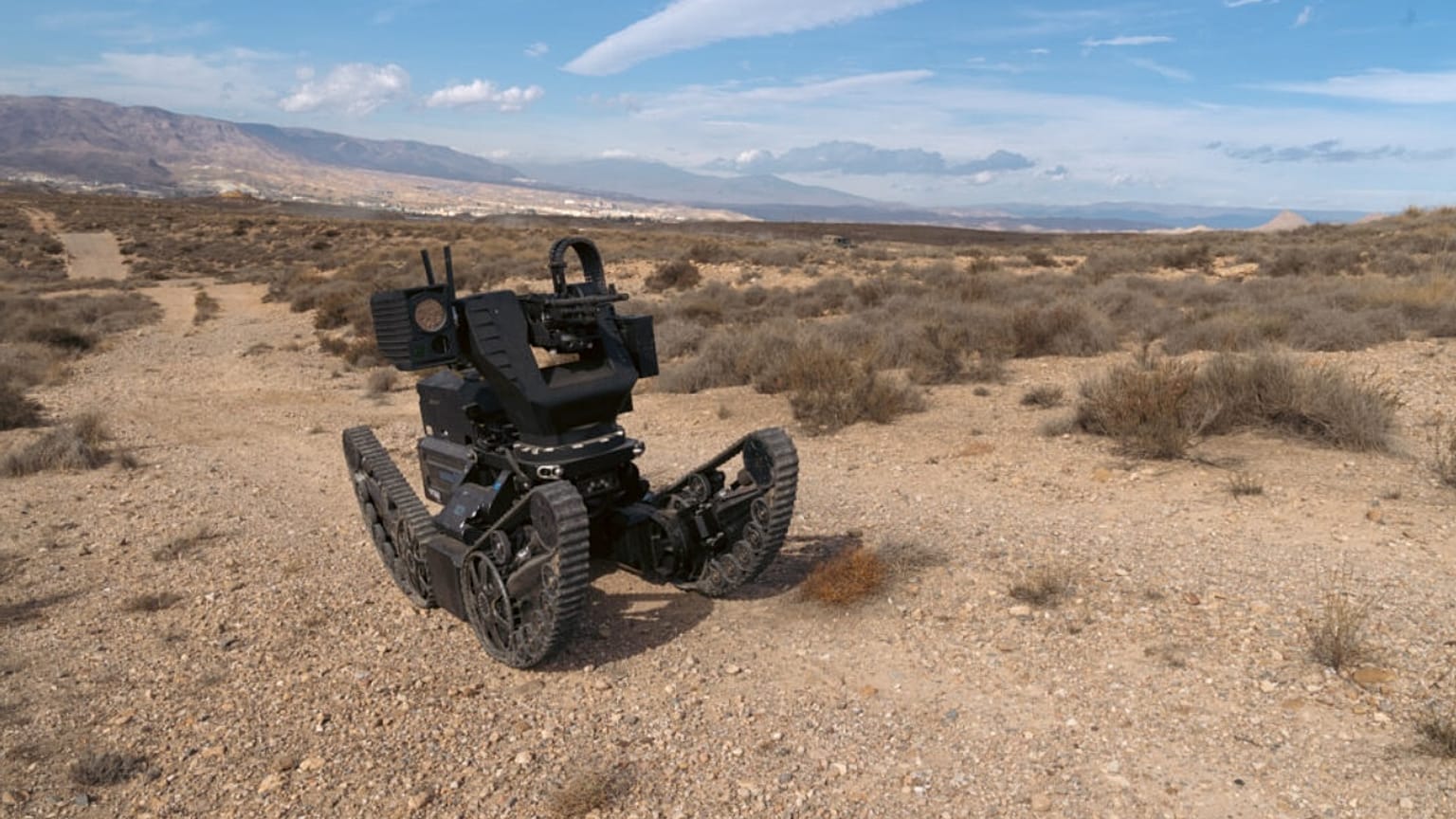
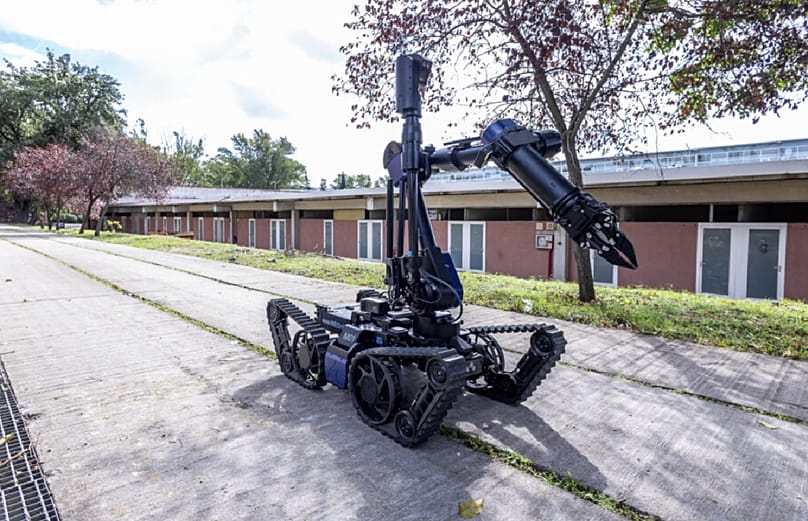
Since then, the plant has evolved to focus exclusively on robots for explosive ordnance disposal, nuclear, biological, radiological and chemical protection, and more recently on unmanned ground vehicles (UGVs) for military use.
The use of robots in modern warfare
These systems, remotely controlled by human operators, can transport ammunition, supplies, fuel or evacuate wounded from the battlefield. They can also integrate self-developed weapons systems.
"The war in Ukraine has put the focus on aerial drones, but ground drones are gaining a lot of importance," explains De Solis. "There are areas about 15 kilometres from the front line where moving troops is extremely dangerous because of the aerial threat, and there these robots can reduce casualties.
EM&E Group has been exporting for more than two decades and has customers in Asia, Africa, the Middle East, Europe and NATO countries. "We are present in more than 20 countries, especially in regions with a high terrorist risk," he adds.
Unlike other European competitors, the Binéfar plant stands out for its scale, especially at the European level. "There is nothing comparable in France," says De Solís. "There was a major competitor in Germany, but it was taken over by an American company. Our main rivals today are American and Canadian," he adds.
Technology and territory: a brake on depopulation
In a context of population loss in large areas of inland Spain, the implementation of advanced technology industry in small towns is emerging as one of the few ways to generate skilled and stable employment**.**
Beyond the military field, the robotics plant has become a key economic engine for Binéfar and its surroundings. It currently employs more than 150 workers, with plans to reach 300. "In little more than a year we have doubled the workforce," explains De Solís. "Eighty per cent of the workers are from the area or from nearby counties. There are also people who had gone to big cities and have decided to return."
And this impact is visible in the town. For Patricia Rivera, Mayoress of Binéfar, the plant has strengthened the role of the municipality as an industrial and technological hub. "Binéfar already had a strong agri-food sector, but this company has clearly boosted the technological field and has made a qualitative leap," she says in an interview with Euronews.
Growth, however, poses challenges for the small town. "It has been very fast, and as an administration we have to react quickly to provide services, housing and infrastructure," Rivera acknowledges. "It's not easy, but we are working to accompany this development.
A decentralised model of industry
The Binéfar plant is part of a broader strategy of EM&E Group to distribute its activity throughout Spain. The company maintains its headquarters in Madrid, but has created specialised centres in different regions: software and artificial intelligence in Barcelona, weapons systems in Cordoba and Linares, research in Asturias and photonics developments in Valencia.
"We didn't want to continue concentrating everything in Madrid," explains De Solís. "The idea is to regionalise production and take advantage of talent in different parts of the country.
For the City Council, this commitment reinforces Binéfar's strategic position. "We are at a key point between Aragon and Catalonia, with good communications and companies that have been established for decades. It is not so much a question of attracting new companies, but of helping those that are already here to grow", emphasises the mayoress.
From this Aragonese town, war, technology and rural Spain intersect in the same production chain. Robots designed to save lives, and to fight, come out of a plant that, at the same time, helps to fix population and redefine the role of industry in rural areas.