





























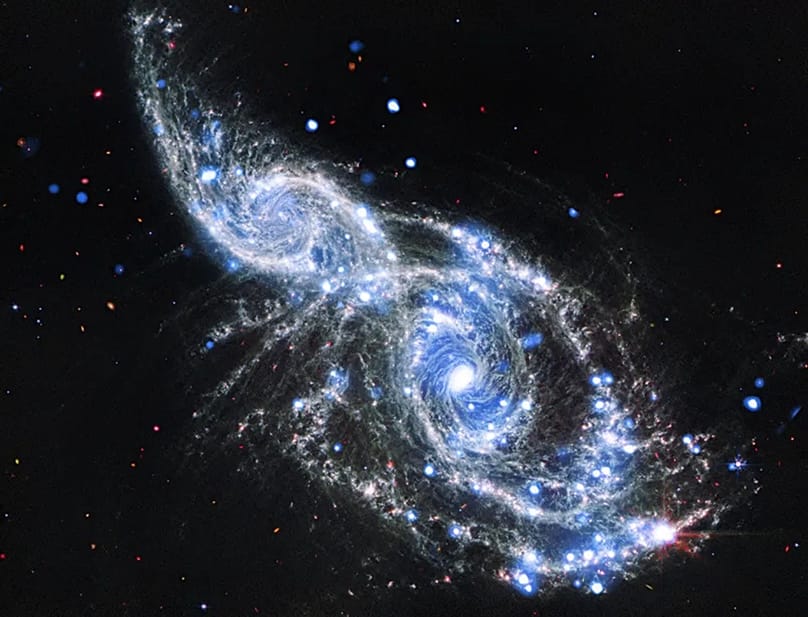
Created using data from the James Webb Space Telescope and NASA’s Chandra X-ray Observatory, the image offers scientists a rare, face-on view of how galaxies interact and merge.
A breathtaking new space image has captured two spiral galaxies in the middle of a slow-motion cosmic collision, glowing in shades of blue, red, and silver.
 ADVERTISEMENT
ADVERTISEMENT
ADVERTISEMENT
The picture shows galaxies NGC 2207 and IC 2163 as they drift towards each other, locked in a gravitational dance.
To create it, scientists layered infrared light captured by the James Webb Space Telescope (JWST), the largest and most powerful telescope ever launched to space, with X-ray observations from NASA's Chandra X-ray Observatory to create one image.
Seen face-on from Earth, the larger galaxy, NGC 2207, dominates the scene while the smaller IC 2163 overlaps its outer edge. As they pull on one another, their spiral arms are twisted and stretched, with streams of stars and gas drawn out into space.

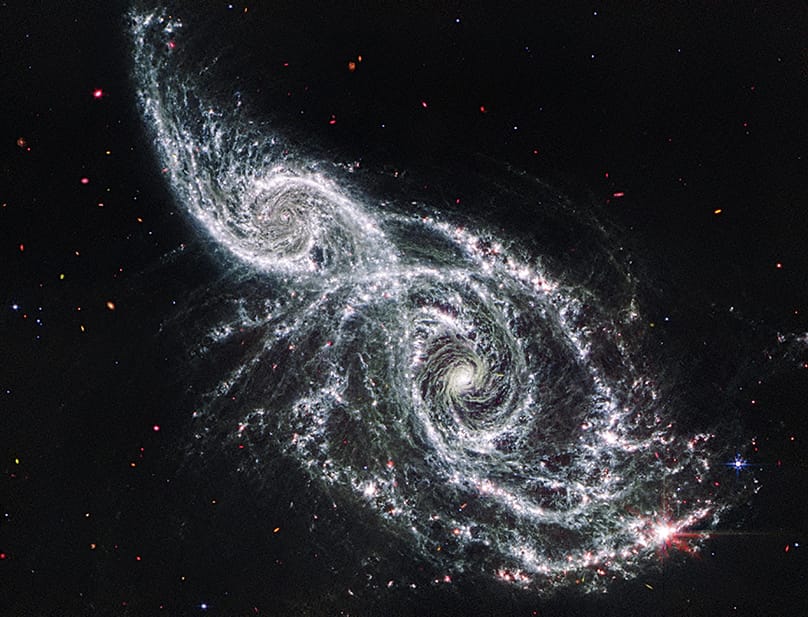
In some regions, gas and dust are squeezed together - conditions that can spark the birth of new stars - creating what scientists describe as an intricate "web of chaos".
In the image, JWST’s mid-infrared data appear in shades of white, grey, and red, tracing cooler dust and material across the galaxies’ cores and spiral arms. Chandra’s X-ray data, shown in blue, highlight the most energetic regions.
The cosmic collision is one of four Chandra-based images that were published at the same time.
The others feature NGC 6334, a star-forming region marked by sweeping arcs of glowing gas and dust, the supernova remnant G272.2-0.3, where hot X-ray-emitting gas spreads through an expanding shell, and R Aquarii, a star system in which a dense white dwarf pulls material from a neighbouring red giant.
According to NASA, studying merging galaxies like these is an important part of JWST’s mission - to help scientists build more accurate models of how galaxies grow, evolve, and eventually combine over cosmic time.