















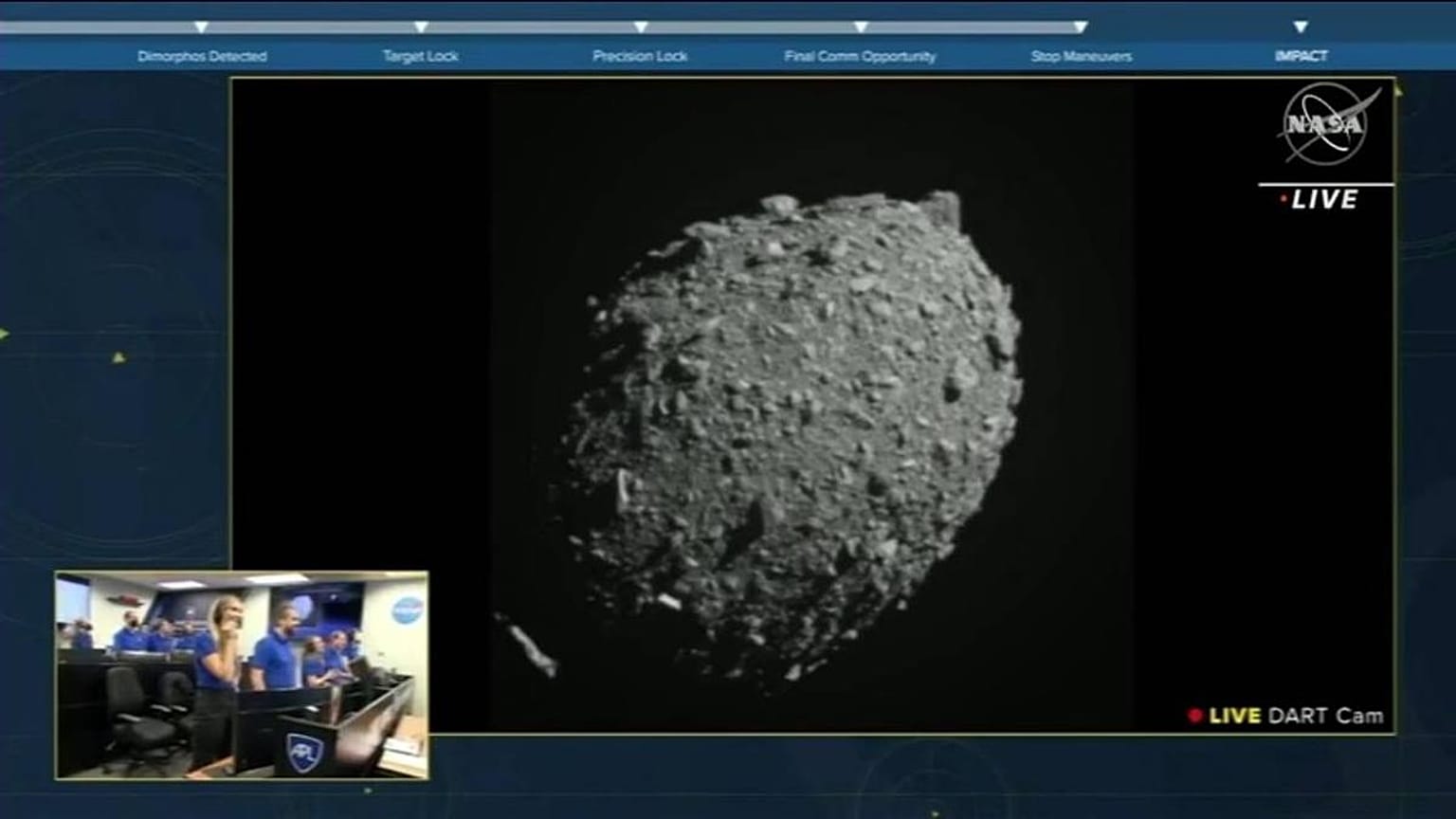













Observations from a global network of telescopes helped verify that NASA’s DART spacecraft successfully altered the orbit of the asteroid moon Dimorphos. The measurements confirmed the first planetary-defence experiment in which a human-made impact changed the motion of a natural celestial body.
Two scientists from Uzbekistan have been recognised by NASA for their contribution to observations that confirmed the first successful attempt to alter the orbit of an asteroid.
 ADVERTISEMENT
ADVERTISEMENT
ADVERTISEMENT
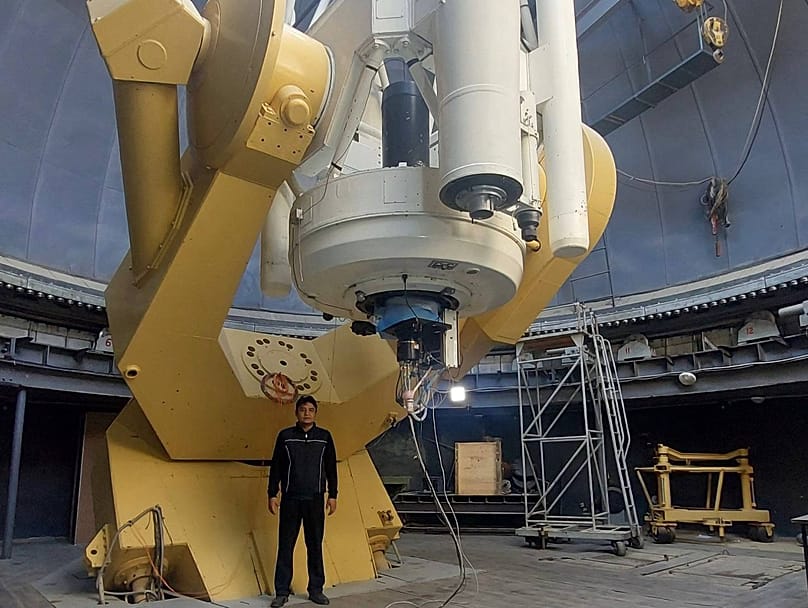
Measurements from the high-altitude Maydanak Observatory helped verify that the trajectory of Dimorphos, a small asteroid moon orbiting the larger body Didymos, changed after the impact of NASA’s Double Asteroid Redirection Test (DART) spacecraft.
Scientists Kamoliddin Ergashov and Otabek Burkhonov of the Mirzo Ulug‘bek Astronomical Institute were among nearly 100 researchers from 28 observatories worldwide who monitored the outcome of the planetary-defence experiment. Their observations contributed to the international dataset used to measure the orbital shift.
The asteroid system targeted by the mission also carries a linguistic link to the Greek language. The larger asteroid, Didymos, comes from the Greek word for “twin,” referring to the binary nature of the system. Its smaller companion, Dimorphos, means “having two forms,” reflecting the asteroid’s state before and after the spacecraft impact.
The researchers involved in the global observation campaign were recognised with a NASA Group Achievement Award, an internal honour typically given to collaborative teams contributing to mission objectives.
“We took part in the first tests in human history aimed at changing the orbit of an object that could threaten Earth or break apart,” Burkhonov said. “We also helped confirm the effectiveness of this method. For that reason, NASA recognised our work and presented this award. In the future, I hope to continue cooperative research with NASA in other scientific fields and achieve new scientific results.”
How the DART mission changed an asteroid’s orbit
The DART mission deliberately collided a spacecraft with Dimorphos to test whether the orbit of a potentially hazardous asteroid could be altered through kinetic impact.
Follow-up observations from ground-based telescopes around the world showed that the orbital period of Dimorphos around Didymos shortened by about 32 minutes. The change was large enough to be independently confirmed by multiple observatories and matched pre-impact models of kinetic-impact deflection.
This marked the first experimentally verified change in the motion of a natural celestial body caused directly by human action.
To confirm the result, astronomers conducted continuous photometric monitoring before and after the impact, comparing variations in brightness as Dimorphos passed in front of Didymos and measuring subtle differences in the orbital period.
Scientists at Maydanak Observatory contributed time-series photometry from Central Asia’s longitude band, helping fill observational gaps in the global monitoring network.
“Nearly a hundred scientists from observatories around the world contributed observations,” said Ergashov. “Our role was to obtain photometric data from Maydanak before and after the impact and help refine the measurements of the orbital period.”
The combined dataset from participating observatories was later used in international analyses confirming the deflection.
Recognition from NASA and the future of planetary defence research
Awards such as the NASA Group Achievement Award recognise coordinated scientific and technical contributions across institutions rather than highlighting a single organisation.
According to Ergashov, the experience will also support future work on monitoring near-Earth objects, studying asteroid rotation and researching orbital debris — areas increasingly linked to global space safety.
Burkhonov believes the project can also inspire young researchers.
“It is necessary to involve young people in scientific work,” he said. “Our experiment increases young people’s interest in science and strengthens the confidence of young researchers.”
For scientists involved in the DART campaign, the mission provided not only a scientific breakthrough but also a model for how a distributed network of observatories can contribute to large-scale space experiments. Participation in the DART follow-up observations reflects Uzbekistan’s growing integration into international astronomical research networks.