

















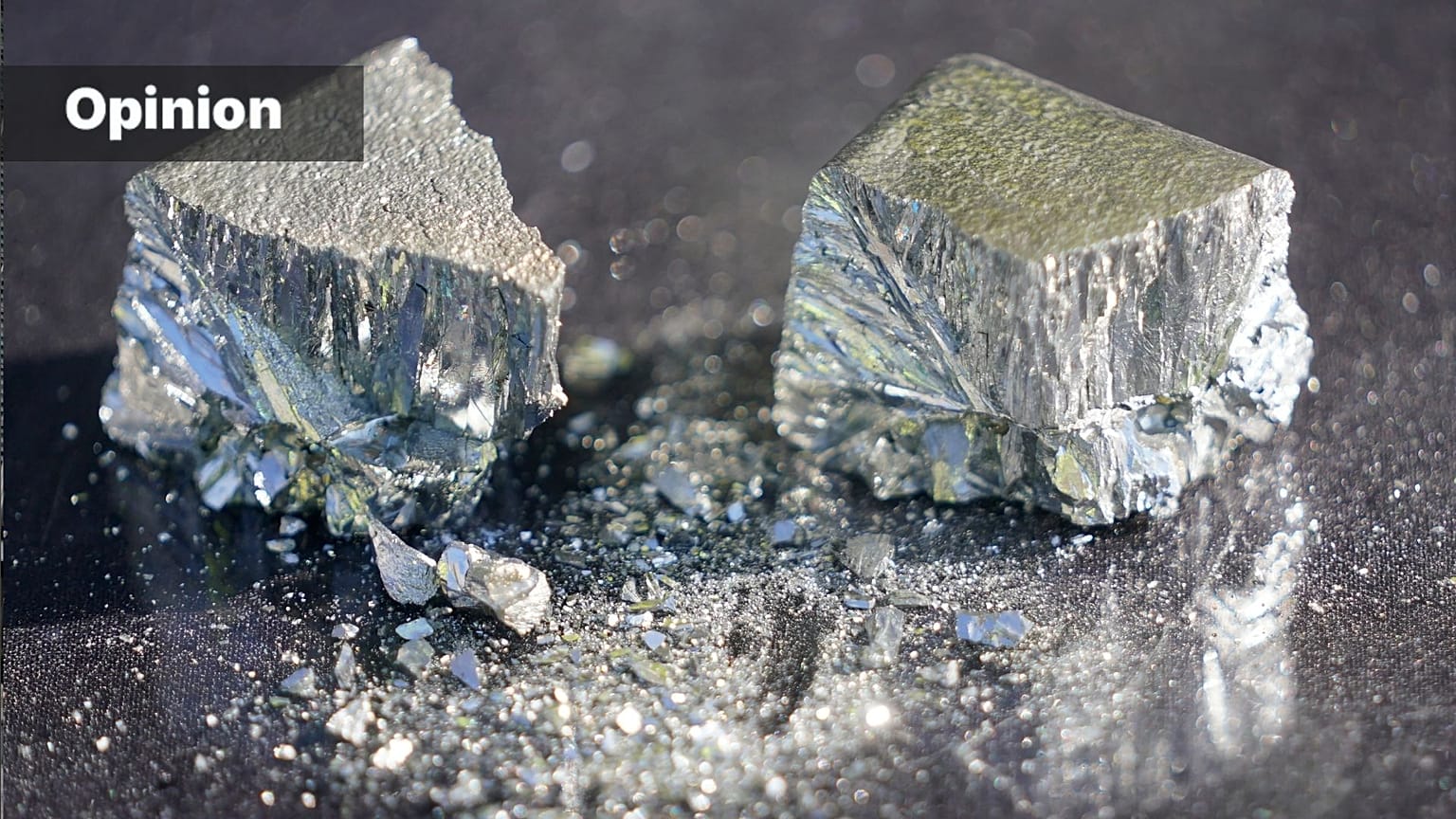













The EU says it wants to break its dependence on China for critical raw materials (CRM)—the next MFF (Multiannual Financial Framework) will test whether Brussels is serious about its sovereignty, argues Nora Kürzdörfer at the Munich Security Conference.
As Brussels enters the final stretch of negotiations over its next seven-year Multiannual Financial Framework, hidden within the budget debate is a strategic question: whether the EU is willing to invest in the partnerships and processing capacity needed to secure the critical raw materials on which its industrial future depends.
 ADVERTISEMENT
ADVERTISEMENT
ADVERTISEMENT
Decisions taken this autumn will help determine whether the EU remains dependent on Chinese-controlled processing technology well into the next decade or begins its diversification towards new and trusted partners.
The EU’s ability to secure access to rare earths, lithium, cobalt, and other critical raw materials, as well as their processed forms, will be a key determinant of whether it can achieve major strategic objectives: electrifying and decarbonizing the European economy, strengthening its defense capabilities, and advancing its digital and AI industries.
Heads of state and government should not lose sight of the substantial investments required to build secure and resilient CRM (Critical Raw Material) value chains, as they enter difficult negotiations over national financial contributions
Reaching an agreement on the 2028-2034 common budget before the end of this year is more than a procedural milestone. It would ensure that the necessary legislation can be adopted in 2027 and that funding becomes available from January 2028 onward.
Strategic dependencies
The urgency of boosting EU investment in partnerships around critical raw materials is compounded by the fact that reducing dependence on Chinese processing and refining will not come cheap. China’s control over processing and refining remains overwhelming.
It dominates rare-earth separation, graphite processing, cobalt sulfate production, and large segments of nickel refining. Recent export restrictions highlighted how vulnerable European industries remain when supply is concentrated in a single country.
The issue is unlikely to become less pressing this autumn.
Beijing’s temporary suspension of expanded export controls is set to expire in mid-November, just weeks after the EU and China aim to conclude trade talks addressing rows over critical raw materials and the broader deterioration of bilateral relations.
Partners have goals too
Whatever the outcome of those negotiations, the strategic lesson for Brussels is clear: as China increasingly weaponizes its dominance of critical raw material value chains - and the United States can no longer be regarded as a fully reliable partner either - the EU needs alternative partners.
This need for diversification pushed the EU to deepen its engagement with resource-rich countries across Africa, Asia, and Latin America, where most of the world’s critical raw material deposits are found.
These resource-rich countries have made their expectations clear: they want investment in local processing, technology transfer, and a fairer sharing of financial risks rather than being confined to the role of raw material suppliers.
Economics make their case compelling. For instance, the value of globally traded cobalt ore amounts to only a few hundred million dollars annually, while the batteries and electric vehicles built upon it generate value measured in the hundreds of billions.
It is little wonder that producing countries increasingly refuse to remain stuck at the lowest-value stage of the supply chain and seek a larger share of that value at home.
Contradictions too difficult to ignore
In its 2024 Critical Raw Materials Act (CRMA), the EU acknowledged this demand and committed itself to supporting industrial development in partner countries. Yet the EU’s flagship projects in the Global South illustrate just how much remains to be done.
Of the six strategic projects designated under the CRMA in Brazil, Kazakhstan, Madagascar, Malawi, South Africa, and Zambia, four remain focused on extraction, with processing taking place abroad, in some cases in Europe itself.
The two projects that do include local processing are both behind schedule and awaiting the capital and technical support they were promised.
The contradiction is difficult to ignore. Brussels speaks of promoting local value addition, yet its project portfolio continues to reflect a traditional extractive model: raw materials are mined abroad and processed elsewhere. The gap between rhetoric and delivery risks undermining the EUs credibility as a long-term industrial partner.
A chance to be seized
This is where the next MFF becomes decisive.
If the new Global Europe instrument, the EUs principal financial vehicle for international partnerships, provides dedicated funding for processing capacity in partner countries, CRM projects would no longer need to compete with a wide range of external priorities.
Brussels would then have a credible chance to close the gap between promises and delivery.
Equally important, it could establish a model for the EUs broader CRM engagement across the Global South, from Global Gateway initiatives and strategic partnerships to future trade agreements.
The sums involved will be substantial. Building processing facilities, supporting technology transfer, and sharing investment risks with partner countries is far more extensive than simply importing raw materials.
But that is precisely the point. Escaping China’s grip on CRM value chains comes at a price. The question is whether Europe is willing to pay it.
If the answer is yes, the rewards are considerable. Resource-rich partners would gain the industrial upgrading they increasingly demand, while the EU would secure more resilient value chains and gradually reduce its dependence on Chinese processing and refining.
While China will remain an indispensable player in many CRM value chains for years to come, the objective should be to build a broader processing base across partner countries, leaving the EU and its partners less vulnerable to disruptions in the longer term. Both sides would stand to benefit.
If the answer is no, the outcome is equally clear. Without revised funding mechanisms, CRM projects will remain chronically underfinanced and resource-rich partners will continue to look elsewhere, most likely to China.
The EU will keep talking about diversification while remaining dependent on precisely the value chains it seeks to escape. The MFF offers a chance to break that cycle.
Brussels should seize it.
Nora Kürzdörfer is a Senior Researcher at the Munich Security Conference (MSC), where she leads the MSC Geoeconomics Project Beyond Lose-Lose, funded by Stiftung Mercator, and specializes in the nexus of economic and security policy.
She is also a NextGen Associate Fellow at the NATO Defense College in Rome and holds a PhD from the Hertie School.