

















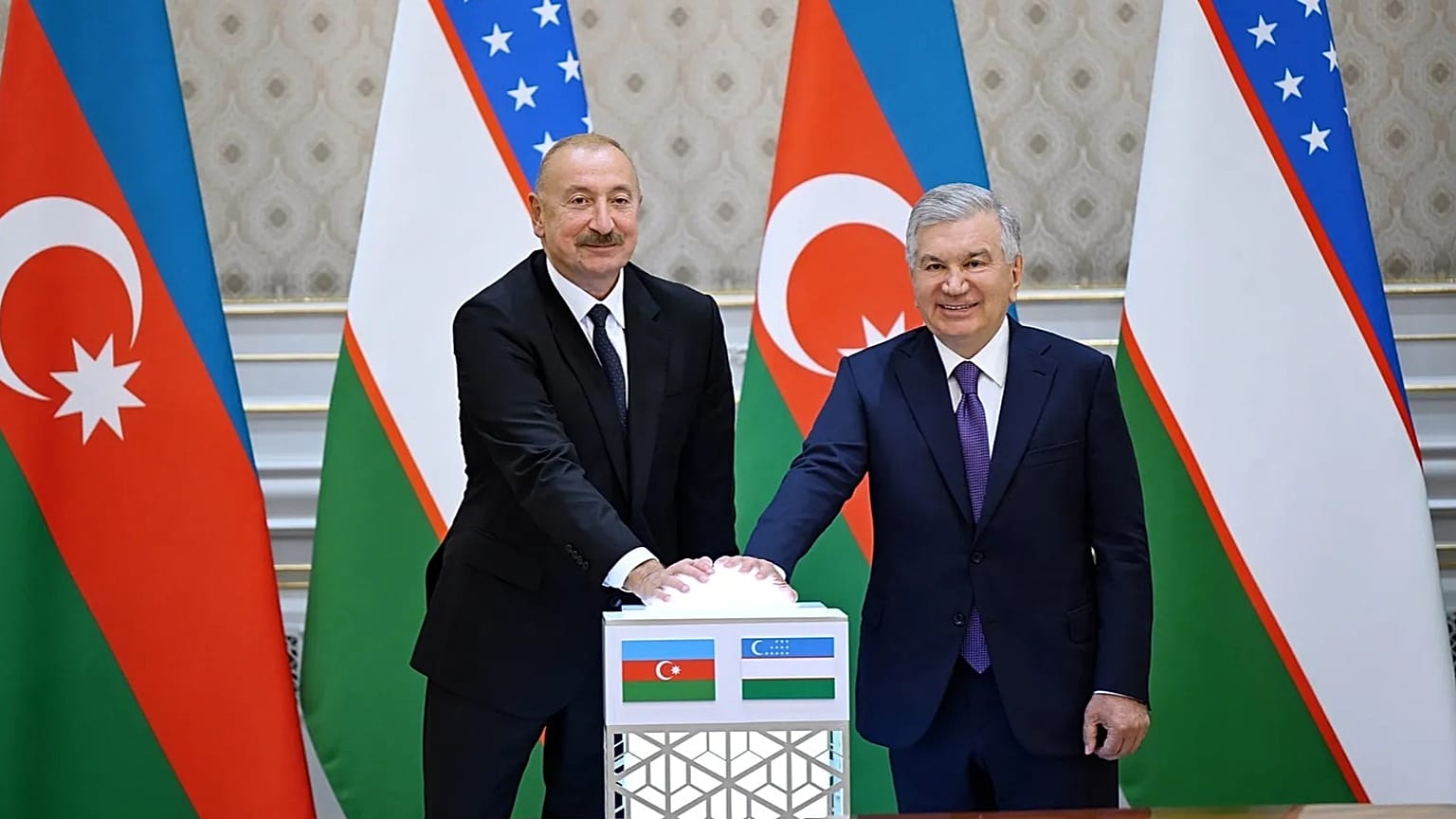













Presidents Shavkat Mirziyoyev and Ilham Aliyev signed a Treaty on Eternal Friendship in Tashkent and launched new projects in banking, energy, tourism and mining. The two countries will also co-host the FIFA U-20 World Cup in 2027.
Uzbekistan and Azerbaijan signed a Treaty on Eternal Friendship on Sunday and set a target of raising bilateral trade to $1bn (€856mn) by 2030, as Presidents Shavkat Mirziyoyev and Ilham Aliyev deepened economic and transport ties during talks in Tashkent.
 ADVERTISEMENT
ADVERTISEMENT
ADVERTISEMENT
The treaty marks one of the hallmarks of President's Aliyev's two-day state visit to Uzbekistan.
Before the signing ceremony, the presidents held one-on-one talks and chaired the third meeting of the Supreme Interstate Council, a presidential-level body established in 2023 to coordinate long-term bilateral cooperation.
The two countries had already upgraded relations by signing a Treaty on Allied Relations in 2024.
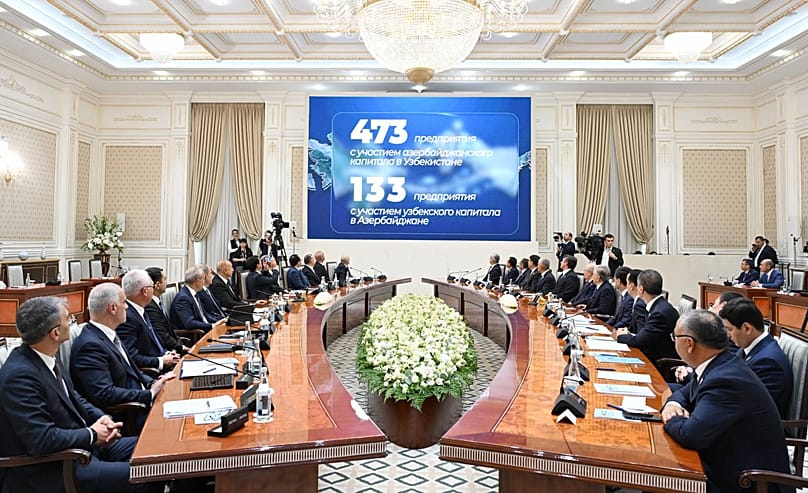
Speaking to the media after the talks, President Mirziyoyev described Azerbaijan as “our reliable ally, strategic partner and brotherly state”.
Trade and investment
In an interview with Uzbekistan's state news agency UzA before travelling to Tashkent, Aliyev said trade reached $795mn (€680mn) in 2025, more than three times the previous year's level. Trade between January and May 2026 reached $144mn (€123mn), up 33% year-on-year.
The two governments also established the Azerbaijan-Uzbekistan Investment Company in 2023, with $500mn (€428mn) in capital to finance projects in both countries.
The leaders inaugurated or launched Azerbaijani-backed projects in Uzbekistan covering banking, construction, education, fuel retail, tourism, housing, mining and agriculture.
Some of the projects nclude a gypsum plant, two STEAM schools, five planned SOCAR filling stations and a facility to process silver-bearing ore.
President Mirziyoyev described them as part of a broader investment portfolio covering energy, geology, chemicals, construction, finance and agriculture.
Azerbaijan's state-owned ABB is also negotiating the acquisition of a 51% stake in Uzbekistan's Davr Bank.
According to S&P Global, the deal exceeds $100 million (€86 million) and remains subject to regulatory approvals. The proposed acquisition would give the Azerbaijani lender a direct presence in the Uzbek banking market.
Meanwhile, President Aliyev also said bilateral oil and gas exploration projects were nearing their final stage, with drilling of production wells potentially starting next year if exploration results are positive.
The largest disclosed project is Sea Breeze Uzbekistan, a planned year-round tourism and residential development by Azerbaijan's Agalarov Development at the Charvak reservoir in the Bostanlyk district of Tashkent region. Uzbek government figures put planned investment in the 577-hectare project at $5bn (€4.28bn).
A public environmental impact assessment hearing for the project was held in January. Uzbek authorities said wastewater would be carried outside the reservoir's coastal zone to treatment facilities.
Trans-Caspian links
After the talks, President Aliyev described Central Asia and Azerbaijan as “a single geopolitical and geo-economic region”.
Both leaders agreed to strengthen connectivity through the Middle Corridor, with a focus on improving logistics infrastructure and increasing freight traffic along the trans-Caspian network linking Central Asia with the South Caucasus and Europe.
President Mirziyoyev also announced plans to step up work on creating a joint fleet on the Caspian Sea.
Transit freight between Uzbekistan and Azerbaijan reached 1.4 million tonnes in 2025. In the first half of 2026, volumes rose 12.2% year-on-year to 675,000 tonnes, according to figures President Aliyev gave to Uzbekistan's state news agency UzA before his visit.
He also noted that the China-Kyrgyzstan-Uzbekistan railway, now under development, could eventually connect with the Middle Corridor and other routes through the South Caucasus.
The European Union is also backing the Trans-Caspian network through its Global Gateway strategy, aiming to connect Europe and Central Asia in 15 days or less. European and international partners announced €10bn in ongoing and planned transport investment commitments in Central Asia in 2024.
In June, the European Commission also signed agreements with international financial institutions expected to mobilise up to €2bn for connectivity projects in the Black Sea region and South Caucasus.
Energy could provide another cross-Caspian link. Azerbaijan, Kazakhstan and Uzbekistan are developing a green-energy corridor to connect their power systems and explore transmitting renewable electricity across the Caspian to Azerbaijan and potentially onwards to European markets.
Uzbekistan, Azerbaijan to jointly host 2027 FIFA U-20 World Cup
The two sides also signed agreements on pensions, culture and tourism, cooperation between their foreign and justice ministries, and city-to-city partnerships pairing Urgench with both Khankendi and Nakhchivan, and Bukhara with Lachin.
The areas of cooperation comes as Uzbekistan and Azerbaijan will jointly host the FIFA U-20 World Cup in 2027, following a FIFA Council decision in 2025.
President Mirziyoyev announced a joint programme dubbed “Two countries – one championship” as part of preparations for the tournament.
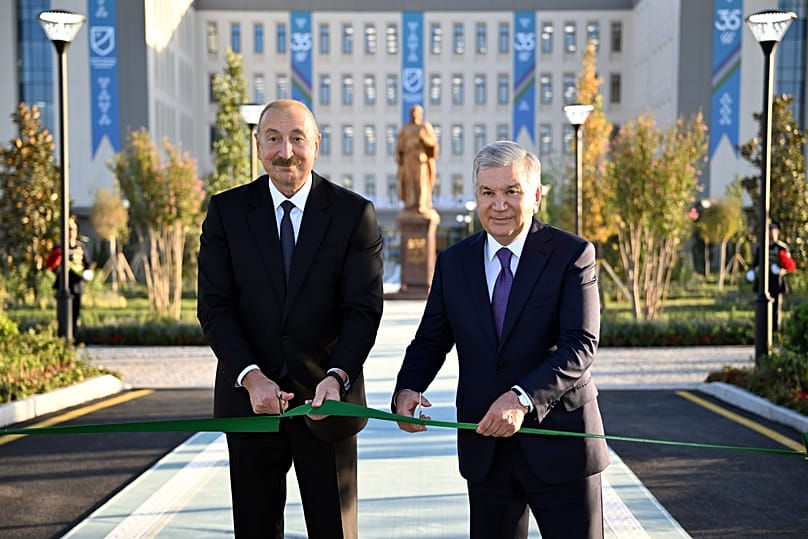
In other highlights, the two leaders also inaugurated the new campus of the Nizami National Pedagogical University in New Tashkent, a 40-hectare complex is designed for 20,000 students. .
They also launched work on a four-hectare Azerbaijan Park in New Tashkent, mirroring an Uzbekistan Park planned in Baku.
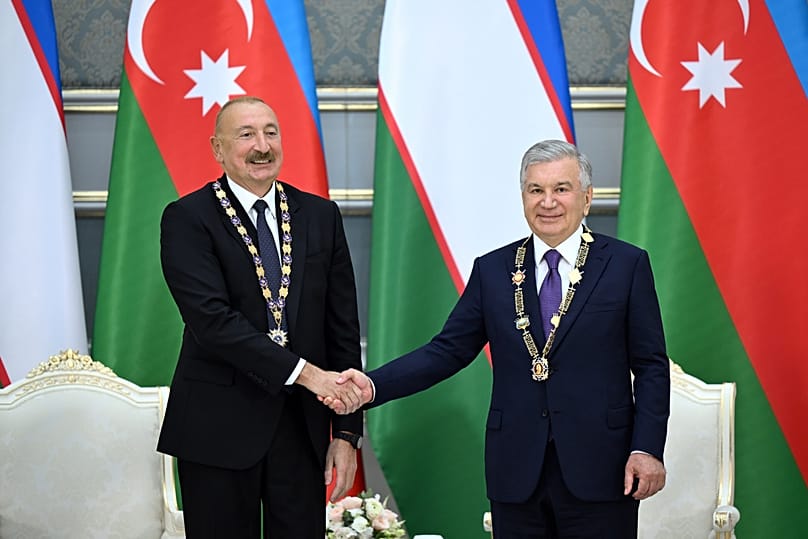
The visit included an exchange of the countries’ highest state honours: President Aliyev received Uzbekistan’s Order of Oliy Darajali Dustlik, while President Mirziyoyev was awarded Azerbaijan’s Heydar Aliyev Order.