

















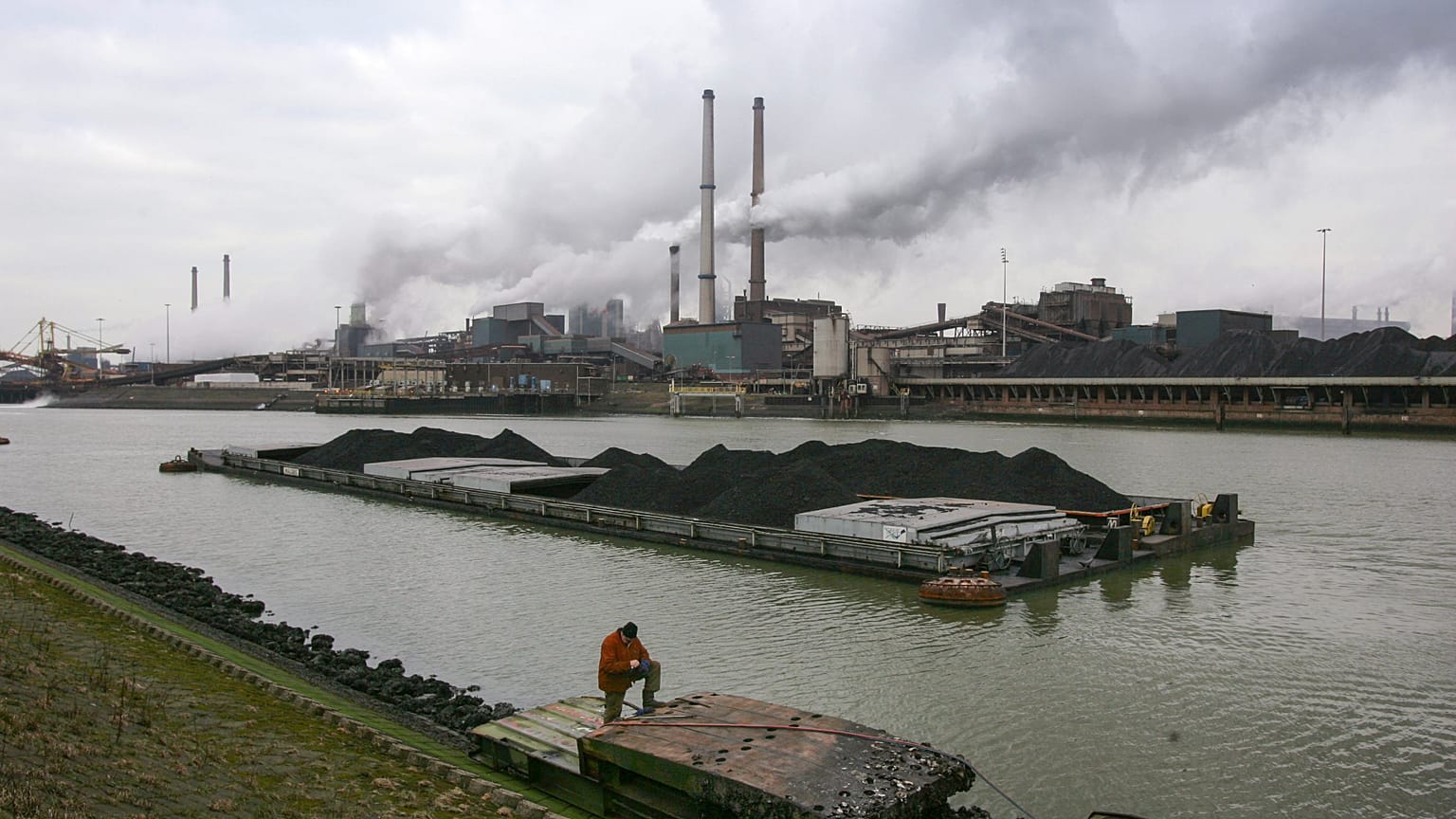













The European Commission proposed revising the bloc's major climate policy, the Emissions Trading System (ETS), on 17 July. Euronews explains what the ETS is, why it is being revised and why it has become an incredibly polarising topic on the EU agenda.
The European Commission's revision of the European Union's carbon market, the Emissions Trading System (ETS), was unveiled on 17 July. It came after months of intense lobbying by those seeking to scrap it, and claims from the other side that it should remain unchanged or only slightly adjusted.
 ADVERTISEMENT
ADVERTISEMENT
ADVERTISEMENT
The ETS review is shaping up to be one of the EU's most consequential climate policy battles because it sits at the intersection of climate ambition, industrial competitiveness and energy affordability.
Euronews' explainer examines the basics of the ETS, what is at stake and why the ETS has been such a hot topic on the EU's agenda.
What is the ETS?
The ETS is a cap-and-trade system used by the EU to lower greenhouse gas emissions (GHG) from heavy-industry sectors that account for around 40% of the EU's total emissions.
In practice, the ETS requires certain industries to pay for the pollution they emit. This means that for each metric tonne of CO2 emitted, they need to purchase ETS allowances.
Some industries have been entitled to free allowances. This prevents them from being forced to relocate to countries with less strict environmental rules, so-called carbon leakage.
Under the previous ETS design, the system's emissions cap was set to reach zero free allowances by 2039.
Every year, the total number of allowances has been reduced to ensure emissions fall in line with the EU's climate targets.
The Commission proposed to extend it beyond 2039, continuing conditional free allocation for industry to address competitiveness concerns, as many industrial sectors are expected to continue producing some emissions well beyond that date.
Why is the Commission revising the ETS?
The ETS was implemented in 2005 to help the EU meet its obligations under the Kyoto Protocol, the world's first legally binding agreement to reduce GHG emissions. Since then, it has cut greenhouse gas emissions by roughly 50% in its covered sectors.
The current ETS system is based on the EU's 2030 climate goals, which require the bloc to reduce GHG emissions by 55% compared to 1990 levels, under the European Climate Law adopted in 2021. By 2050, the EU is legally bound to reach net-neutrality.
But the EU has also now adopted an intermediary binding climate target to reduce net GHG emissions by 90% by 2040.
The Commission says that predictability and stability are needed for investments, and the ETS must be revisited accordingly to reach the new target.
In its upcoming fourth legislative revision, it will assess whether key design features, such as free allocation of allowances and market functioning, continue to balance the EU's climate and competitiveness goals.
Which industries are covered?
Steel and iron, cement, chemicals, oil refineries, paper and pulp, glass, ceramics, and aluminium are all covered by the ETS; aviation and maritime are also partly covered.
Flights within the European Economic Area must pay for the emissions they produce. International flights arriving in Europe from destinations within 5,000 km are required to pay for their CO2 emissions starting in 2029, according to the new Commission proposal.
Large ships calling at EU ports have been included in the EU ETS since 2024, with shipping companies gradually becoming responsible for all of their reported emissions.
The collected revenues are meant to be channelled to clean technologies, including the decarbonisation of heavy industries, which are typically harder to go green. The idea is to encourage industries to pollute less while also monetising it for the green transition.
What's at stake?
There will be both winners and losers after changes to the carbon market, depending on whether carbon will be priced higher or lower. The revision may also determine the pace of financing Europe's green transition.
The ETS has raised a total of €265.7 billion since its inception, with the majority going directly to EU countries. Part of the revenues are also channelled to EU funding programmes that support investments in clean tech innovation and the energy transition.
From 2013 to the end of 2025, ETS auctions have raised over €258 billion in revenue. In 2025 alone, revenues totalled more than €43 billion, with some €24 billion directly benefiting EU countries. However, not all of these funds went to the energy transition.
Now, the Commission wants member states to earmark at least 50% of ETS revenues for industry to decarbonise domestic industry. This could be politically significant, as many finance ministries have used ETS income to support general state budgets.
Who wants to scrap it and who wants to keep it?
Several industries, particularly the chemical industry, were instrumental in putting the ETS in the spotlight as one of the culprits for the high electricity prices.
They argued that high energy prices were shutting down factories in Europe, which never fully recovered after ditching cheap Russian gas. Carbon costs were passed on the electricity bill, exacerbating their lack of competitiveness vis-a-vis China and the United States.
The industry was backed by several EU countries, with Italy openly asking for the ETS to be scrapped. Austria, the Czech Republic, Slovakia, Hungary, and Poland — nations traditionally more reliant on fossil fuels — also sided against high carbon costs.
Portugal, Spain, Denmark, Finland and countries producing vast amounts of renewable energy were lobbying the Commission to keep the ETS and not to eliminate climate ambition, citing important revenues for sectors in need of decarbonisation.
Interestingly, among heavy-industry sectors, some companies that had already invested in clean technologies to decarbonise their operations were also backing a more robust ETS rather than scrapping it, fearing lost investment and regulatory certainty.
Even among the supporters, several EU countries have asked for more free allowances in light of a sluggish competitiveness landscape.
Why did the ETS become controversial?
The controversy boils down to a fundamental trade-off.
Supporters say the ETS is the most cost-effective way to cut emissions because it makes pollution more expensive and rewards cleaner technologies.
Critics argue that, unless accompanied by strong support measures, it could raise energy costs, put European industry at a disadvantage and disproportionately affect households — as the EU is planning to launch ETS2, a separate piece of legislation, from 2028, covering fuel suppliers for road transport and buildings.
Consumers will not buy ETS allowances directly, but fuel suppliers are expected to pass some of the carbon cost on through higher prices for petrol, diesel, natural gas and heating oil.
Next steps
The baton has now passed to the EU co-legislators, the European Council and the European Parliament, which will start political talks after the summer break.
However, as it expects the wider ETS overhaul to become one of the EU's most contentious climate files, the Commission wants to fast-track decisions on free carbon allowances for energy-intensive industries. It argues companies need investment certainty long before the broader reform is concluded.