

















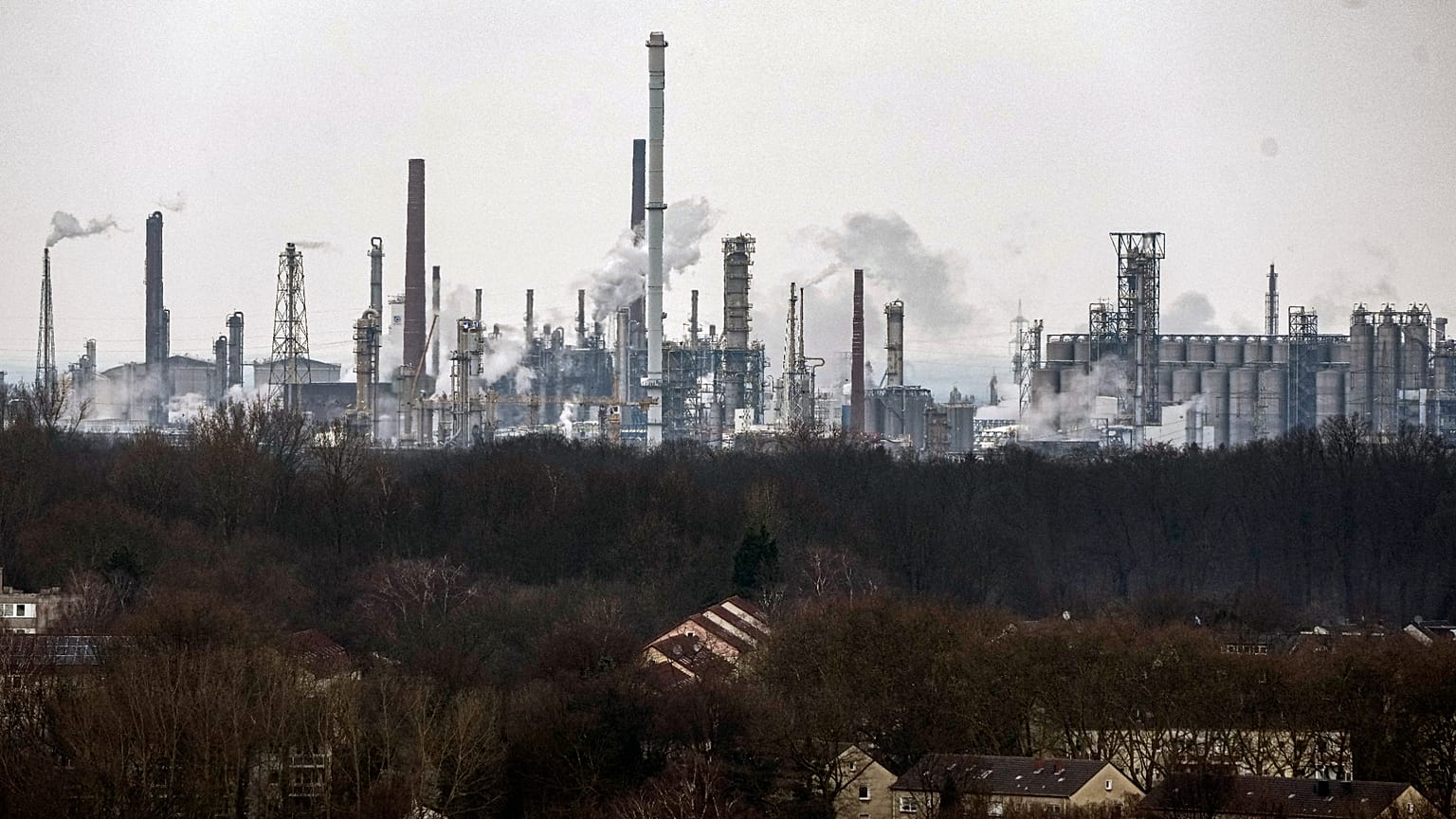













Estonia, France, Germany and Spain support the Emissions Trading System, the EU’s major climate policy tool, but want clearer, simpler and possibly more flexible rules to protect industrial competitiveness, according to a document seen by Euronews.
Four European Union countries are urging the European Commission to rethink part of its planned carbon market reforms, warning that some industries could face serious competitive pressure under stricter emissions rules due to take effect between 2026 and 2030, according to a document seen by Euronews.
 ADVERTISEMENT
ADVERTISEMENT
ADVERTISEMENT
At stake is the bloc's carbon market, the Emissions Trading System (ETS), which requires heavy industry companies to pay for the carbon pollution associated with their emissions. The Commission will soon revise its major climate policy tool, which has suffered repeated attacks from several EU countries and industry due to soaring electricity prices and loss of competitiveness vis-a-vis China and the US.
In the document, Estonia, France, Germany and Spain warn that the European Commission’s proposed new method for calculating free carbon permits could force companies to cut emissions faster than many industries can realistically manage.
Their reaction comes in response to the Commission's recent intention to allow fewer free pollution permits for industries, a measure that has been in place to help them remain competitive with countries with weaker climate rules.
"This risks accelerating delocalisation of our industry, given the current context," said the French Industry Minister Sébastien Martin, during the gathering of industry ministers in Brussels on Thursday.
"I don't see how the chemical industry can absorb an increase of €3bn in taxes due to these benchmarks."
The Commission urged EU countries to accept the surcharge, noting that the ETS revenues would be redirected for governments to invest in industrial decarbonisation. However, the French minister argued that the EU executive didn't provide "any sort of specific timetable" or "legal analysis".
"We can't just accept promises. We need something concrete," Sébastien added.
Estonian Industry Minister Erkki Keldo stressed that EU funds meant for industrial decarbonisation must take into account both "geographical balance" and "the needs of small economies".
Green vs industrial ambitions
The ETS debate highlights a persistent challenge facing the EU's green agenda: how to maintain aggressive emissions reductions while ensuring that European heavy industry remains globally competitive.
The document backed by the four countries mainly focuses on industries that rely heavily on heat production and fuel use, arguing that many companies still lack commercially viable low-carbon technologies or affordable alternatives needed to reduce emissions at the pace expected by Brussels.
While none of the signatories is seeking to scrap the ETS, their major arguments in the document focus on industries already struggling with high energy prices, noting that the outcome of discussions on the new method for allocating free allowances could significantly affect investment decisions and production costs over the coming decade.
“If implemented as planned, free allocation for some sectors may become insufficient to prevent carbon leakage,” the document states, referring to fears that manufacturers could relocate production outside Europe to countries with weaker environmental rules.
The four countries are also asking the Commission to provide rapid clarification on how the new free polluting allowances will be calculated and whether these could vary depending on the challenges faced by different industrial sectors.
They also called for a separate legislative proposal on the default calculation values used when no specific data is available before January 2027, rather than waiting for the broader ETS revision, now slated for 15 July.
In addition, the governments requested a legal assessment of whether the new method for defining the volume of free allowances could be applied retroactively from January 2026.
The coordinated move increases pressure on the Commission ahead of an upcoming high-level meeting chaired by the EU executive with EU countries in attendance, where the rules on free polluting allowances are expected to be voted on.