






























Labour's likely next PM set out a 10-year economic plan in his Manchester speech, promising greater regional powers and a shift away from trickle-down economics.
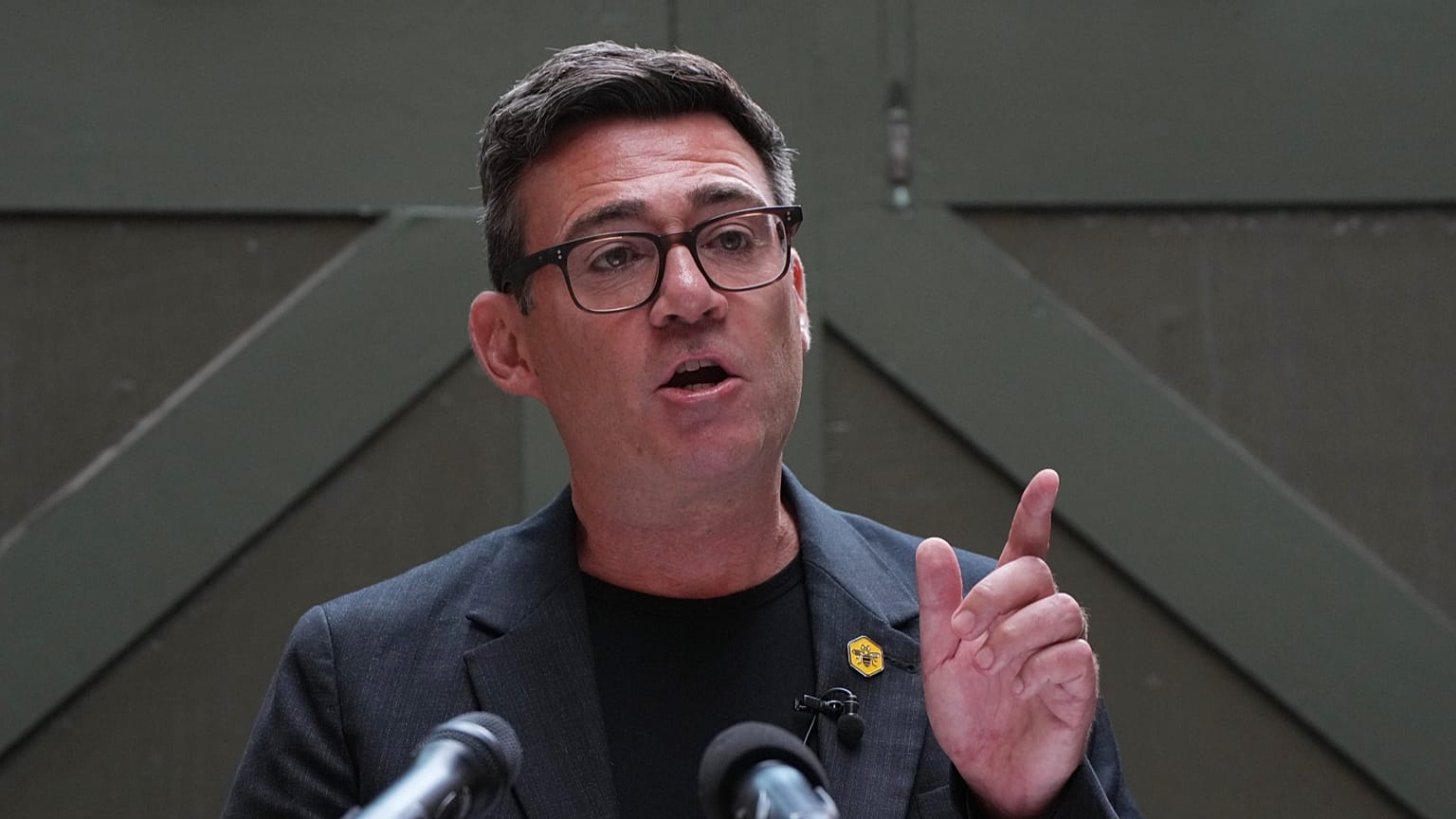
Andy Burnham has used his first major policy speech as Labour leadership frontrunner to promise the biggest shake-up of political power in modern British history, pledging to hand sweeping new authority to local leaders and relocate part of the prime minister's office to Manchester.
 ADVERTISEMENT
ADVERTISEMENT
ADVERTISEMENT
Speaking at the People's History Museum in the city where he spent nine years as mayor, Burnham laid out a 10-year plan to revive a UK economy he described as stuck in a rut since the 2008 financial crash.
"Growth cannot be ordered from the top down. Indeed, it can only be nurtured from the bottom up," he told the audience on Monday.
Central to his pitch was the creation of a new government hub in Manchester he dubbed "No. 10 North," which he said would become "the nerve centre of a rewired Britain." Regional mayors would receive expanded powers over housing, welfare and education under the arrangement, which Burnham framed as "the biggest rebalancing of power our country has seen."
The approach draws heavily on what he calls "Manchesterism" — a philosophy he has described elsewhere as "business-friendly socialism" and a rejection of trickle-down economics. During his mayoral tenure, the policy translated into initiatives including the Bee Network, Manchester's publicly-controlled bus system, and the Good Growth Fund, which directed investment into each of Greater Manchester's boroughs. Burnham is now betting he can scale that model up to national level.
He also pledged to create new industrial jobs, expand educational opportunity and tackle what he characterised as the wastefulness of the UK's privatised water and energy sectors.
A near-certain coronation
Burnham is by far the most likely successor to Keir Starmer, who announced his resignation on 22 June after two years in office defined by slumping poll ratings, ministerial walkouts and a string of bruising election defeats. His departure followed months of mounting internal pressure, culminating in Labour's catastrophic May local election results that saw the party lose nearly 1,500 council seats, many of them to Nigel Farage's Reform UK.
Burnham won the Makerfield by-election on 18 June, a seat vacated specifically to allow him to return to Westminster, securing around 55% of the vote in a result that exceeded pre-election forecasts. He was sworn in as an MP on 22 June, the same day Starmer went public with his decision to step down.
Since then, his path to Downing Street has grown steadily clearer. Former health secretary Wes Streeting, once considered his most likely rival, threw his weight behind Burnham last week. Cabinet minister Darren Jones also ruled himself out on Wednesday, telling Sky News: "Andy Burnham is going to be the next prime minister." Leadership nominations open on 9 July and close a week later; if no one challenges him, he could be in Downing Street by 17 July.
Old challenges, new face
Despite his momentum and the genuine enthusiasm his name generates in parts of the Labour movement, Burnham will inherit a deeply difficult political situation. The UK economy remains sluggish, public services are strained and household budgets are squeezed, the same conditions that eroded Starmer's standing. He will also be bound by Labour's 2024 manifesto commitments, including a pledge not to raise taxes on working people.
The Conservative Party was quick to dismiss Monday's address. "Andy Burnham's big idea is to shuffle power between politicians," said Tory chairman Kevin Hollinrake. "Not fix the welfare system. Not cut the taxes strangling working families and British business. Not fund the defence our country desperately needs."
On defence, Burnham is expected to inherit the commitments in the government's long-awaited investment plan, the one whose publication prompted defence secretary John Healey to quit on 11 June, ahead of the NATO summit in Turkey on 7-8 July.
Foreign policy presents its own pressures. Deputy Prime Minister David Lammy told Euronews last week that he expected continuity on key issues including support for Ukraine and the ongoing effort to deepen ties with the EU. A planned UK-EU summit due on 22 July has been postponed in light of the leadership transition, and questions remain about where Burnham stands on the single market, with some pro-EU Labour MPs already urging him to drop the red lines maintained by his predecessor.
For now, Burnham is the undisputed frontrunner, and Monday's speech was his opening bid to convince voters, markets and his own party that the man who transformed Manchester is ready to do the same for Britain.