






























The new migration law approved on Monday allows EU countries to establish return centres outside the bloc. But critics warn it could lead to human rights violations, while governments are seeking partner countries to host the facilities.
The new Return Regulation marks a significant shift in EU migration policy as it enables member states to set up return hubs for migrants in countries outside the bloc.
 ADVERTISEMENT
ADVERTISEMENT
ADVERTISEMENT
According to the law, these hubs are presented as an “innovative solution” to enhance and accelerate the return of irregular migrants from Europe.
However, they also raise concerns regarding their compatibility with EU law, the protection of human rights, and the willingness of non-EU countries to host migrants on their territory, potentially for indefinite periods.
Here is an overview of the controversial return hubs, proposed by the European Commission in 2025, which could soon become a reality on the ground.
How the return hubs work
Return hubs will be built outside the European Union and meant to host migrants who have come to an EU country but have no right to stay.
They can be either places of transit, where a person is placed waiting to be returned to their country of origin, or locations where a person is expected to stay with no guarantee of onward returns.
These hubs represent a significant departure from the current framework under which migrants can generally be returned only to their country of origin or to a country with which they have a proven connection. Under the new system, this requirement would be removed and migrant people could be sent to countries with which they have no prior links or established ties.
Despite the term “return hubs” not being mentioned in the final text of the regulation, the law reframes the original proposal from the European Commission, outlining the conditions to set up centres outside the EU.
Each hub requires “an agreement or arrangement” to be concluded by the EU, or one or more of its member states, with a non-EU country.
The new law features the procedures applicable to migrants, the conditions of their permanence, the responsibilities of the EU country involved and the consequences in case it is not possible to return a person to their own country.
It leaves great flexibility to member states to negotiate the terms of cooperation with non-EU countries on a case-by-case basis.
Why are return hubs so controversial?
Return hubs have been criticised by NGOs and civil society for a number of reasons, particularly when established in countries with limited democratic standards.
According to the law, only non-EU countries — “where international human rights standards and principles in accordance with international law are respected" — are eligible to host return hubs.
This generic safeguard is considered too weak, as the agreements struck by member states are not subject to external scrutiny and do not require the approval of the EU Commission at any stage. Each EU country is only obliged to notify the others when it enters into discussions with a non-EU partner.
While unaccompanied minors would be excluded from transfer to return hubs, families with children would be eligible, giving rise to concerns about the impact on minors’ education and welfare.
There is also no specified time limit for a migrant’s stay in a return hub. “The goal is to send people to their country of origin. If this is not possible, we would wait until it is possible,” an EU diplomat said.
The conditions of stay in return hubs will very likely result in a de facto detention, as migrants will not be allowed to leave the centres.
All these aspects could entail legal complications when the return hubs are enforced.
“The European Court of Human Rights prohibits States from transferring individuals to States or situations where they may be subjected to violations of fundamental rights. [With this system], migrants may be subjected to torture and inhuman or degrading treatment,” said Eleonora Celoria from Asgi, an Italian association of legal experts specialized in migration.
Where can the return hubs be set up?
According to anotherEU diplomat, “the majority of EU countries” are interested in setting up return hubs.
Some Member States are already working to identify potential partner countries for future return centres. In March, Germany, the Netherlands, Austria, Denmark, and Greece teamed up to find solutions together.
The general approach has been to identify countries in Africa or Asia that are geographically distant from European borders. Uganda and other African states have been mentioned in discussions among member states, but no concrete outcomes have yet emerged.
“I can imagine that it would be countries in Africa who are respecting international law,” Dutch MEP Malik Azmani, who has negotiated the law, told Euronews.
Who pays for return hubs?
EU countries are expected to fully finance the return hubs and may also provide additional funding, commercial partnerships, or other incentives to encourage third countries to accept such agreements.
Several EU diplomats told Euronews that many member states were pushing to increase the migration budget in the next 7-year EU budget to implement these projects.
However, some analysts consider that few non-EU countries would be willing to host return hubs, as doing so could have negative repercussions on domestic public opinion.
There are no current estimates about the costs, as any agreement could feature different time frames and conditions.
Italian centres in Albania: a model for return hubs?
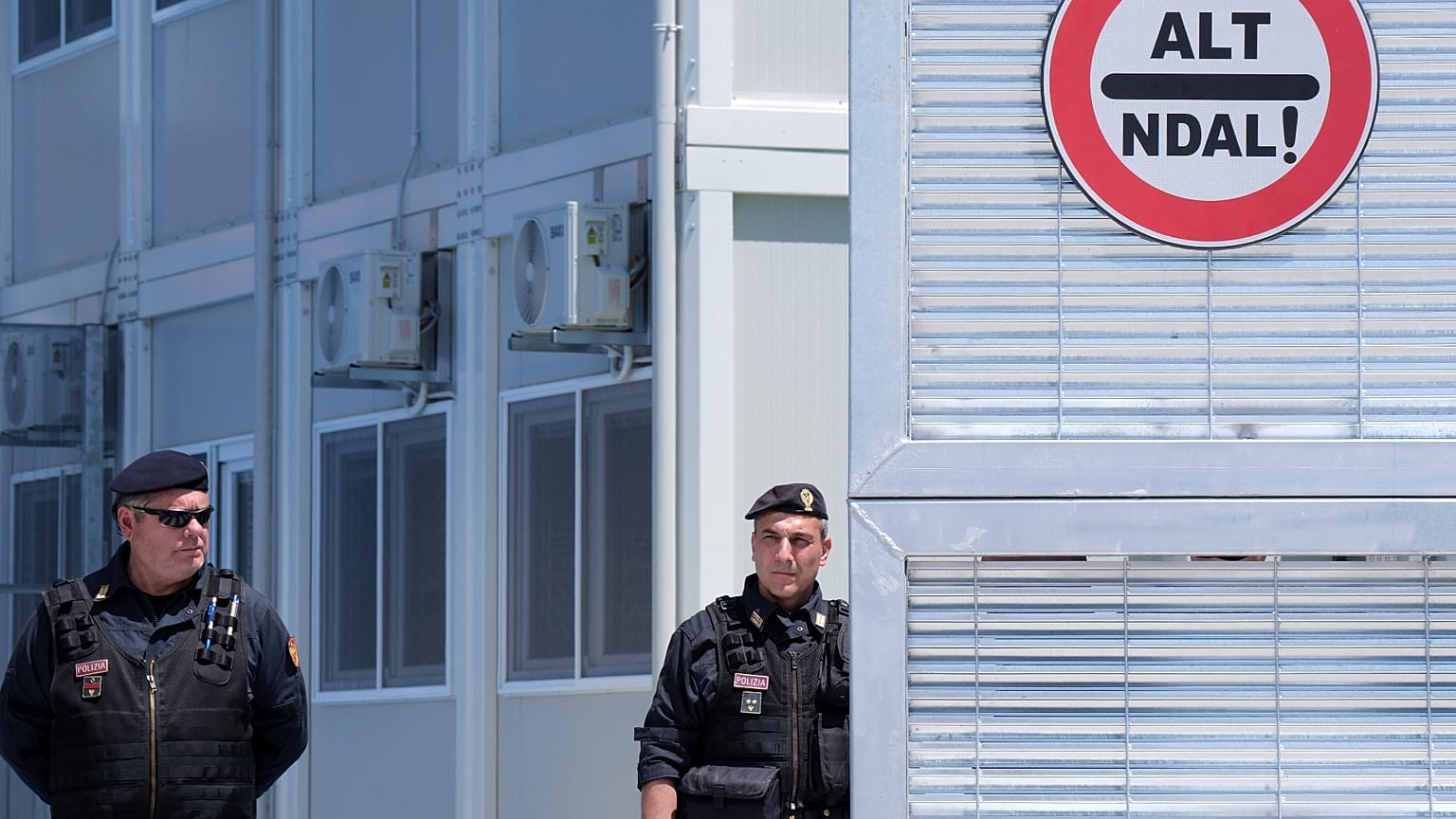
Italy is already operating two deportation centres in Albania under a five-year agreement with Tirana, a scheme widely considered similar to the return hubs.
At first, in October 2024, the centres in Shengjin and Gjadër were meant to temporarily host asylum seekers while their asylum requests were assessed by Italian authorities.
After a couple of legal challenges, in March 2025, the government led by Giorgia Meloni turned them into deportation centres for irregular migrants.
“The Italian approach to migrant flows management has become Europe’s approach,” Meloni said, adding that the “Albania model” has paved the way for an “innovative solution” at EU level.
The Italian Interior Minister does not provide the number of migrants hosted in the centres. A parliamentary visit reported by the Italian press found that, at the end of April, fewer than 100 people were accommodated in the two centres, while 536 had been hosted since their conversion into return hubs in March 2025. The original plan envisaged accommodating 36,000 migrants per year.
All the expenses related to the centres, the transfers of migrants, their surveillance and their medical assistance are paid by Italy.
The entire bill amounts to over €670 million. According to a recent study from an Italian University, detaining migrants in these centres is much more expensive for Italy than hosting them on its own territory.
Each available place in Albania costs over €153,000, whereas comparable facilities in Sicily could accommodate migrants for approximately €21,000 per place.