

















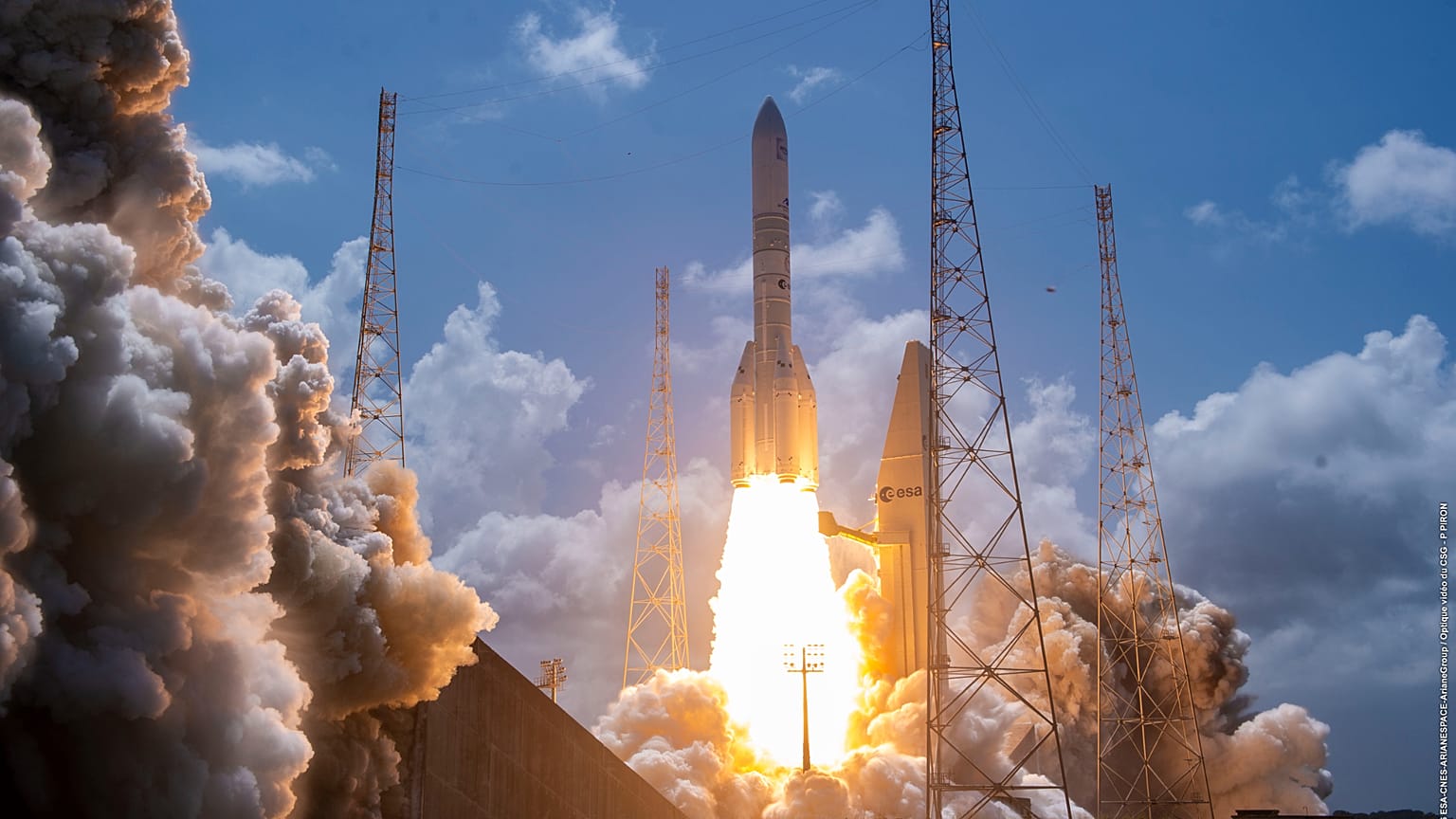














On 12 February 2026, the French company Arianespace successfully launched 32 Amazon LEO satellites with its Ariane 64 mega-rocket from the European spaceport in Kourou, French Guiana. The satellites were placed into low Earth orbit with a launch that went far beyond a simple mission.
Ariane’s day starts early. Ours too: we are a group of around thirty international journalists invited to attend the maiden launch of Ariane 64, the most powerful European rocket. We arrive about a hundred metres from the launch pad shortly after three o’clock in the morning to watch the structure surrounding the rocket being moved.
 ADVERTISEMENT
ADVERTISEMENT
ADVERTISEMENT
Shortly afterwards, the area is evacuated in preparation for the launch. It’s a slow and delicate process.
Philippe Clar, Director of Space Transport Programmes at ArianeGroup, explains:
“In Europe, 13,000 people from 13 countries have been working on this launch vehicle. 600 European companies have supplied the various components of the rocket. ArianeGroup, as prime contractor and designer, has done everything possible to ensure that things run smoothly. But, there is always a small amount of uncertainty, and that is what keeps us excited every time. In the world of launch vehicles, that’s what we live for.”
Europe has come a long way to reach this launch. The Ariane family of European rockets began in 1979 with Ariane 1. Since then, this project has continued to evolve. The development of Ariane 6 began in 2014. It has two versions: Ariane 62, with two boosters – or auxiliary thrusters – and 64, with four boosters. Arianespace selects the version best suited to the mission. On 12 February 2026, the launch of 32 Amazon LEO (Low Earth Orbit) satellites required the maximum power of Ariane 64.
The rocket carried the heaviest payload ever transported by the European launch vehicle into space: nearly 20 tonnes, almost double the payload capacity of the two-booster version, Ariane 62.
David Cavaillolès, Chief Executive Officer of Arianespace, explains:
“This is a major step forward for us. Arianespace was founded 45 years ago, and the vision of my predecessors was to take an institutional launch vehicle, Ariane 1, and bring it to the commercial market.”
Challenge met. After years of waiting, Arianespace has secured its largest private contract with Amazon: 18 launches. The American e-commerce giant plans to deploy more than 3,000 satellites in the coming years. This is a group of satellites - a ‘constellation’ - which work to provide fast internet connectivity to underserved areas. Amazon Leo is in direct competition with Elon Musk’s Starlink.
The hours pass, the excitement builds. I head to the Toucan Station to watch the launch. Only eight kilometres from the launch pad, the closest one authorised. At 1:45 p.m. local time, Ariane 64 takes off. The launch is a success.
“With the success of Ariane 64’s maiden flight,” says Arianespace Chief Executive Officer David Cavaillolès, “the European heavy-lift launch vehicle has demonstrated its ability to accomplish the most complex missions, such as the deployment of large-scale constellations.”
Ariane 5 was decommissioned in 2023 after 27 years of loyal service. The delays accumulated by Ariane 6 left Europe without autonomous launch capacity and dependent on foreign providers for over a year.
The successful launches of Ariane 62 last year, followed by Ariane 64, mark Europe’s return to full autonomy in space access and a step towards greater space sovereignty.
For mere spectators like me, this launch sparked cries of joy, followed by a respectful silence, charged with emotion. This trail of fire in the sky remains etched in my memory, like a striking image of humanity’s ability to go beyond its own limits.