














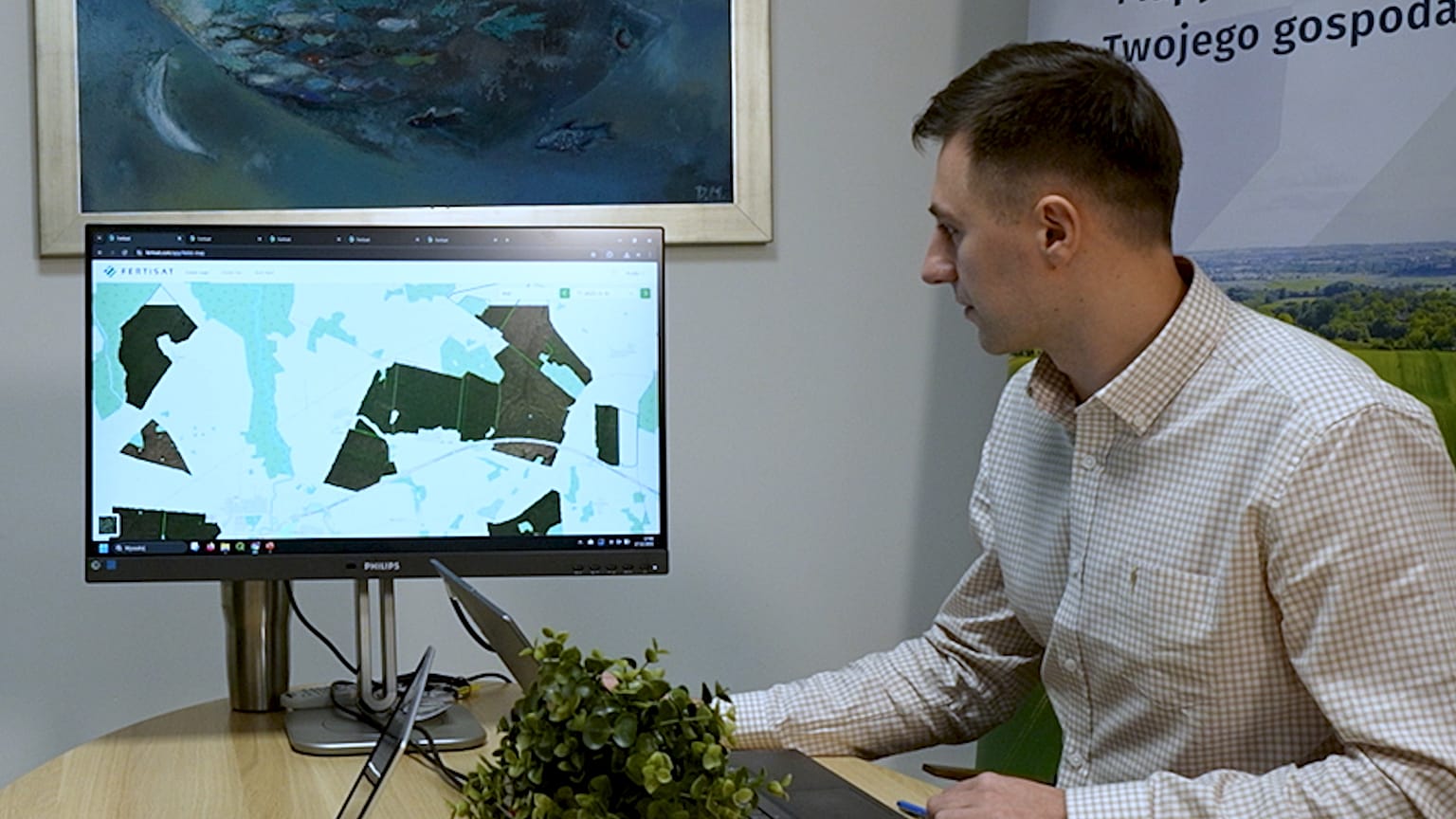














Polish company Wasat turns radar satellite data into fertilisation maps, helping farmers optimise their work even under the frequent cloud cover common in northern Poland.
Frequent cloud cover in northern Europe makes traditional optical satellite imagery unreliable for farmers.
 ADVERTISEMENT
ADVERTISEMENT
ADVERTISEMENT
“The cloudiness level in Pomerania, for example, is around 60 percent. So the optical imagery we normally used couldn’t be utilised for producing fertilisation maps or even basic crop monitoring. That’s why we decided to use other types of satellite imagery: radar data,” says Bartosz Buszke, managing director at Wasat, a Polish company specialised in satellite remote-sensing services.
Wasat uses Synthetic Aperture Radar (SAR) technology to “see” through clouds. SAR satellites send microwave signals to the Earth’s surface, which are reflected back to the satellites’ sensors, creating radar images of the land below. These data, however, must be carefully interpreted to become useful for farmers.
“We combine radar data with reference data from the fields, such as in-field measurements, biomass data and other agronomic information. Based on this, we build machine-learning models that allow us to convert the radar signal into a biomass map,” explains Michał Michalski, remote-sensing expert at Wasat.
The resulting maps are then translated into precise fertilisation recommendations, available through the company’s digital platform, Fertisat.
Farmers like Karol Piekutowski, farm manager at Farm Frites Poland, use Fertisat to guide nitrogen distribution over winter rapeseed fields in Bobrowniki.
“I click ‘prepare the map’, the map appears on the screen, and then it’s uploaded to the tractor. We can immediately start spreading fertiliser in the field,” he says.
By translating radar signals into actionable fertilisation maps, Wasat helps farmers optimise fertiliser use even under cloudy conditions.
“They save approximately 20% of fertilisers while using our service, which translates into savings of hundreds of euros per hectare per year,” concludes Buszke.