




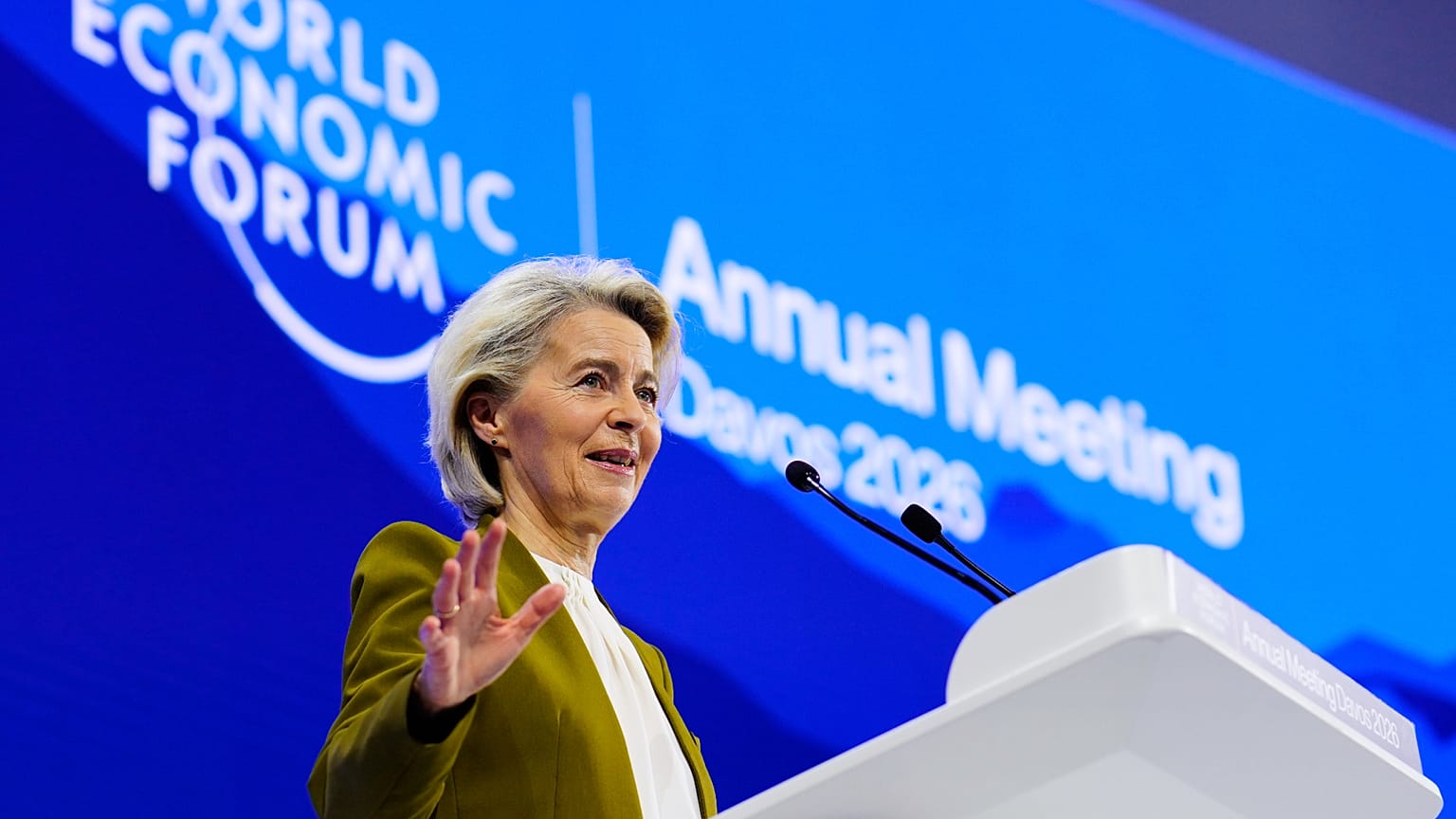













Ursula von der Leyen announced the EU-INC, promising a 48-hour digital incorporation framework to unify Europe’s fragmented market.
European Commission President Ursula von der Leyen presented the EU-INC at the World Economic Forum in Davos. Europe’s plan to radically simplify startup operations across the bloc and improve the EU’s competitiveness against the US and China’s tech.
 ADVERTISEMENT
ADVERTISEMENT
ADVERTISEMENT
Ursula von der Leyen endorsed the initiative, legally designated as the ‘28th Regime’, since it would act as a de facto “28th state” where founders can register companies.
“Our entrepreneurs, the innovative companies, will be able to register a company in any Member State within 48 hours and fully online”, she told a crowd that included tech CEOs, founders, and venture capitalists.
According to von der Leyen, European startups “will enjoy the same capital regime across the EU. We need a system where companies can do business and raise financing seamlessly across Europe, just as easily as in uniform markets like the US or China.”
How does the EU plan to bridge 27 regulatory markets into a single pan-European system? For those behind EU-INC, the first step toward a European Silicon Valley is to reduce fragmentation and increase digitalisation.
“The idea is to have a standardised EU legal entity with a central, digital-first registry so companies (not only startups) can register fast and affordably”, Robin Wauters, COO of European Startup Network and co-driver of EU-INC, told Euronews.
What is EU-INC?
Europe has 27 different company law systems, which makes it harder for startups to grow. Early-stage companies face confusing digital services, strict compliance, tax delays, and conflicting stock-option policies, hurdles when it comes to scaling up, securing funding, and retaining talent.
The alarm was first raised in 2024, when Mario Draghi, former president of the European Central Bank, warned that Europe’s overregulation and fragmented startup market pose risks to the bloc's competitiveness. Overregulation is one of the key factors preventing it from closing the upscaling gap with the US and China.
Von der Leyen’s endorsement of EU-INC in Davos aims to reduce these administrative frictions by providing a uniform, scalable European company structure as an additional option parallel to existing national systems.
It’s a direct echo of the US’ corporate playbook. It mirrors the Delaware General Corporation Law, in yet another example of the saying “the US innovates, China replicates, and the EU regulates”.
In a nutshell, EU-INC creates a new alternative for founders. They can establish their company in one of the 27 member states or register it under the EU-INC form, the 28th option. This hopes to create a new European startup-scaling structure, from conception to financing, to bring a dramatic change for startups, founders, and venture capitalists all over the bloc.
The new process aims to be drastically simpler. Founders will be able to form companies in 48 hours through a single EU-level portal, all online. This is done through a single, unified process that automatically grants the right to operate across all member states. Founders can run their entire corporate structure under a single standardized rulebook rather than 27 different ones.
For founders, this turns today's uber-fragmented milieu into one with a single shared register, a set of governance rules, and a system for issuing and managing equity, including stock options that work the same way for all employees, regardless of where they're based. Expansion into new markets will no longer require additional subsidiaries, duplicating documents, or rebuilding legal infrastructure in every country.
On the financing side, the predominant hurdle for European startups is that investors can review a single, consistent corporate entity, rather than navigate dozens of jurisdiction-specific quirks. As such, investment opportunities will be unified across the EU.
This also means that hiring talent across Europe should become simpler, as companies can use the same equity and administrative workflows everywhere without having to change their corporate identity for HR, payroll, and employee participation.
Founders and European citizens should be happy; under EU-INC, they will see more services, products, and the like, because companies can launch EU-wide without the usual bureaucratic delays. Consumers would also benefit from stronger cross-border competition in cases like the one involving the bank Wise. Instead of spending 14 years setting up separate entities and licenses across multiple countries, as Wise did, a future fintech company could offer low-fee international transfers immediately.
This means cheaper, faster, and more innovative services for European consumers, though it risks stripping national authorities of supervisory control.
A long-awaited plan
EU-INC is not the EU’s first attempt to create a single market for startups. Previous projects such as Societas Europaea (2004), European Private Company (2010), and Single-Member Company (2014) failed due to administrative burdens and a lack of unanimity among member states.
Will the EU-INC attempt succeed? Von der Leyen’s choice to endorse the plan shows the Commission’s willingness to listen to the tech startup and investor community. “[The EC] now has the possibility to show, not talk, ‘show’- that they listen to the community and that they want to be bold and ambitious”, said Wauters.
By introducing a fully online registration process, the Commission aims to address the longstanding issue of bureaucracy and accelerate startup formation. This approach responds directly to prior critiques of complexity. Shifting from a unanimity requirement to a qualified majority (15 out of 27 member states) for the “28th regime” is intended to mitigate decision-making deadlocks observed in earlier initiatives.
Before this, the Commission must submit a legislative draft. The Commission is expected to present its plans for creating the so-called 28th regime in March, with a rollout scheduled for 2027.
The European Parliament has already signalled strong political backing, adopting a report on the initiative with a broad cross-party majority, 492 votes in favour and 144 against. Part of the reason for this broad support is the inclusion of safeguards for labour standards and employee participation in management decisions.
Parliament is calling for the framework to take the form of a directive rather than a regulation, despite warnings from start-ups about continued fragmentation, and is also pushing back on the name, preferring Societas Europaea Unificata (SEU) over “EU-INC”, which Repasi said sends the wrong signal for a European company model.
The proposal is in its early stages, and no official government has yet voiced its opinion on something that could result in a loss of control over company laws, impact national standards, and undermine the administrative sector as a source of revenue.
The EU-INC remains a voluntary system that countries will not be obligated to implement. It will sit alongside national company laws rather than replace them, allowing founders to choose either the EU-wide form or their domestic one. In any clash between the EU-INC rulebook and a state’s corporate rule, the EU-level framework overrides it for companies that opt into it.
A step closer to Silicon Valley
It remains to be seen which avenue startups will choose, but the initiative has already received positive feedback from across Europe.
The 2024 EU-INC petition grew from 15.000 signatures to over 23.000 supporters across the tech startup system, including tech leaders like Arthur Mensch, CEO of French company Mistral, Anton Osika, co-founder of Swedish AI company Lovable, and Patrick Collison, CEO of Irish-American fintech firm Stripe, amongst others like Wise, Klarna, and Cabify.
It also secured support from national organizations such as France Digitale, the Dutch Startup Association, the Danish Entrepreneurs, Startup Hungary, the German Startup Association, and Austrian Startups, signalling Europe-wide interest at this stage.