




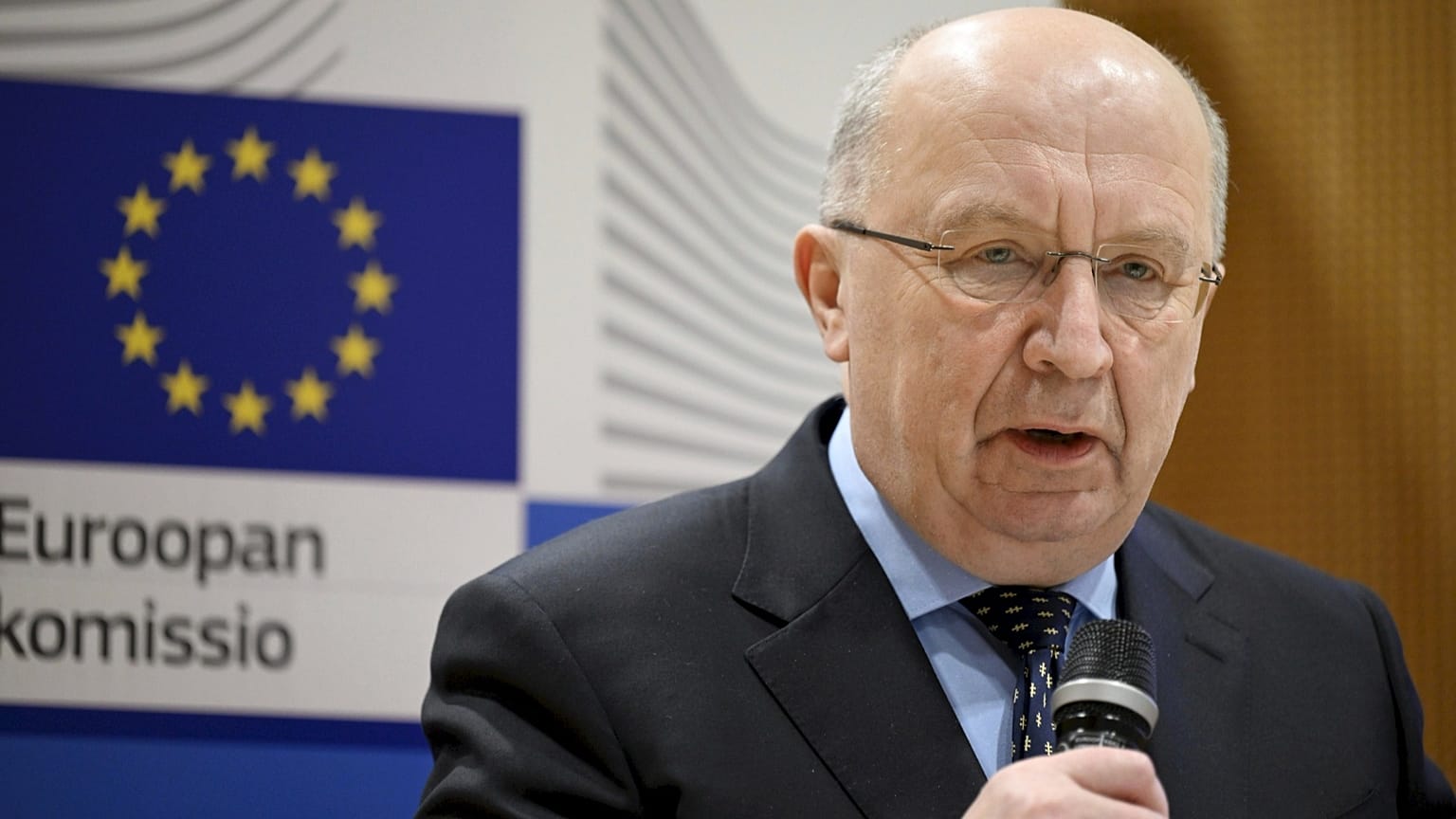













Eight satellites from five different member states are currently being pooled as part of GOVSATCOM. The Commission hopes this is the first step towards less dependence on the US - whose own communication systems are a lot more mature.
European Union member states now have access to European-made "secure and encrypted" satellite communication, the bloc's Commissioner for Defence and Space announced on Tuesday.
 ADVERTISEMENT
ADVERTISEMENT
ADVERTISEMENT
"Last week we started GOVSATCOM operations," Andrius Kubilius said from the European Space Conference on Tuesday, referring to the European Union Governmental Satellite Communications programme. "That means all member states can now have access to sovereign satellite communication. Military and government. Secure and encrypted. Built in Europe, operated in Europe, under European control."
He described it as the "first step in satellite connectivity". Expanded coverage and bandwidth set for 2027, while the operationalisation of the Infrastructure for Resilience, Interconnectivity and Security by Satellite (IRIS²), a multi-orbital constellation of 290 satellites, is now expected in 2029 instead of 2030.
These efforts are all part of plans to reduce the EU's dependence on foreign space services, such as Starlink, which is owned by Elon Musk. They also go hand-in-hand with the EU's efforts to bolster the bloc's defence capabilities and readiness before the end of the decade, a point when some intelligence agencies estimate Russia could attack another European country.
"Competition is competition"
GOVSATCOM, which offers bandwidth to member states to transmit data, currently involves eight satellites from five different member states, but is open to all. The Commission is now analysing a Ukrainian request for access, Euronews understands.
Kubilius said in a group interview Euronews took part in on the sidelines of the conference that the launch of GOVSATCOM "really gives very much needed services for, specifically, our military and security people" and shows Europe is "starting to be less dependent" on US space services.
Asked about Europe's lag given Starlink became fully operational in 2021, Kubilius expressed confidence that IRIS² will ultimately offer a better service.
"Things are developing very rapidly globally, new technologies are coming. We are really planning to have good, well-advanced technologies to be used, like with navigation. There was existing GPS service, an American one, but then we built Galileo."
"Galileo we built as a better version of navigation system: three times more precise, five billion consumers if I'm correct. So competition is competition," he said.
A "virtual European Space Command"
He conceded too that Europe is behind when it comes to sovereign satellite launches, especially when it comes to reusable launchers.
"Yes, we are behind Elon Musk, but we understand how important it is to have good and effective transportation systems, and we shall build them," Kubilius said, adding that money in the bloc's next budget will be earmarked for that.
The Commission has proposed to boost the funds allocated to space and defence in the 2028-2034 multi-annual financial framework to €131 billion.
The Space Commissioner also urged member states on Tuesday to focus on interoperability as they build up their space assets. Germany, for instance, has announced it will spend €35 billion on military space capabilities by 2030, and other member states are following suit.
Strategic enablers, which include space assets, have been designated among the nine priority defence capability areas for member states to invest in as part of the Commission's 2030 defence readiness roadmap.
The Commission confirmed to Euronews that member states that have subscribed to its SAFE loan for defence scheme have asked for money to purchase equipment covering all nine priority areas, including strategic enablers.
"If you protect only your own country, your own army, we shall not learn to fight as Europe. We will not deter Putin. We will not succeed in our defence," Kubilius said in his speech, in which he pitched the idea of a "virtual European Space Command".
"There is no process for mobilising European assets for our joint defence. It’s not clear who does what," Kubikius said. "I see this partnership as a cooperation framework".