




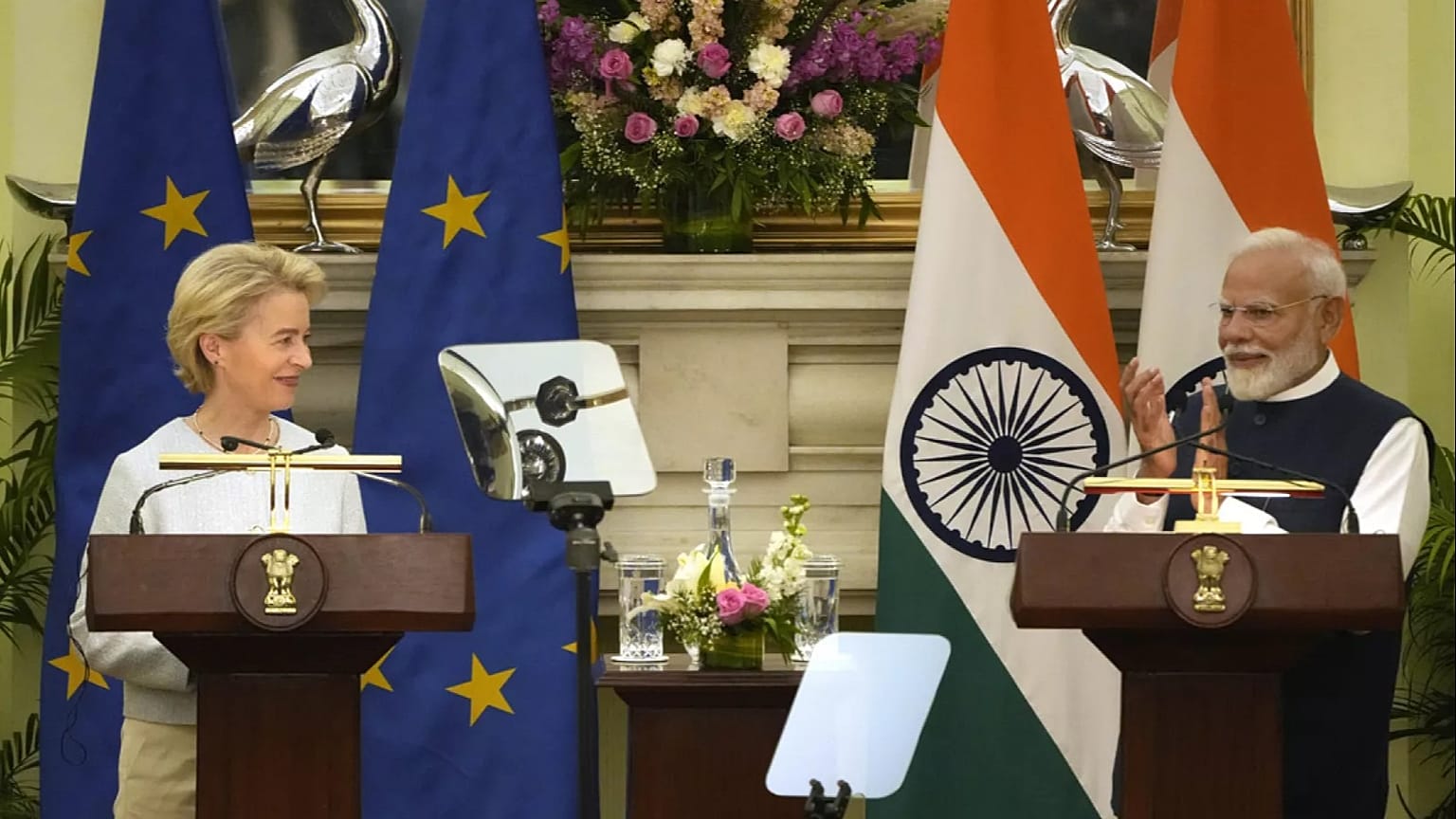













The German chancellor is already a strong supporter of the contentious Mercosur agreement adopted by EU countries last Friday.
Speaking on Monday during a trip to India, German Chancellor Friedrich Merz said European Commission President Ursula von der Leyen and European Council President Antonio Costa could sign a free trade agreement with New Delhi by the end of the month.
 ADVERTISEMENT
ADVERTISEMENT
ADVERTISEMENT
Merz's comments came days after a majority of EU member states backed the Mercosur free trade pact, a deal strongly supported by Germany as part of the bloc’s strategy to diversify trade ties beyond the US and China – two countries that have pursued strongly nationalist trade policies over the past year.
“Unfortunately we are seeing a renaissance of protectionism. It is directed against the principles of free trade and open markets,” Merz said at a press conference, adding that EU leaders could travel to India “towards the end of this month” to sign a free-trade agreement.
“In any case, they will take another major step forward to ensure that this free trade agreement comes into being,” he said.
The idea of holding an EU-India summit by the end of January was floated in Brussels as negotiations intensified late last year, though the original aim of sealing a deal by the end of 2025 ultimately came to nothing.
In his remarks encouraging a timely deal, Merz called India “the fastest growing economy of the G20” and described it as a “pivotal partner in the Indo-Pacific.”
EU trade agenda fuels turmoil in France
Last week, India’s Minister of Commerce and Industry Piyush Goyal travelled to Brussels for further high-level negotiations with EU trade chief Maroš Šefčovič, who last year described Indian negotiators as “tough”.
Both India and the EU are facing escalating trade problems with the US, which has raised tariffs on its trade partners, and China, which is increasingly attempting to weaponise other countries' dependencies on raw materials and technology.
But negotiations over the sustainability chapter have proven difficult, the Commission told EU lawmakers last September, particularly regarding the introduction of a dispute settlement mechanism tied to green standards.
The EU’s Carbon Border Adjustment Mechanism, adopted in 2023, has been also a particular sticking point for India.
Merz nonetheless said he was confident the talks have entered their final stretch, remarking that the signing of the deal would be “an encouraging sign on the path to continue down the road of forging and concluding free trade agreements”.
The EU’s diversification agenda is fuelling political turmoil in France, the bloc’s second-largest economy after Germany, which opposed the Mercosur agreement over concerns that French farmers' livelihoods could be endangered by a flood of Latin American imports.
While von der Leyen is set to travel to Paraguay to sign the Mercosur deal on 17 January, as first reported by Euronews, tensions have escalated between French President Emmanuel Macron and the political opposition, with both far-right and far-left parties calling to subject his government to a vote of no confidence.