




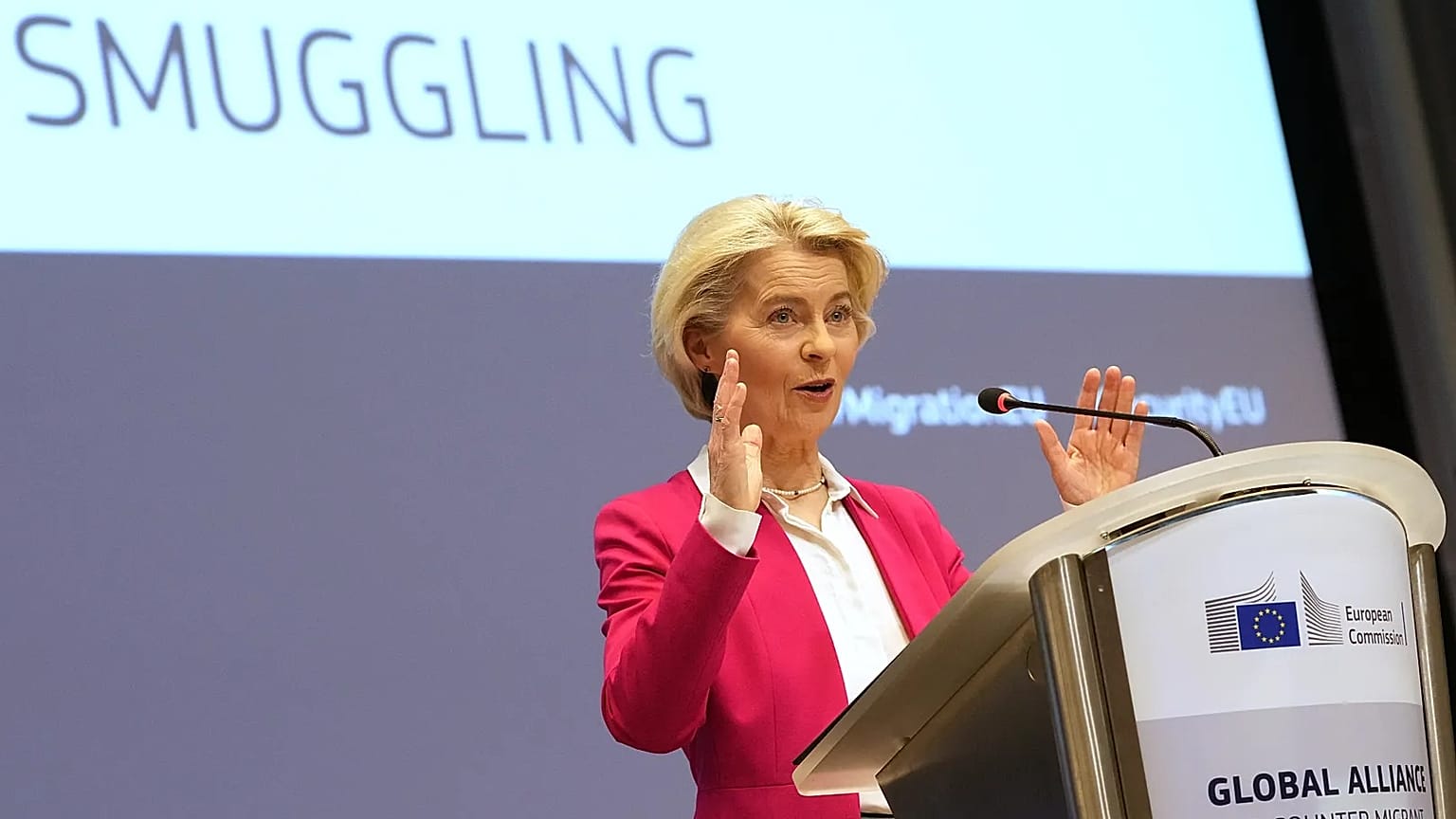













This week, the European Union took significant steps to tackle illegal migration making it easier to deport asylum seekers and irregular migrants. Von der Leyen also announced a new sanctions regime for smugglers.
A combination of stricter rules for asylum, easier deportations of irregular migrants, and sanctions towards smugglers all marked a renewed push by the European Union against illegal migration this week.
 ADVERTISEMENT
ADVERTISEMENT
ADVERTISEMENT
In recent days, EU countries have agreed on three controversial laws aiming at speeding up asylum procedures and increasing returns, while the European Commission has announced a new sanctions regime against people-smugglers.
These moves reflect the bolder stance the EU has taken on the issue in recent years, including by breaking taboos and aligning its policies with stances once taken only by far-right parties.
"Bankrupt smugglers’ business"
On Wednesday, Commission President Ursula von der Leyen announced that Europe is developing a stringent new sanctions regime in coordination with G7 partners.
“Our goal is simple. We want to bankrupt their businesses through all means available,” she said. “We want to be able to freeze the smugglers’ assets – to destroy their very financial base. But also to issue travel bans, so that we can restrict their movements."
She made the announcement in her opening statement at the International Conference of the Global Alliance to Counter Migrant Smuggling in Brussels, which was attended by more than 80 delegations, including EU members and several non-EU states.
Von der Leyen's statement follows a commitment already stated during her State of the Union speech three months ago, when she outlined a new system of sanctions specifically targeted at smugglers and traffickers.
According to EU sources, the Commission will come up with concrete proposals on the sanctions regime, though the timing is not yet clear. Currently, it is consulting EU member states before putting forward any new measures.
“The Commission took forward the work on establishing a new sanctions regime against smugglers and traffickers to freeze their assets, restrict their freedom of movement and deprive them of their profits," reads the press release.
Also on Wednesday, more than 50 delegations endorsed a joint declaration based on three main pillars: preventing migrant smuggling by strengthening national frameworks and exchanging information among states, developing alternatives to illegal migration, and stepping up financial investigations to trace, seize, and confiscate smuggling proceeds.
"If we want to stop smugglers, we need to work together at a global level", EU Commissioner for Migration Magnus Brunner told Euronews.
A crackdown on irregular migrants' chances to stay in the EU
In parallel, the EU is pursuing a clear strategy to make it harder for irregular migrants to reach European territory and easier to be deported far away.
On Monday, the EU Council agreed on three major legislative changes that have to be negotiated with the European Parliament before final approval.
One of these is the return regulation, which, among other provisions, would allow EU member states to build “return hubs” in third non-EU countries where they could send asylum seekers they have rejected.
“Return hubs” could also be used as “transit hubs” to accommodate migrant people before they are actually returned to their countries of origin, something that Italy is already doing with two centres built in Albania. But they could also represent a "final destination" if the third country accepts non-nationals and respects human rights standards.
This would help EU states to speed up returns, but it could also put migrant people at risk, since they would be sent to countries with which they have no connection.
Even asylum seekers could end up in completely unrelated countries under another law approved on Monday.
“The incentive to pay a human smuggler [to reach Europe] will diminish, if you know that as soon as you arrive, you will be returned to a centre in a third country", Rasmus Stoklund, Danish Minister for Immigration, who led the negotiations on the files, told Euronews.
Places of safety
A change in the concept of “safe third country” would expand the circumstances under which an asylum application can be rejected as inadmissible, enabling EU states to deport asylum seekers to third countries with which they have no link – provided that those countries have an agreement with an EU state and that respect human rights.
This framework would allow EU governments to implement schemes similar to the UK's scrapped Rwanda deportation policy, which was ruled unlawful by the British Supreme Court.
The third law agreed by member states would create a list of “safe countries of origin” for the purposes of asylum, which includes Kosovo, Bangladesh, Colombia, Egypt, India, Morocco, and Tunisia, plus all the current candidate countries for EU membership except for Ukraine.
Nationals of these countries would still have the right to apply for asylum in EU member states, but their applications would be assessed via fast-track procedures.
These new measures have drawn criticism from leftist groups in the European Parliament and civil society.
"In 2018, the European Commission itself said that ideas such as return hubs or setting up offshore deportation centres far from Europe would put people at risk of refoulement, torture or arbitrary detention," Olivia Sundberg Diez, EU Advocate on Migration and Asylum for Amnesty International, told Euronews.
"I don't understand why the Commission now thinks that these ideas can comply with EU law and human rights standards"
According to Frontex, irregular crossings of EU borders fell 22% in the first ten months of 2025, with strong declines recorded on the route from Western African shores to the Canary Islands, in the Western Balkan area, and at the border with Belarus.