






























Hitting back at the inaccurate portrayals of Macron's comments, the Elysée shared an X post with the caption "Pravda? Ministry of Truth? When talking about the fight against disinformation leads to disinformation..."
France's President Emmanuel Macron has found himself at the heart of a politicised spat after his proposal to certify trustworthy media outlets with "labels" was distorted by media commentators and politicians, leading him to be accused of promoting autocracy.
 ADVERTISEMENT
ADVERTISEMENT
ADVERTISEMENT
In one stark example, on 30 November, the Journal du Dimanche — owned by media mogul Vincent Bolloré — published a front page story claiming that Macron was seeking to "control the media".
In an editorial segment aired on 1 December, right-wing political commentator Pascal Praud, who works for CNews and Europe 1 — outlets also owned by Bolloré — jumped on the bandwagon, referring to the "authoritarian temptation of a president dissatisfied with media coverage, who wants to impose a single narrative".
Praud also mentioned "Pravda" — the official newspaper of the Communist Party of the Soviet Union — in this context.
The same day, the conservative Les Républicains party accused Macron of eroding democracy by seeking to establish "an official truth". The party claimed Macron's plans were part of a campaign to distinguish "good" and "bad" news outlets, with their petition on this matter amassing more than 42,000 signatures.
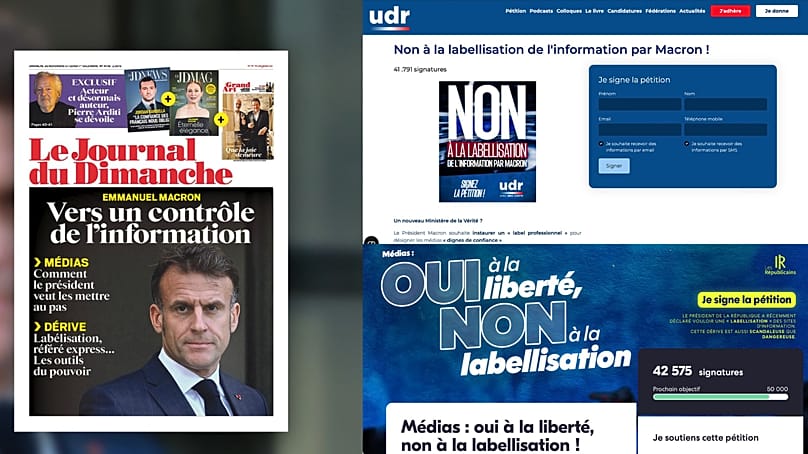
Another petition penned by the conservative Union des droites pour la République party — which has amassed more than 41,000 signatures — peddled similar accusations, alleging that the French executive was trying to establish a "Ministry of Truth", calling for the "label" project to be abandoned.
Hitting back at the inaccurate portrayals of Macron's comments, the Elysée shared an X post with the caption "Pravda? Ministry of Truth? When talking about the fight against disinformation leads to disinformation..."
An attached video contrasted various clippings of media headlines, as well as political commentators' TV statements, with authentic video footage as a badge of proof for Macron's original statements.
Where does the controversy come from?
A series of comments by the French president when he met with readers of French local newspaper La Voix du Nord on 19 November are at the heart of the controversy.
Asked about the government's plans to fight fake news online, Macron defended the importance of distinguishing "news sites" from "networks and sites that make money from advertising".
In this context, Macron brought up his media "label" proposal.
"I think it's important for there to be a certification process carried out by professionals, who can say 'this does not comply with ethical standards and is a manipulation of information'," he said. "Information is a dangerous question in fact. So there are ethical rules."
However, the president highlighted a caveat: "It's not the government or the state that can say, 'this is information, this is not'," he said. "We don't want to fall into that trap either, because that's not what democracy is about. Otherwise, it quickly becomes an autocracy."
Citing an example for his plan, Macron referred to the Journalism Trust Initiative's (JTI) certification, which was launched in 2021 by media monitoring organisation Reporters Without Borders, focusing on how journalistic content is produced and the ethics surrounding this process, rather than judging pieces of content.
The certification criteria were developed by a committee of 130 experts featuring journalists, various institutions, regulatory bodies, publishers, and members of the tech industry.
"An increasing number of news consumers find information through search engines and social media networks," Benjamin Sabbah, director of the JTI, told Euronews' fact-checking team, The Cube. "The goal of our certification is to identify reliable sources of information and promote them."
To date, more than 2,400 media outlets across 127 countries have participated in the Journalism Trust Initiative.
"The Journalism Trust Initiative was not originally designed as a tool to combat misinformation, but it ultimately has become one, out of necessity", said Sabbah.