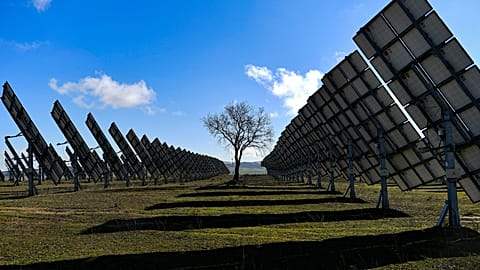





























Experts warn that the EU’s interim climate targets are being ‘undermined’ by a loophole that comes into effect in 2036.
The EU has been accused of “weakening its climate leadership” after greenlighting an interim emissions target for 2040.
 ADVERTISEMENT
ADVERTISEMENT
ADVERTISEMENT
Last week, the European Council formally adopted the amended European climate law. It means by 2040, member states must reduce their net greenhouse gas emissions by 90 per cent compared to 1990 levels.
The Council states the interim target will help strengthen the EU’s path towards achieving climate neutrality by 2050 across all sectors of the economy. This is where heat-trapping emissions that are released into the atmosphere are balanced out by initiatives that remove an equivalent amount, meaning there is no contribution to global warming.
“The EU remains committed to leading the global fight against climate change while protecting our competitiveness and ensuring no one is left behind,” says Maria Panayiotou, Minister for Agriculture, Rural Development and Environment of the Republic of Cyprus.
“[The] adoption of the landmark 2040 climate target will give industry, citizens and investors the reassurance they need for the clean transition in the decade ahead.”
Is the EU’s 2040 climate goal ambitious enough?
In 2023, the European Scientific Advisory Board on Climate Change recommended that the EU should strive for net emissions reductions of 90 to 95 per cent by 2040 compared to preindustrial levels.
The EU’s approved target is therefore at the lower end of the guidance, but still adheres to recommendations set out by the independent body.
Sarah Heck of Climate Action Tracker tells Euronews Green that while the interim target is “positive”, a controversial loophole risks delaying “real, ambitious cuts in the EU”.
This is because from 2036 onwards, “high-quality international credits” may be used up to a limit of five per cent of 1990 EU net emissions to contribute towards the 2040 target. This will allow member states to buy credits generated by emissions-cutting projects in other countries and count those cuts as part of their own targets.
It’s an initiative already used by nations such as Japan, and means that only 85 per cent of emissions reductions must be achieved within the EU.
The EU Council says these credits must be based on “credible activities” of greenhouse gas reduction in partner countries, in line with the Paris Agreement. However, Heck argues that existing safeguards are "insufficient" to ensure this.
“It’s a risky step backwards that undermines the principle that climate targets should drive real, domestic emission reductions,” she says.
The EU scrapped the use of international credits back in 2021 over concerns that the EU Emissions Trading Scheme was being bombarded with cheap, low-quality credits that weakened incentives to reduce emissions.
“The reintroduction of offsets severely weakens the EU’s domestic ambition by opening the door to accounting loopholes and putting the achievement of the EU’s net zero target at risk,” Heck adds.
What’s missing from the EU’s 2040 climate goal?
Climate Action Tracker warns that the EU’s 2040 climate goals lack both “clarity and ambition” when it comes to the land use sector and the trajectory after 2030.
The EU has not provided separate Land Use, Land-Use Change and Forestry (LULUCF) targets for 2035 or 2040. This sector covers emissions and removals of greenhouse gases resulting from direct human-induced land use, land-use change and forestry activities.
Carbon is sequestered by forestry and grassland, while carbon losses occur on existing cropland and natural land that is converted to cropland or settlements.
Heck argues that the lack of LULUCF targets makes it “difficult to understand” how much of the EU reductions will come from real emissions cuts versus land sinks.
Is the EU over-relying on carbon storage?
The amended climate law sets out further key elements the Commission must consider when preparing proposals for the post-2030 period. This includes EU-based permanent carbon removals (CCS) – where emissions are captured from the atmosphere and stored durably.
“In the 2040 climate target impact assessment, EU scenarios suggest hundreds of millions of tonnes of CO2 may need to be captured and stored by 2040,” Heck says.
“It’s crucial that any CCS complements deep emissions ducts rather than replacing them. Over-reliance on removals or storage risks delaying the structural transition away from fossil fuels."