




























Thanks to an unprecedented collaboration between the Musée d l'Orangerie in Paris and the Philadelphia-based Barnes Foundation, the life and times of Henri Rousseau are being explored in France. It's a unique opportunity to immerse yourself in the world of the painter, often described as naive.
Around 50 works by Henri Rousseau (1844-1910) are the focus of a new in-depth exhibition at the Musée de l'Orangerie in Paris, entitled Henri Rousseau: The Ambition of Painting.
 ADVERTISEMENT
ADVERTISEMENT
ADVERTISEMENT
The painter, nicknamed "Le Douanier" in France or "the customs officer" because of his day job collecting taxes, was often derided during his lifetime and whose early artistic efforts were considered by some to be naive as he was self-taught.
"I have to say that we've been very lucky, we've had an incredible opportunity. By working with two major institutions, one American and one French, we were able to pool our strengths, and as a result of this international cooperation, we've had some fabulous loans," says Claire Bernardi, director of the Musée de l'Orangerie.
"The first critics to see his works at the Salon des Indépendants referred to his naivety," adds Juliette Degennes, co-curator of the exhibition. "He was mainly a self-taught painter, but he did benefit from an education, even if he didn't follow an art course," she continues.
Wild inspiration
Rousseau, who began painting shortly before his 50th birthday after leaving his job at the Paris Customs office, found his inspiration in albums of illustrations of wild animals and visits to the 'Jardin des plantes'.
To set himself apart from other artists, Rousseau, who always wanted to make a living from his art, "diversified genres and techniques to carve out a place for himself on the Parisian art scene", says Bernardi.
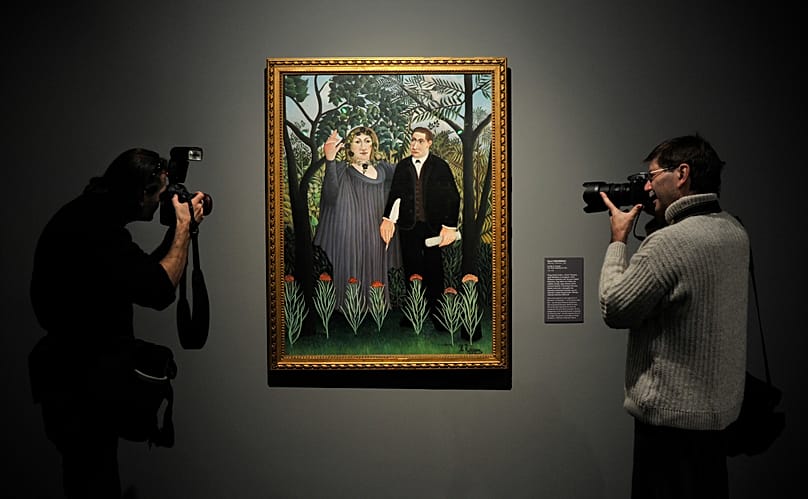
His style is particularly evident in his scenes of luxuriant jungles populated by wild animals, such as the painting "The lion, hungry, pounces on the antelope".
"He was the most exotic of exotic painters", the poet Apollinaire once said.
"It's a work that speaks to children because it's so direct. I think that today, more than ever, we will see in these works their strength and their modernity", explains Bernardi. "It comes out of the dream, but it also comes out of something that touches us, I was going to say, quite directly in our dreams, but also our anxieties."
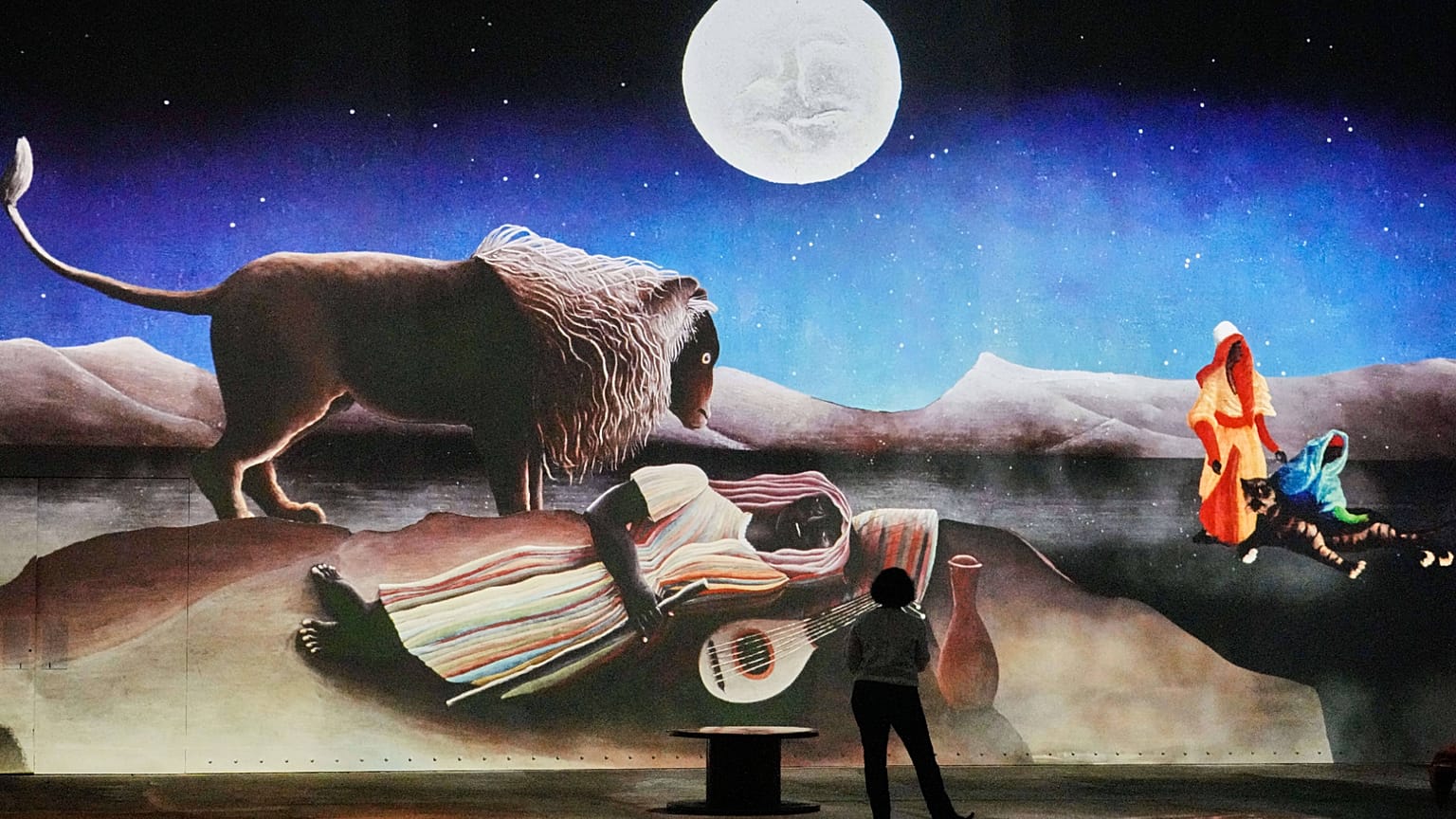
The exhibition also features the painting "The Sleeping Gypsy", on loan from New York's Museum of Modern Art (Moma), one of his masterpieces but also one of his most mysterious canvases.
Recognition in the United States
Albert C. Barnes, a fervent collector, was one of the first to take an interest in Rousseau's work: "His paintings have the charm of a child's fairy tale, but there is nothing childish or uneducated about the skill with which they are executed."
But he wasn't the only person from the other side of the Atlantic to be interested in Rousseau, according to Degennes: "There are some very fine loans from American institutions, because Rousseau was very quickly noticed in the United States. First of all his painter friend Max Weber who, when he returned to the United States in the 1910s, organised an exhibition at Galerie 291."
"American collectors were also quick to take an interest in his work. 'La Bohémienne endormie', for example, was acquired by MoMA in 1939. It was very early on and a major monographic exhibition was devoted to it in 1942. So there really was early attention paid to Rousseau on the American side," concludes Degennes.
Read more